How materials affect guitar tone
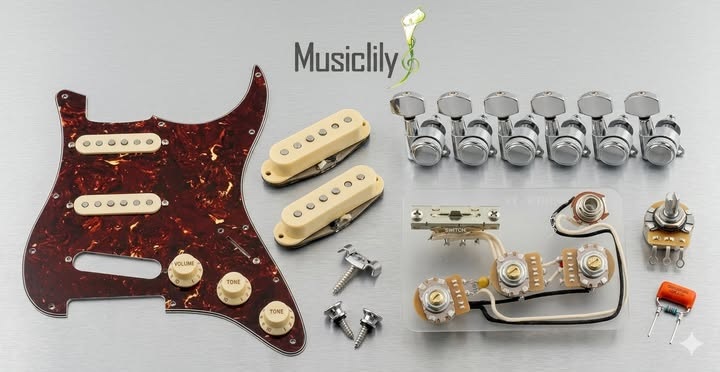
Materials matter for tone.
The Blueprint of Tone: The Ultimate Guide to Guitar Hardware Materials
As most of my readers and group members know, I rarely promote any
businesses in my tutorials, or on my various websites. I do, on occasion.
But just so you know - I receive zero compensation for doing so! I do it
only because I feel knowing about them will be a benefit to you!
The following artical was written by a member of the Musiclily Club Facebook
group. Musiclily is a supplier for guitar and bass replacement and mod parts.
The Musiclily Club Facebook page
Musiclily Club website
 Special thanks to Silvio Celeste, Musiclily FB member for
sharing this incisive article!
Silvio's Facebook page
Special thanks to Silvio Celeste, Musiclily FB member for
sharing this incisive article!
Silvio's Facebook page
 Wayne (Also a Musiclily member!)
The Blueprint of Tone: The Ultimate Guide to Guitar Hardware Materials Have you ever noticed how drastically an electric guitar's voice changes by replacing just the bridge saddles or the tremolo sustain block? We often spend months comparing pickup frequency responses or arguing over capacitor brands, completely forgetting that the hardware is the instrument's very first acoustic filter. Before the string's vibration ever reaches the magnetic field of the pickups, it must travel through the bridge and the nut, which absorb, reflect, or em- phasize specific frequencies based on their density, mass, and elasticity. Every material possesses a distinct mechanical signature that translates directly into a tonal footprint on your amplified sound. Below is an in-depth, detailed breakdown of the most common materials used in guitar hardware to help you understand how they influence sustain, attack, and the natural equalization of your instrument. Brass Sound and Physical Behavior: Brass is a copper-zinc alloy renowned for its high density and its unique ability to gently damp harsh, ultra-high frequencies. It acts almost like a natural passive low-pass filter, delivering a warm, round, and woody tone with a prominent presence in the low- midrange. This material provides excellent sustain and a smooth, highly musical note decay, free from any sharp or piercing spikes when you strike the string with a pick. Typical Use and Applications: This is the go-to material for players chasing a vintage, retro-inspired tone. It is traditionally used for the iconic barrel saddles on old-school Telecasters, in heavy sustain blocks for Stratocaster-style tremolo systems to add body to overly bright guitars, and in the machined metal nuts popular in the 1970s and 1980s designed to make open strings sound as consistent as fretted notes. Steel (Cold Rolled Steel) Sound and Physical Behavior: Steel, particularly cold-rolled steel machined from solid billets, offers an incredibly bright, transparent, and open acoustic response. Compared to brass, it retains significantly more energy in the high- frequency spectrum, resulting in an immediate, snappy, and percussive pick attack. Note definition is impeccable, meaning your chords stay clear and articulate even under heavy gain or complex chord voicings, while extending the guitar's dynamic range at both the lowest and highest frequencies. Typical Use and Applications: This represents the historical construction standard for classic Californian bolt-on guitars. You will find it primarily in the vintage-style bent steel saddles of Stratocasters and in high-quality machined tremolo blocks. It is the ideal choice for guitarists who want maximum touch sensitivity, transparency, and a dynamic, airy tone that never feels congested in the midrange. Hardened Steel Sound and Physical Behavior: Through the thermal process of tempering, steel alters its internal crystalline structure to become considerably harder and more rigid. Aesthetically and acoustically, this extreme rigidity minimizes the absorption of vibrational energy; the string essentially meets a perfectly reflective surface. The result is a lightning-fast transient response, a sharp emphasis on the upper-midrange, and a highly aggressive, biting tone. If paired with already bright tone-woods it can border on harsh, but it excels at giving definition, punch, and cutting power to high-gain tracking. Typical Use and Applications: This material is absolutely fundamental for high-performance double-locking tremolo systems, such as original Floyd Rose units. In this context, using hardened steel is a structural necessity as much as a tonal one: the knife edges that pivot against the mounting posts must withstand tons of continuous friction without deforming, ensuring the guitar returns to perfect pitch even after extreme dive-bombs. Aluminum Sound and Physical Behavior: Aluminum stands out for its exceptional strength-to-weight ratio. Being an incredibly lightweight metal, it reduces the overall mass at the string anchoring point. This allows for a very fast transfer of energy that highlights the acoustic, resonant qualities of the wood. The resulting tone is frequently described as airy, open, and rich in upper har- monics, with a low end that is leaner but highly defined, and an overall resonance that lets you clearly feel the guitar body vibrating against your ribs. Typical Use and Applications: Historically, lightweight aluminum was the material of choice for the stopbar tailpieces on short-scale Gibson guitars during the late 1950s. Today, swapping out a modern heavy zinc alloy tailpiece for an aircraft-grade aluminum upgrade is one of the most popular modifications for players looking to open up a dark, compressed instrument and give it a more responsive, vibrant feel. Titanium Sound and Physical Behavior: Titanium is a boutique material that offers a rare combination of low mass, extreme structural hardness, and an incredibly low internal damping coefficient. Tonally, it behaves in an exceptionally linear and transparent manner: it does not add the round warmth of brass, nor does it accentuate the harshness found in cheap metals. It provides superb string-to- string separation, flawless pitch definition even in low drop-tunings, and virtually infinite sustain by transferring the string's vibration in its purest, most unaltered form. Typical Use and Applications: It is heavily utilized for ultra-premium replacement saddles, bridges for multiscale modern guitars, and hardware for progressive metal instruments. Beyond its acoustic traits, titanium offers a massive practical benefit: it is completely immune to sweat, skin acidity, and corrosion, making it practically indestructible over time. Zinc Alloys (Zamak / Pot Metal) Sound and Physical Behavior: Zinc alloys, widely known in manufacturing as Zamak, feature a relatively low melting point and excellent fluidity, making them perfect for high-precision, cost-effective die casting. From an acoustic perspective, zinc has structural properties that tend to damp the extreme ends of the frequency spectrum. This results in a slightly softer pick attack and less overall sustain compared to solid-billet metals, creating a more compressed tone that can actually help tame harsh frequency spikes on certain budget instruments. Usage and Common Applications: This is by far the most widespread material used for stock factory hardware on entry-level and mid-tier guitars. Standard Tune-O-Matic bridges, zinc stopbars, and budget tremolo blocks are almost always made of die-cast zinc. However, it is worth noting that high-grade zinc alloys (like Zamak 5) are still utilized on professional, Historically accurate hardware, offering an authentic vintage compression and a great balance between production costs and traditional tone. Nylon (Nylon 6/6) Sound and Physical Behavior: Nylon is a polymer material that stands completely apart from the metal hardware family. Because it is inherently flexible and energy- absorbent, it acts as a literal dampener for high frequencies and sharp pick attacks. it completely eliminates the initial metallic 'click' of the plettrum, yielding an incredibly dark, warm, velvety tone centered heavily on the midrange. While absolute sustain is slightly reduced, the notes gain a round, almost acoustic fatness. Typical Use and Applications: This material has a very specific place in guitar history: Gibson introduced molded nylon saddles in the early-to-mid 1960s on their ABR-1 bridges (found on legendary models like the Les Paul and ES-335). Today, nylon saddles are highly sought after by jazz, fusion, and blues players who want a warm, smoky texture, as well as players looking to eliminate string breakage at the bridge due to nylon's ultra-low friction coefficient. Graphite and Engineered Composites (TUSQ) Sound and Physical Behavior: Man-made engineered composites, such as high- density graphite or TUSQ (an advanced synthetic ivory), are formulated in laboratories to guarantee completely uniform energy transfer without any structural dead spots. Unlike natural materials, they do not contain hidden micro-voids or unpredictable grain patterns. Their impact on the tone is perfectly balanced, offering a highly linear frequency response, a crisp but never harsh attack, and a noticeable boost in mid-to-high register harmonics alongside a natural sustain. Typical Use and Applications: These materials find their home in high- performance nuts and bridge saddles for both acoustic and electric guitars. Beyond their tonal balance, these composites are often impregnated with lubricants (such as PTFE), which drastically reduce string binding during heavy bending or tremolo use, effectively solving tuning stability issues at the source. Bone Sound and Physical Behavior: Bleached or unbleached organic animal bone is the traditional benchmark material in both classical and modern luthiery. Thanks to its naturally dense, rigid cellular structure, it creates an extraordinary acoustic coupling between the string and the wood of the neck. The tone it yields is bright, crisp, organic, and incredibly alive, characterized by a percussive attack on open strings. It provides a frequency balance that many purists consider the organic baseline for natural acoustic dynamics. Typical Use and Applications: It is used almost exclusively for premium nuts on high-quality electric and acoustic guitars, as well as acoustic bridge saddles. Because it is a natural material, it requires meticulous manual cutting and shaping to select the densest pieces and avoid internal soft spots that could dull the string's vibration. Urea (Urea Resin) Sound and Physical Behavior: Urea resin is a thermosetting polymer compound characterized by high surface hardness and remarkable rigidity, which sharply distinguishes it from softer, cheaper, standard plastics like ABS. Tonally, this structural stiffness translates into a surprisingly bright, crisp acoustic response with a well- defined percussive attack, particularly on open strings. It does not excessively absorb high frequencies, ensuring good sonic clarity and preventing the dull, muddy sound typical of low-grade plastic materials. On the downside, urea is relatively brittle when subjected to sudden impacts and lacks natural self-lubricating properties. As a result, strings can experience binding and friction inside the slots, requiring precise filing and maintenance to prevent tuning stability issues. Typical Use and Applications: It finds its almost exclusive application in the factory production of stock nuts and saddles for entry-level and mid-tier acoustic and electric guitars. Major legacy manufacturers frequently use urea as their standard factory material because it offers an excellent production compromise: it is highly cost-effective to mold in large volumes, yet it delivers acoustic performance and resistance to string pressure that are vastly superior to standard plastic, approaching —though not quite matching— the performance of premium engineered composites or bone. ****** Choosing the right hardware material allows you to acoustically EQ your guitar before your signal ever hits a pedalboard or an amplifier, helping you correct a wood's natural shortcomings or emphasize its best traits. What is your go-to hardware configuration when upgrading a guitar? Do you lean toward the classic warmth of brass, the crisp snap of steel, the hi-tech clarity of titanium, or the organic response of bone? Silvio Celeste, Musiclily Club Facebook member Silvio's Facebook page The Musiclily Club Facebook page Musiclily Club website
There ya have it! As always, stay safe! Wayne
PS: Hope you found this interesting. If you did, please feel welcome
to drop me a line. Email me, or drop me a PM on Facebook!
Email me any time! ~/~ Wayne on Facebook
wayne@playthedarnthing.com
"I Just Wanna Play The Darn Thing" on Facebook
Get updates when a new tutorial or workshop is added to the site!
Back to the Tutorials Home Page
My Band and Personal Website
Check out my Support Group
Musicians and Performers Support Group
Ask questions. Request a topic for the next tutorial or workshop!
Plus tips n tricks posted to the group!
My main Backing Tracks Support Website with over 43,813
free MIDI, KAR and BIAB bacing tracks! SoundFont, MIDI
editors and players and more! Nearly 280 WEB PAGES!
All distributed for free!

Visit the MidKar website! Please help keep us online with a small donation! This site is free for all. The tutorials, workshops. 43,813 MIDI, KAR & BIAB backing tracks files, 23 BIAB User Styles. A FREE SoundFont, Timbres of Heaven. Free MIDI players and editor! The fees for a site this large (Nearly 280 pages with over 50K files) is pretty high, as you can imagine. Please consider making a small donation to help keep us online. It would help so much! Thanks! Wayne PS: I pay for the site and all hosting, security and domain related expenses out of pocket. Donations appreciated. Please click the link below. You do not need a PayPal account to make a donation.
Special thanks to Silvio Celeste, Musiclily FB member for
sharing this incisive article!
Silvio's Facebook page
Wayne (Also a Musiclily member!)
The Blueprint of Tone: The Ultimate Guide to Guitar Hardware Materials Have you ever noticed how drastically an electric guitar's voice changes by replacing just the bridge saddles or the tremolo sustain block? We often spend months comparing pickup frequency responses or arguing over capacitor brands, completely forgetting that the hardware is the instrument's very first acoustic filter. Before the string's vibration ever reaches the magnetic field of the pickups, it must travel through the bridge and the nut, which absorb, reflect, or em- phasize specific frequencies based on their density, mass, and elasticity. Every material possesses a distinct mechanical signature that translates directly into a tonal footprint on your amplified sound. Below is an in-depth, detailed breakdown of the most common materials used in guitar hardware to help you understand how they influence sustain, attack, and the natural equalization of your instrument. Brass Sound and Physical Behavior: Brass is a copper-zinc alloy renowned for its high density and its unique ability to gently damp harsh, ultra-high frequencies. It acts almost like a natural passive low-pass filter, delivering a warm, round, and woody tone with a prominent presence in the low- midrange. This material provides excellent sustain and a smooth, highly musical note decay, free from any sharp or piercing spikes when you strike the string with a pick. Typical Use and Applications: This is the go-to material for players chasing a vintage, retro-inspired tone. It is traditionally used for the iconic barrel saddles on old-school Telecasters, in heavy sustain blocks for Stratocaster-style tremolo systems to add body to overly bright guitars, and in the machined metal nuts popular in the 1970s and 1980s designed to make open strings sound as consistent as fretted notes. Steel (Cold Rolled Steel) Sound and Physical Behavior: Steel, particularly cold-rolled steel machined from solid billets, offers an incredibly bright, transparent, and open acoustic response. Compared to brass, it retains significantly more energy in the high- frequency spectrum, resulting in an immediate, snappy, and percussive pick attack. Note definition is impeccable, meaning your chords stay clear and articulate even under heavy gain or complex chord voicings, while extending the guitar's dynamic range at both the lowest and highest frequencies. Typical Use and Applications: This represents the historical construction standard for classic Californian bolt-on guitars. You will find it primarily in the vintage-style bent steel saddles of Stratocasters and in high-quality machined tremolo blocks. It is the ideal choice for guitarists who want maximum touch sensitivity, transparency, and a dynamic, airy tone that never feels congested in the midrange. Hardened Steel Sound and Physical Behavior: Through the thermal process of tempering, steel alters its internal crystalline structure to become considerably harder and more rigid. Aesthetically and acoustically, this extreme rigidity minimizes the absorption of vibrational energy; the string essentially meets a perfectly reflective surface. The result is a lightning-fast transient response, a sharp emphasis on the upper-midrange, and a highly aggressive, biting tone. If paired with already bright tone-woods it can border on harsh, but it excels at giving definition, punch, and cutting power to high-gain tracking. Typical Use and Applications: This material is absolutely fundamental for high-performance double-locking tremolo systems, such as original Floyd Rose units. In this context, using hardened steel is a structural necessity as much as a tonal one: the knife edges that pivot against the mounting posts must withstand tons of continuous friction without deforming, ensuring the guitar returns to perfect pitch even after extreme dive-bombs. Aluminum Sound and Physical Behavior: Aluminum stands out for its exceptional strength-to-weight ratio. Being an incredibly lightweight metal, it reduces the overall mass at the string anchoring point. This allows for a very fast transfer of energy that highlights the acoustic, resonant qualities of the wood. The resulting tone is frequently described as airy, open, and rich in upper har- monics, with a low end that is leaner but highly defined, and an overall resonance that lets you clearly feel the guitar body vibrating against your ribs. Typical Use and Applications: Historically, lightweight aluminum was the material of choice for the stopbar tailpieces on short-scale Gibson guitars during the late 1950s. Today, swapping out a modern heavy zinc alloy tailpiece for an aircraft-grade aluminum upgrade is one of the most popular modifications for players looking to open up a dark, compressed instrument and give it a more responsive, vibrant feel. Titanium Sound and Physical Behavior: Titanium is a boutique material that offers a rare combination of low mass, extreme structural hardness, and an incredibly low internal damping coefficient. Tonally, it behaves in an exceptionally linear and transparent manner: it does not add the round warmth of brass, nor does it accentuate the harshness found in cheap metals. It provides superb string-to- string separation, flawless pitch definition even in low drop-tunings, and virtually infinite sustain by transferring the string's vibration in its purest, most unaltered form. Typical Use and Applications: It is heavily utilized for ultra-premium replacement saddles, bridges for multiscale modern guitars, and hardware for progressive metal instruments. Beyond its acoustic traits, titanium offers a massive practical benefit: it is completely immune to sweat, skin acidity, and corrosion, making it practically indestructible over time. Zinc Alloys (Zamak / Pot Metal) Sound and Physical Behavior: Zinc alloys, widely known in manufacturing as Zamak, feature a relatively low melting point and excellent fluidity, making them perfect for high-precision, cost-effective die casting. From an acoustic perspective, zinc has structural properties that tend to damp the extreme ends of the frequency spectrum. This results in a slightly softer pick attack and less overall sustain compared to solid-billet metals, creating a more compressed tone that can actually help tame harsh frequency spikes on certain budget instruments. Usage and Common Applications: This is by far the most widespread material used for stock factory hardware on entry-level and mid-tier guitars. Standard Tune-O-Matic bridges, zinc stopbars, and budget tremolo blocks are almost always made of die-cast zinc. However, it is worth noting that high-grade zinc alloys (like Zamak 5) are still utilized on professional, Historically accurate hardware, offering an authentic vintage compression and a great balance between production costs and traditional tone. Nylon (Nylon 6/6) Sound and Physical Behavior: Nylon is a polymer material that stands completely apart from the metal hardware family. Because it is inherently flexible and energy- absorbent, it acts as a literal dampener for high frequencies and sharp pick attacks. it completely eliminates the initial metallic 'click' of the plettrum, yielding an incredibly dark, warm, velvety tone centered heavily on the midrange. While absolute sustain is slightly reduced, the notes gain a round, almost acoustic fatness. Typical Use and Applications: This material has a very specific place in guitar history: Gibson introduced molded nylon saddles in the early-to-mid 1960s on their ABR-1 bridges (found on legendary models like the Les Paul and ES-335). Today, nylon saddles are highly sought after by jazz, fusion, and blues players who want a warm, smoky texture, as well as players looking to eliminate string breakage at the bridge due to nylon's ultra-low friction coefficient. Graphite and Engineered Composites (TUSQ) Sound and Physical Behavior: Man-made engineered composites, such as high- density graphite or TUSQ (an advanced synthetic ivory), are formulated in laboratories to guarantee completely uniform energy transfer without any structural dead spots. Unlike natural materials, they do not contain hidden micro-voids or unpredictable grain patterns. Their impact on the tone is perfectly balanced, offering a highly linear frequency response, a crisp but never harsh attack, and a noticeable boost in mid-to-high register harmonics alongside a natural sustain. Typical Use and Applications: These materials find their home in high- performance nuts and bridge saddles for both acoustic and electric guitars. Beyond their tonal balance, these composites are often impregnated with lubricants (such as PTFE), which drastically reduce string binding during heavy bending or tremolo use, effectively solving tuning stability issues at the source. Bone Sound and Physical Behavior: Bleached or unbleached organic animal bone is the traditional benchmark material in both classical and modern luthiery. Thanks to its naturally dense, rigid cellular structure, it creates an extraordinary acoustic coupling between the string and the wood of the neck. The tone it yields is bright, crisp, organic, and incredibly alive, characterized by a percussive attack on open strings. It provides a frequency balance that many purists consider the organic baseline for natural acoustic dynamics. Typical Use and Applications: It is used almost exclusively for premium nuts on high-quality electric and acoustic guitars, as well as acoustic bridge saddles. Because it is a natural material, it requires meticulous manual cutting and shaping to select the densest pieces and avoid internal soft spots that could dull the string's vibration. Urea (Urea Resin) Sound and Physical Behavior: Urea resin is a thermosetting polymer compound characterized by high surface hardness and remarkable rigidity, which sharply distinguishes it from softer, cheaper, standard plastics like ABS. Tonally, this structural stiffness translates into a surprisingly bright, crisp acoustic response with a well- defined percussive attack, particularly on open strings. It does not excessively absorb high frequencies, ensuring good sonic clarity and preventing the dull, muddy sound typical of low-grade plastic materials. On the downside, urea is relatively brittle when subjected to sudden impacts and lacks natural self-lubricating properties. As a result, strings can experience binding and friction inside the slots, requiring precise filing and maintenance to prevent tuning stability issues. Typical Use and Applications: It finds its almost exclusive application in the factory production of stock nuts and saddles for entry-level and mid-tier acoustic and electric guitars. Major legacy manufacturers frequently use urea as their standard factory material because it offers an excellent production compromise: it is highly cost-effective to mold in large volumes, yet it delivers acoustic performance and resistance to string pressure that are vastly superior to standard plastic, approaching —though not quite matching— the performance of premium engineered composites or bone. ****** Choosing the right hardware material allows you to acoustically EQ your guitar before your signal ever hits a pedalboard or an amplifier, helping you correct a wood's natural shortcomings or emphasize its best traits. What is your go-to hardware configuration when upgrading a guitar? Do you lean toward the classic warmth of brass, the crisp snap of steel, the hi-tech clarity of titanium, or the organic response of bone? Silvio Celeste, Musiclily Club Facebook member Silvio's Facebook page The Musiclily Club Facebook page Musiclily Club website
There ya have it! As always, stay safe! Wayne
Visit the MidKar website! Please help keep us online with a small donation! This site is free for all. The tutorials, workshops. 43,813 MIDI, KAR & BIAB backing tracks files, 23 BIAB User Styles. A FREE SoundFont, Timbres of Heaven. Free MIDI players and editor! The fees for a site this large (Nearly 280 pages with over 50K files) is pretty high, as you can imagine. Please consider making a small donation to help keep us online. It would help so much! Thanks! Wayne PS: I pay for the site and all hosting, security and domain related expenses out of pocket. Donations appreciated. Please click the link below. You do not need a PayPal account to make a donation.