|
There’s a WHOLE BUNCH of information below. And honestly, for many of
you, way more than you might care to read. Because many players are happy
with one, two or a few effects pedals. But still, you can have some great
pedals, and not get the most out of them because you don’t understand how to
get them dialed in properly to optimize the affects they produce . . .
Especially if you stack pedals! (Use more than one at a time!)
Your amp might have really nice reverb, for example. BUT . . . If you’re like me,
I have a small amount of reverb on ALWAYS! The problem is, I would need to
constantly be adjusting the reverb on my amp if I didn’t have one (or two)
reverb pedals! So my lush, sweet reverb from my Fender Deluxe Reverb is
set to a sweet spot. To always sound good. Then I use pedals for varying
amount of reverb for dynamics.
Example: I play a lot of the old SURF tunes. When I go into “SURF MODE”,
I use additional reverb, with 2 delay pedals, each set differently. Two delays
set differently gives me THREE delay effects. When you stack delay pedals,
you can get some incredible ambience! So I have one delay set for a long
delay, and one set for a shorter delay. The short delay is 1st in the signal
chain, so if both are on, the sound goes into the 1st one, and gets a short
delay. Then that short delayed sound hits the 2nd pedal, and that pedal
puts a long delay on the short delayed signal, producing a really cool affect.
Same thing with gain pedals. My overdrive pedal is on during any Rock
or Blues songs. Just a little to give the sound of my amp being louder
than it really is, to the point where it sounds like it’s about to break up.
Many (most) distortion and fuzz pedals sound better running through
an amp that’s set loud, and breaking up. If you turn your fuzz tone on,
while the amp is set to super clean and pretty, you will get fuzz. But
turn on your overdrive pedal which is 1st in your chain of effects, going
into your fuzz pedal, and the fuzz comes alive! And won’t be so buried
in the mix.
Same thing with distortion pedals. OD, into distortion. Much better!
The main focus on this tutorial is two-fold. How to dial in “a” pedal, and
how to dial in pedals to work together.
I hope you enjoy! Wayne
How to dial in your gain pedals: This is going to vary a lot. How you set any of them
will be determined by many things. Will you be using just the one gain pedal, not
stacking (using more than one) or will you be using more than one gain pedal
together? Will you mainly be using single coil guitars like Strats? Of humbucker
style guitars like a Les Paul? Will you be using guitars with active pick ups?
Are you using a tube amp or a solid state? Or a hybrid with tubes in the pre-amp?
Another consideration is. . . where are you putting the pedal in your signal
chain? Do you have OD first, then distortion, then fuzz? Cool. Or do you prefer
putting the fuzz first? Are you also using a wah pedal? Is the wah before or after
your gain pedals? Or do you have your wah in the middle, like after the OD but
before the distortion or fuzz? Each of these scenarios will create different sounds.
The exact correct way to do it is really subjective, although all of the Pros
suggest the same thing. "Here's how it's generally done. … But you need to
experiment. See what works best for you."
Setting them up and dialing them in: As I said before several times, your settings
might sound killer in your studio, music room, where ever you play, but they will
sound different in a live band setting. I strongly suggest playing over backing
tracks sound different in a live band or recordings of the bands you're trying
to emulate while dialing in your pedals!
NOTE: When you hear a guitar solo, and just GOTTA have that tone!!! Well, the
tone you hear on that recording is NOT what that guitar would sound like if the
band stopped playing and he kept playing. It’d no doubt sound good. But not
the same. What you are trying to do is sound like that guitar sounds while it’s
playing with other instruments.
Also, how loud you play has a strong affect! So you could set them up to sound
great at "bedroom" volume. But when you turn up the amp for rehearsal or a gig,
your sound will be totally different! All the highs and lows on stage can drown out
your sound. If your mids aren't clear, you're going to conflict with the kick drum the
snare, cymbals, bass guitar, etc.. And yes, enough to hurt!
OK, so let's discuss how to get a gain pedal tweaked to sound great on your pedal
board. Keep in mind again, this will vary pedal to pedal, brand to brand. Guitar to guitar.
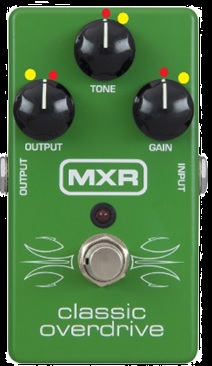
Let's start with your OD pedal. I suggest starting with an OD if you're
just starting to experiment with gain pedals. Here's how I set up mine.
Let's assume you have volume, gain and tone. You might have different
names for the controls, depending on the pedal you have. Maybe they have
loud, grit and range. Some get more creative. But you can figure it out.
Often the 3 will be in a triangle with 2 small knobs on top and a big
knob in the middle. Usually they are top left, volume - top tight, tone -
Big knob GAIN! There might also be a toggle switch. Generally, this is
going to be some type of EQ control. Probably 2 different types of OD.
The main difference between OD pedals is the amount of midrange they
produce, or scoop out!
Turn all knobs off, counter clock wise. Play something with the pedal off.
Not with your amp turned way down! You gotta have some volume! Now
step on the pedal. What happened? Did the volume drop? Did the volume
get louder? What you want to do now is keep adjusting the volume knob,
while turning the pedal on and off, until the volume is the same. Unity.
Many pedals are made to hit unity with the volume knob at 12 o'clock,
noon. But others can get loud quickly. Set the volume to unity.
Next, slowly bring the drive, or gain knob up until you get the sound you're
going for. You'll need to adjust the volume down as you bring the gain up.
Again, pedal on and off as you get the gain up. In general, most people put
the gain up way too much. This isn't a distortion pedal.
You want it to sound like you've turned your amp way up and it's breaking
up. How much do you want it to break up? That's how much gain you want.
OK, now for the backing tracks. Or MP3s of your favorite songs. You need
to crank up the tracks or recording a bit. So they're at unity with your amp
Now start playing. If your sound is getting buried, lost, or sounds like you
aren't playing loud enough, NOW start tweaking your tone knob! Adjust it
until you start hearing your guitar cut through the mix.
Your tone, your EQ! can determine how you sit in the mix. Don’t simply
crank up the volume or the gain if you don’t hear yourself through the
mix. You’re probably lost behind the bass, kick drum and the cymbals.
Adjust your TONE and start cutting through. Once you do hear yourself,
listen to the tone, and how the gain sounds in the mix. If it sounds
good, but too quiet, SLOWLY bring up the volume until you’re where
you want to be.
NOTE: Check your mix without the pedal on! Clean. Set your volume
to match your backing tracks or MP3. Then go back and get your gain
pedal to unity.
THIS IS ALL TRIAL AND ERROR AND CANNOT BE DONE WITH
ONE OR TWO QUICK ADJUSTMENTS!
Take your time. If you have a bunch of pedals to set up, set aside a LOT
of time to do this. Or just do one pedal each session. But don’t rush it.
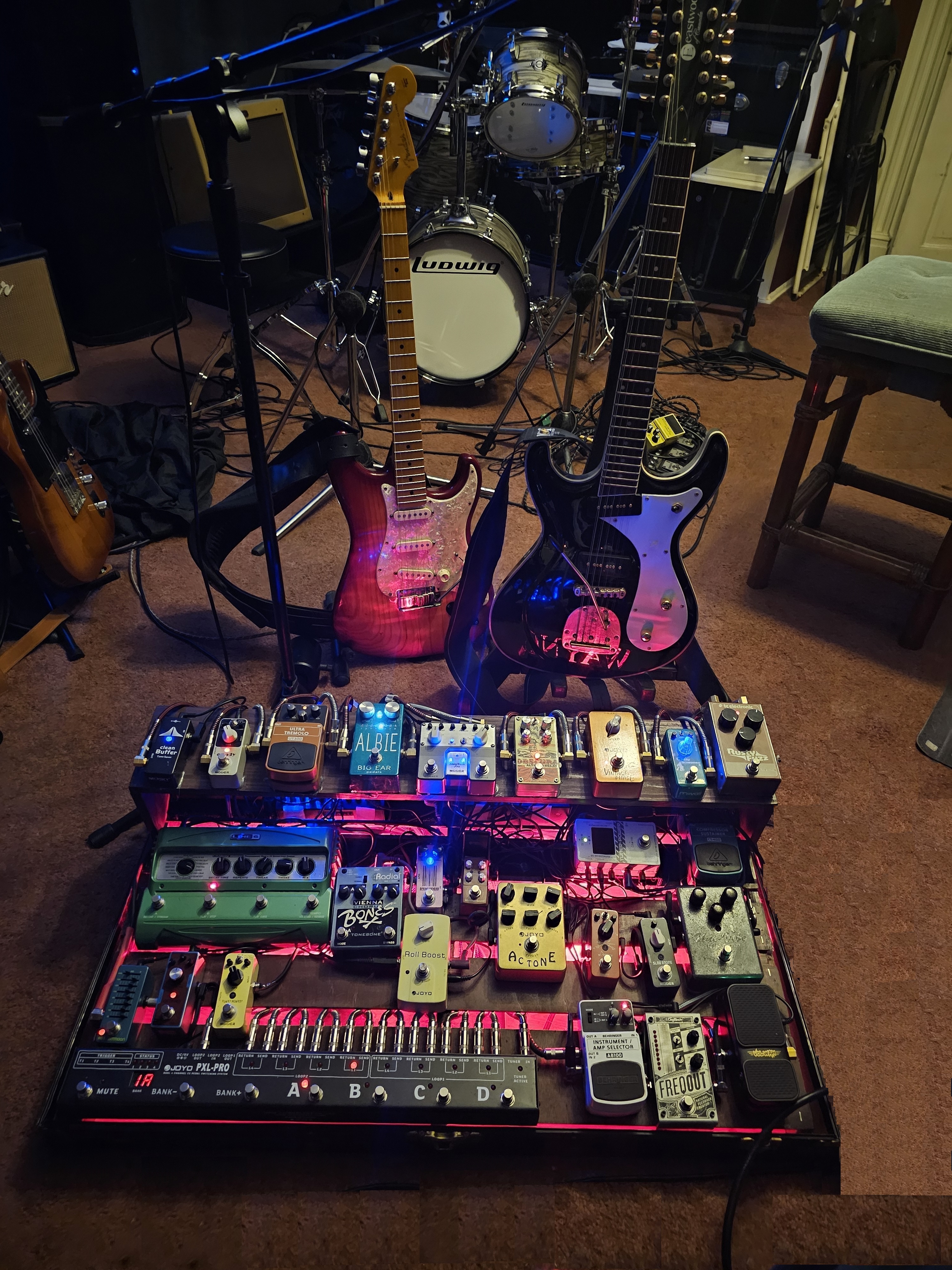
It took me a couple of WEEKS to get my pedal board dialed in! Keep in
mind I have about 30 pedals, not 3 or 4. (It changes from time to time!)
Now it’s time to OPTIMIZE!
Once you're hearing the guitar pretty well in the mix, you can take some
time (like several minutes, not seconds) and adjust each knob a little
at a time. Rotate the volume slightly higher. Improvement? Keep it. No
improvement in the sound, cut it back to where it was. Adjust the tone
multiple times. Up a teeny bit, down a teeny bit. Which is better?
Maybe it was better put up a little bit. OK, then try boosting it a teeny
bit higher than it was. Better? Cool. Tweak it up again. Keep doing that
a TEENY BIT at a time until you love the tone. Now do the same thing
with the gain knob. The secret is, only adjust it a little bit. Like if the
gain is at 10 o'clock, adjust it to almost 11 o'clock. Then to 11. Then
11:30. Until you get the grit you're looking for.
It's trial and error. And the pain is, grab another guitar and see if it's set to
sound good for that guitar. If you use (example) a Strat and a Les Paul at
your gigs, you have 2 options.
1). Write down the settings that worked for the 1st guitar you use. then
start over! When you get it right for the other guitar, write down your
settings. You can use a silver pencil, or a drop of pain, swipe your wife's
finger nail polish, but don't tell her I said to do it! Put a teeny drop at each
setting on the pedal for each knob. You might only need one dot if say, the
tone is the same for both guitars. You will definitely need 2 dots for volume.
The Paul is going to be louder than your Strat! So when you go from guitar
to guitar, you simply adjust to one set of dots or the other.
2). The other option is to get another pedal! Have 2 on your board. Not as
practical but it depends on your budget, and how serious you are about getting
"your tone". Then the question will be . . . Do you get another of the same
pedal? Or try a different pedal. That's going to be your call.
Up until recently I had about a hundred pedals to choose from. So I chose
the OD that sounded best on my Strat, and a different one for my Humbucker
guitars. As it turned out, I was able to strike a happy medium. So I only needed
the one OD pedal. (BTW: Not 100 OD pedals! LOL I’ve been collecting pedals
a while. I probably had a dozen OD pedals. My UniVibe is a 1969. And I have
an OD pedal from the 70s. But I have a LOT of new or newer pedals as well.)
OK, this just got you started. Again, it's trial and error. Take some time to
tweak your pedals in. It should take you DAYS (or nights) to get your board
tweaked in! I have 31 pedals on my board. It took me WEEKS to get it all
tweaked in. I did it while cranking our band's backing tracks through the
PA. In the studio. And I tweaked during rehearsals. It took a couple weeks,
including a couple full rehearsals to dial the board in how I want it. Don't
be in a hurry. Don't fool yourself thinking "It's good enough."
I played a really cool gig a week ago. Plugged in. Tuned up. Sound checked,
and didn’t tweak a single pedal! So my board is perfect, right? Then why did
I buy yet ANOTHER OD pedal this week, and add it to my board? Because
you’ll never be totally 100% satisfied for more than MAYBE the time between
a couple gigs! Ha! I found an OD I liked a lot! Very different from the OD I
have. So I bought it, and added it to the last remaining spot where a pedal
could possibly fit on my board! Now I’m worried! If I find another pedal, I
have to remove one to add one! Yikes! LOL
That brings up another issue. Where the pedals physically go on your board.
They do not need to be in signal chain order. Place them in a logical order,
based mainly on how often you use each pedal. You “wire” it as needed. But
don’t get fooled into thinking you need your pedals in the same order as
your signal chain. However, it will require more longer patch cables if your
signal chain is a lot different from how the pedals are placed.
One more thing. Yes, you do the same thing for each gain pedal. But there are
times when you might want to stack a couple gain pedals. Perfect example: Some
gain pedals (many!) work better when running through an already cranked amp.
For those pedals, it's common to have the OD pedal on, 1st in the signal chain.
Then hit the Distortion pedal. It's going to sound different than it did with the
OD off. Decide if you'll use them stacked more often than not. If so, adjust/tweak
a bit. Think of it like this: If you're mainly playing Rock or heavier Blues, you'll
most likely leave the OD on all the time. So set it for your rhythm sound, and use
the distortion (or a booster pedal) to kick it up a little for solos.
If you play mostly clean, then use the OD for your kick/boost. If you mostly play
clean, you might not even want or need a distortion pedal! Same with fuzz.
Blues greats like Stevie Ray Vaughan used 2 tube screamers. One was set with
the gain at zero! So it was just a boost.
So there you go. If you don't have your gain pedals yet, I suggest buying them used!
And/or buy inexpensive mini pedals! You can find minis for $25 new. $15 used.
How about dialing in other pedals besides gain pedals?
To start, run your guitar into your tuner, then into your compressor pedal, which
you absolutely MUST have! Into your wah, then into your OD, Distortion and
then fuzz. If your amp has an effects loop, run your time based and modulation
pedals into the loop. Then back to the board, into your volume pedal. Do not
put your volume pedal first! You want your entire sound to go up or down. If
your volume pedal is at the beginning of your signal, when you turn it down,
you'll change the mount of each effect pedal's affect!
Your gain pedals will get less signal because the vol pedal is down. And it will
reduce the amount of grit you worked so hard to get!
Same with your reverb, chorus, etc.. Putting your vol pedal at the end
turns your whole sound up or down without changing how it sounds.
NOTE: If you want to use the vol pedal like you do when you roll your guitar
volume down, as in, clean up the grit a little, then roll it back up for a grittier
solo, put the vol pedal before your gain pedals. But generally, that's not going
to work out very well. That's why some players have 2 vol pedals. One before,
and one after gain.
One more tip. Although a wah pedal is not a gain pedal, you can use it as a super
tool for tone. Leaving it on, with the rocker pedal positioned somewhere around
the middle will give you a really cool "woman" tone with the right amount of
gain added.
As you add pedals, a couple more tips: I strongly suggest getting a
compressor pedal FIRST! Not to add grit like some players do. But
to even out your pedals! A little compression goes a LONG way, and
your board will sound MUCH better. Plus, you'll get better sustain.
Next, buy an EQ pedal. When you do, start over! It will get your rig
sounding SO MUCH FULLER! Get your clean sound. Then tweak your
other pedals. You will not be sorry!
Next you'll want to add some reverb, unless your amp has a good
sounding reverb. One more "must have" will now be a buffer pedal.
At the end of the chain. If you want to go further, you'll want a
chorus pedal. Especially if you play a lot of clean! A teeny bit goes a
long way! Or use more for ambient music. You can also get a bit of a
doubling effect. Like playing a 12 string.
You can expand your sound by adding modulation pedals. A flanger,
and/or a phase shifter.
No doubt about it. I'm a pedal junkie! I don't care for effects processors
that "do it all". Nothing wrong using them! I just don't care for them.
Nothing sounds as good as a pedal!
While you're contemplating what all pedals you want, I strongly suggest
adding a pedal switcher/looper. I use a Joyo that has 8 loops. I run my most
used 8 pedals into the looper. I can turn on (or off) up to 8 pedals just tapping
on ONE footswitch! (There is a MIDI version if you use MIDI pedals.)
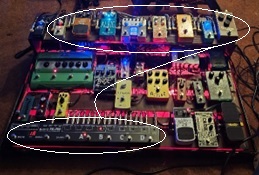
What you do is program a patch to turn on any one, or more pedals. When
you step on a switch to turn on any one or more pedals, it turns off the pedals
you had on before. So no tap dancing turning on 2 or 4 (or more) pedals, and
turning off 2 or 3 or more pedals between songs. Or between verses and
choruses, or solos.
I have 4 foot switches. A, B, C & D. That's 4 patches, plus bypass, so I have 5
totally different combinations of any of 8 pedals. And that's on Bank 1. It has
8 banks! So you have up to 32 combinations of your 8 pedals.
I have mine set up like this . . .
Bank 1. Clean and pretty! A little reverb. B the reverb and some
tremolo and delay (my surf setting). C is the same as B plus OD,
And D is the same as B with a little distortion. So bank 1 covers
light Rock, light Blues, Country, SURF!
Bank 2 is for ambient songs. Like Zep (Kashmir, No Quarter) Pink Floyd tunes,
ETC. From super clean ambient, to heavy ambience with a bit of flanger and OD.
(Floyd solos, etc.)
Bank 3 is all Blues! From clean to driving boogie! This bank is great for
Santana tunes as well.
You can have up to 8 banks. You might never need 8 banks of different
sounds. But what I do is make identical patches/banks of my most used
bank in between the other banks. Example: I can have Bank 1, 3 and 5 be
the same. All cleans. Then in between, have my ambient bank and blues
bank on 2 and 4. That way I'm never more than 1 stomp to get to the
bank I use the most.
1 Cleans ~ 2 Ambient ~ 3 Cleans ~ 4 Blues ~ 5 Cleans ~ etc..
I never have to go up or down more than 1 bank to get to my main patches,
cleans! I used a processor for a while. I set it up the same way.
OK, print this out, and use it as a guide as your travels into the . . .
“Realm of Pedaldome”
. . . take you places you never dreamed you could go!
Your pedal board will give you endless hours of fun!
BAZINGA!
Click to go back to the main Tutorials and Workshops Directory

Main Directory
Hope you found this interesting. If you did, please feel welcome
to drop me a line. Email me, or drop me a PM on Facebook!
Email me any time! ~/~
Wayne on Facebook
My Band Website
Check out my Support Group
I Just Wanna Play The Darn Thing!
My main backing Tracks Support Website with over 43,813
free bacing tracks! SoundFont, MIDI editors and players and
more! All distributed for free! MidKar

Visit my MidKar websie!
Please help keep us online with a small donation!
This site is free for all. The tutorials, workshops. 43,813 MIDI, KAR &
BIAB backing tracks files, 23 BIAB User Styles. A FREE SoundFont,
Timbres of Heaven. Free MIDI players and editor!
The fees for a site this large (Nearly 200 pages with over 50K files)
is pretty high, as you can imagine.
Please consider making a small donation to help keep us online. It
would help so much! Thanks! Wayne
PS: I pay for the site and all hosting, security and domain related
expenses out of pocket. Donations appreciated. Please click the link below.
|
