251 Substitution Tutorial 1:
Using the 2 & 5 chords inside your progressions!
Spruce up your MIDIs! SPICE UP YOUR PROGRESSIONS!
The ii V I trick!
So, are you stuck trying to figure out the chords
in a song you're making a backing track for?
"What are those "connecting" chords? Hmmmm!"
Or are you writing a song, and can't figure out
how to smoothly transition to the next chord?
Or do you just want to take some great old song
progressions and make them new and fresh? OR . . .
Do you want to take a current song you "kinda" like,
and make it sound "older", or maybe JAZZ IT UP!
In all cases above, it's pretty easy to find the missing
chords you're looking for.
Here's a trick I use a lot! In Blues, Jazz, or anywhere!
We're going to look at adding part of the 2 5 1 into
our progressions. The 2 and the 5.
The 2 5 1 is just playing the ii (2) V (5) and I (1) chord of
the Major Chord Scale.
C Dm Em F G7 Am Bdim C (We typically make the V a Dom7th.)
Let's listen to a C Major Chord Scale . . .

Before we begin, let's have a listen to what a 2 5 1 sounds like.
Here are two examples, in one short audio snip.
Fist there are two measures that use simple standard chords. [Dm G7] [C].
Followd by two more measures, but this time, we'll play the Jazz chords
[Dm7 G7] [Cmaj7]
ii (2 minor) and the V in one measure to resolve to the I, the C. And . . .
ii7 (2 minor7) and the V in one measure to resolve to the I, the Cmaj7.
[Dm ' G7 '] [C ' ' '] [Dm7 G7] [Cmaj7]
The 251 is most often used to end a verse, or sometimes end the song.
But it can be used in other ways as well. Let's listen to the above
couple bars in context with other instruments.
And one more . . .This one repeats 8 bars a few times with different
instruments, etc. It goes like this . . .
[G ' ' '] [C ' ' '] [Dm ' G7 '] [C ' ' '] then [G ' ' '] [Cmaj7 ' ' '] [Dm7 G7] [Cmaj7]
OK, here's the "trick"! You're going to add the 2 and the 5,
but not just to resolve the end of the progression! You're going
to add it into the progression!
Use the ii V before the chord you want to transition to!
Yeah, the Jazz Standard Go To 2 5 1 !
Think of it this way . . . When you want to transition to any chord,
consider the chord you're transitioning TO as a new Tonic, or new 1
chord. So going from C to Am for example, think of Am as a new key,
not just a chord change. The Am becomes the 1 of the 2 5 1. So you add
the 2 & 5 in the previous measure, ending on the 1, or Am.
It works EVERYWHERE!
OK, here's a quick n dirty overview of what the ii V I is.
(Note, I said overview instead of "theory" so I don't lose
80% of you! HA!)
Super quick overview . . . then the examples!
Upper case = major. Lower case = minor. So ii is the 2nd chord
in the scale and it's minor. If I typed iv, that would mean you
play the 4th chord of the scale, BUT make it minor, not major.
IV would be the 4th chord, major.
The natural order in a chord scale would be I ii iii IV V iv vii- I
(vii- = 7 diminished)
So, what is a 2 5 1? Here's one in the key of C.

C Major Harmony Scale:
C Major Harmony Jazz Scale:

So the ii would be Dm, or Dm7 in the Jazz scale. The V would be G7 for both.
NOTE: In the Jazz scale, the I and IV are maj7. The V is always a Dom7,
never a major7! The Dom7 resolves WAY better back to the 1!
OK, enough theory. You see where the chords for the ii V I come from.
So let's take a really simple progression or two and make them . . . COOL!
[: [C ''' ] [C ''' ] [F ''' ] [F ''' ]
[C ''' ] [C ''' ] [Am ''' ] [Am ''' ] :] C
Play the above progressions in an extremely simplistic cadence. Just one strum
or hit per quarter note. Nothing rhythmic. Just hit
1 2 3 4 1 2 3 4 1 2 3 4 1 2 3 4.
Do that once for the whole progressions.
Now let's substitute the 2 & 5 into the 2nd, 4th, 6th & 8th measures.
NOTE . . . This is the tricky part! NOT the 2 & 5 of the key you're in!
But the 2 & 5 of the key/chord you're transitioning TO! In this case . . .
F, C and Am, then back to C!
To transition to the F, we go to the key of F and use the ii and V. So . . .
F Gm Am Bb C7 Dm Edim (or Em7b5) F
An easy way to do this is go up a whole step from the chord you're going
to, and make it minor. Then go up a 4th from that chord, and make it a
Dom7th. So if you're going to a G chord, use Am and D7.
So we'll substitute a Gm and C7 in the measure preceding the F. To go
from the C to the Am, same thing. And we'll use Bm and E7. And for the
Am to C, we'll do the same thing and substitute C's 2 & 5, Dm and G7.
(Same chords going from the F to the C.)
Simple Progression . . .
[: [C ''' ] [C ''' ] [F ''' ] [F ''' ]
[C ''' ] [C ''' ] [Am '' ] [Am ''' ] :] C
New Progression . . .

Is that cool or what!
Let's make it pretty! Use the C Major Jazz Scale chords . . .

Here's a practice progression you can work on right here,
or you can download it, with the chord sheet. Jusy click on
the 3 vertical DOTS on the play button to DL the MP3. And
click the "Here's the chords" link for the text file.
Note that in the 20th measure I didn't use the 2 & 5. I
changed it up a bit using the relative major of the minor
chord I'm transitioning to. That's for another lesson!
If you don't know the Jazz chords yet, just play the "regular"
chords for now. As in, For Am7, just play Am. Etc.
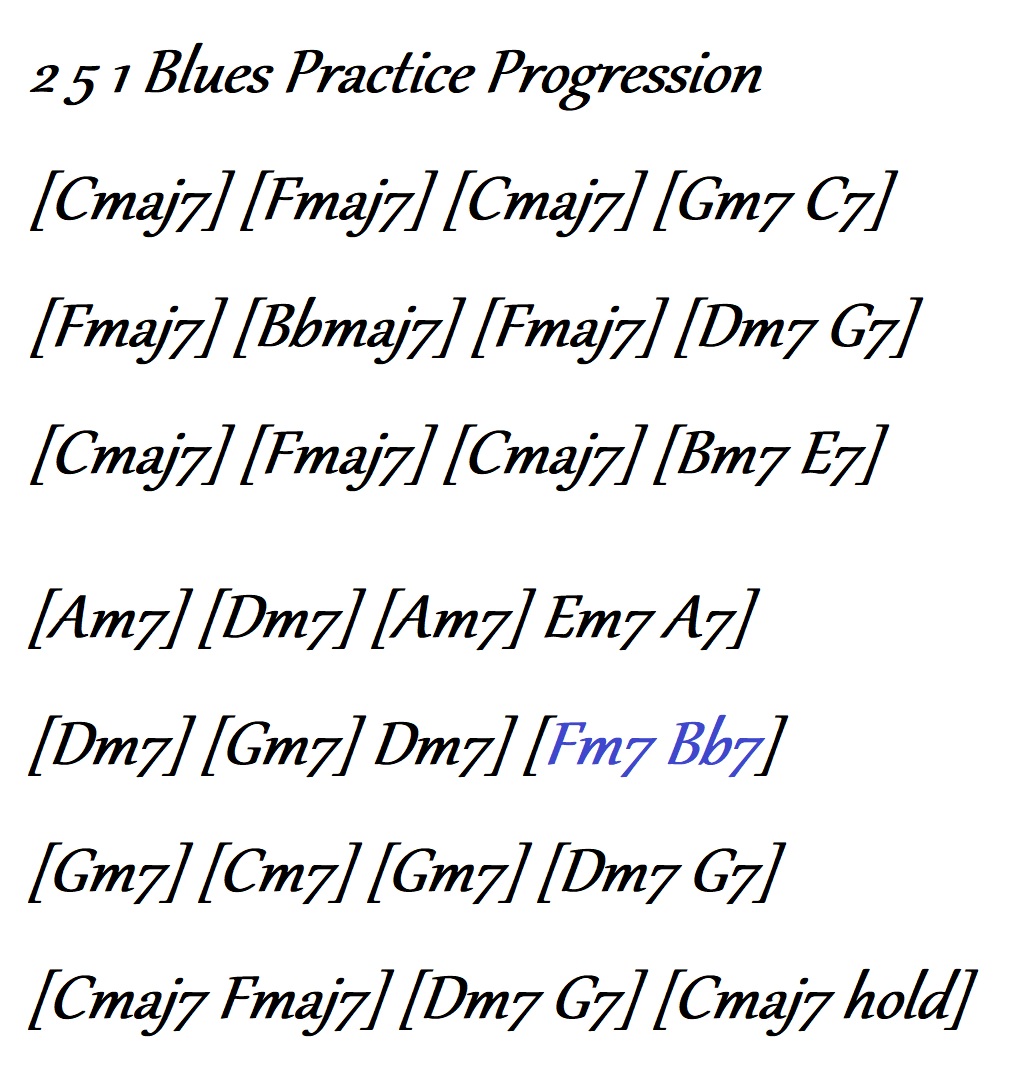
Here's the chords. click to download
Download the MP3 by clicking the 3 verticle dots on the right
side of the M3 player, right next to the little speaker icon.
Then click on the top "download" icon.

There ya go!
Let me know if you like this lesson. I'll follow up with some cool
things to do with Secondary Dominant chords.
Enjoy! Wayne
Back to the Tutorials Home Page
Hope you found this interesting. If you did, please feel welcome
to drop me a line. Email me, or drop me a PM on Facebook!
Email me any time! ~/~ Wayne on Facebook
I Just Wanna Play The Darn Thing on Facebook
My Band & Personal Website
Check out my Performing Musicians & Backing Track Support Group
I Just Wanna Play The Darn Thing!
My main Backing Tracks Support Website with over 43,813
free bacing tracks! SoundFont, MIDI editors and players and
more! 260+ pages!All distributed for free!

Visit my MidKar website!
Please help keep us online with a small donation!
This site is free for all. The tutorials, workshops. 43,813 MIDI, KAR &
BIAB backing tracks files, 23 BIAB User Styles. A FREE SoundFont,
Timbres of Heaven. Free MIDI players and editor!
The fees for a site this large (Nearly 200 pages with over 50K files)
is pretty high, as you can imagine.
Please consider making a small donation to help keep us online. It
would help so much! Thanks! Wayne
PS: I pay for the site and all hosting, security and domain related
expenses out of pocket. Donations appreciated. Please click the link below.