CLICK HERE to go to workout section!
Pentatonic Master Class Workshop
for Keyboard and Horn players!

Part 3: The JAMS! It's time to PLAY!
~~~~~~~~~~~~~~~~~~~~~~~~~~~~~~~~~~~
Part 3 will get you playing, two ways. For one, you'll be jamming
over Jam Tracks. Just having some fun! But equally as important,
we'll be spending more time on all 5 positions, and using them
over the jam tracks! Plus there are more patterns to learn!
BB King Box ~ Albert King Box ~ More Jammable Penta Phrases!
Did you ever hear someone say . . . Play me the blue note?

We're also going to add just one note to the scales you've been working
on. The 5-note Pentatonic Scale becomes the Blues Scale by just adding
the one "blue" note! The flat 5. b5

I should mention that this scale is called the Jazz Scale to Jazz
players. Country players call it the Country Scale. We ALL use it!
You are going to actually learn solos, AND get good at playing them!
THEN . . . once you finish this workshop, you'll move on to the next
one. Very similar to this one, but with much less text. And these same
exercises and drills will be . . .
IN ALL 12 KEYS!
We're going to literally create SOLOS! Remember the BIG scale
from Part 2? Well, we're going to EXTEND that into one HUGE,
LONG pattern! AND below, you're going to learn one more LONG
pattern! Then we're going to EXTEND THAT! THEN . . .
We're going to put'm into JAM TRACKS! Many different tracks!
YOU ARE GONNA BE JAMMIN' AND SOLOING!
If you have been following the plan, doing this workshop as per
the instructions, you have been working on Part 1 EVERY SESSION!
Before you worked on Part 2. And before your regular practice
sessions, and by now you can play each of the 5 positions fairly well!
Here we go!...
Before we learn more great riffs, take a few minutes and jam a bit to the
jam track. Don't "work" on the track. Just relax, and have fun with it!
See if you notice any improvements from before you started the workshop.

Am Slow Blues: Am Dm Em
Are you coming up with some new ideas you haven't used before? Are you
playing any better? Articulating better? Enjoying it more! If you DO . . .
DROP ME AN EMAIL OR PM AND LET ME KNOW!
Email me any time! ~/~
Wayne on Facebook
I hope that was FUN!
More SHAPES!
3 SHAPES
Before we play to a jam track, let's take one track and WORK on it!
Now play it back down.
~~~~~~~~~~~~~~~~~~~~~~~~~~~~~~~~~~~~~~~~~
EXTENDED SHAPES
READY FOR SOME FUN!!!
I don't care what genre of music you're into, you use the Pentatonic
You're about to play the scale in the track exactly as it is in the track.
We worked on "boxes" in Part 2. Let's go a bit deeper into the boxes.
We broke up the full scale into 4 boxes and played to tracks. But now
we're going to break the scale into THREE boxes, or scale shapes!
Each of the 3 boxes plays GACDE. Same notes (each an octave higher)
and same shape. Here's how they sound. The 1st one is GACDE played
straight. Then again in a Swing feel.

PLAY THIS SEVERAL TIMES. LEARN THIS PATTERN!
SOUNDS LIKE
Starting the Am scale on the G before the root, and playing GACDE,
we can extend Position 1 and move to Position 2. Just using ONE 5-
note pattern, and incorporating a very cool cadence!
These have a swing feel. 123 123. This track holds the 1st note 2
counts, 12, the 3rd note 1 count. So the 1st 2 notes get 3 counts.
G'A. The next 3 notes are triplets. CDE. So you play it: G'ACDE % %
The pattern is played 3 times. G'ACDE G'ACDE G'ACDE E. Then
plays it again, up one octave, ending on A.
G'ACDE G'ACDE G'ACDE E HOLD
G'ACDE G'ACDE G'ACDE A HOLD
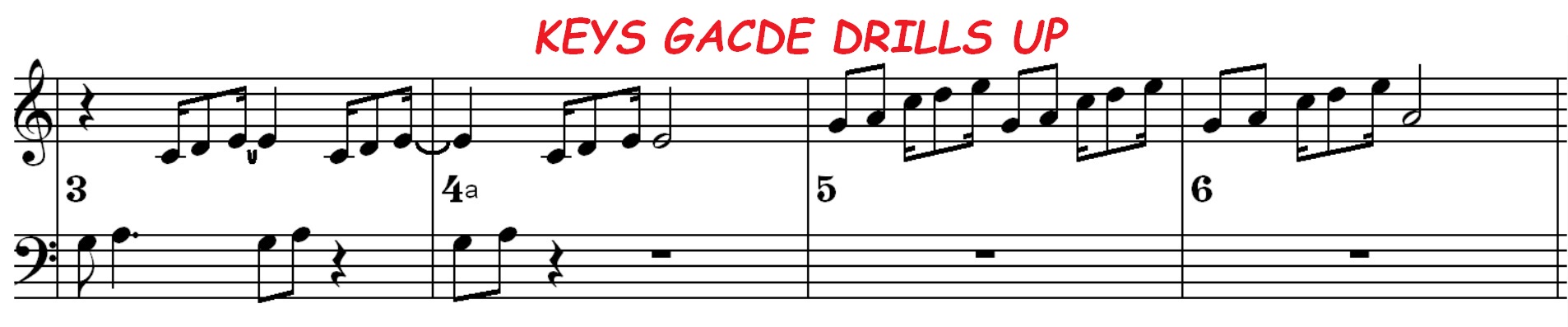
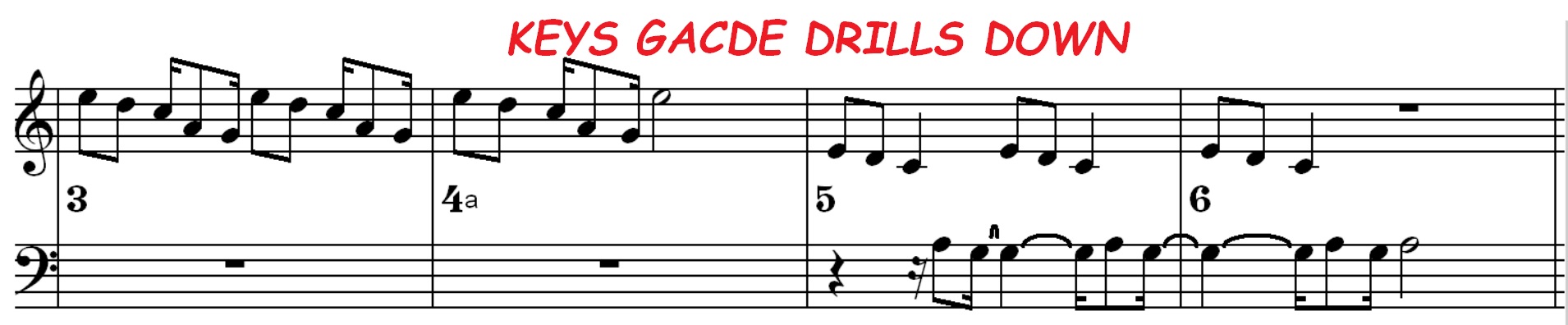
Put them together! Play it up and down, then an octave higher, Up and Down.

~~~~~~~~~~~~~~~~~~~~~~~~~~~~~~~~~~~~~~~~~~~~~~~~~~~
~~~~~~~~~~~~~~~~~~~~~~~~~~~~~~~~~~~~~~~~~
Let's EXTEND!
Two more exercize groups that literally tie it all together!
We're going to take the above scale SHAPE, and . . . EXTEND IT!
We'll also extend the BB King Box by adding in the
Albert King Box. AND . . . The Blues Scale!!
The scales we're going to work on now are extensions of
what we just did above, and the Big Box, and everything
else we've done so far! These are KILLER! And FUN!
SOUNDS LIKE
Remember this from part 2?
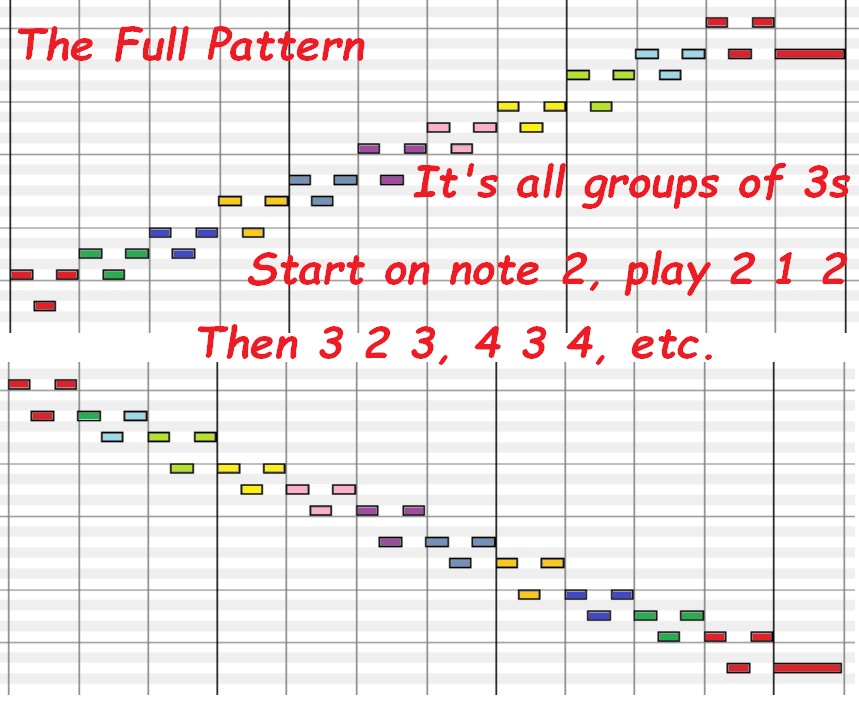
We can make that scale a LOT longer, and cooler to play! You know now
the scale is made by breaking up the single note scale by playing
212, 323, 434, etc. Well, we can even break up THAT broken scale!
We take the 1st 4 sets of 3 notes and play them once. Then we back up
one set of 3 notes, play them then the next 3 sets. So we have . . .

Think of it like climbing a stair case. Go up 4 steps, then back
down 1. Go up 4 more, and back down 1. ETC!
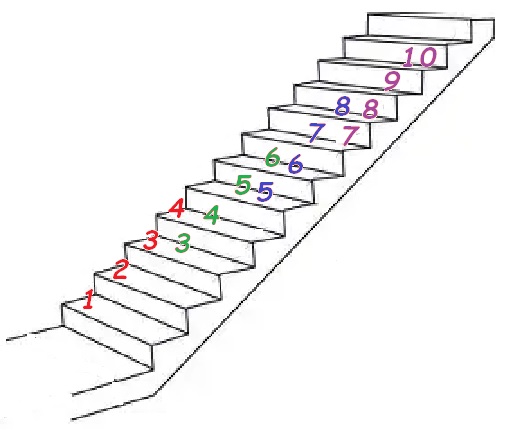
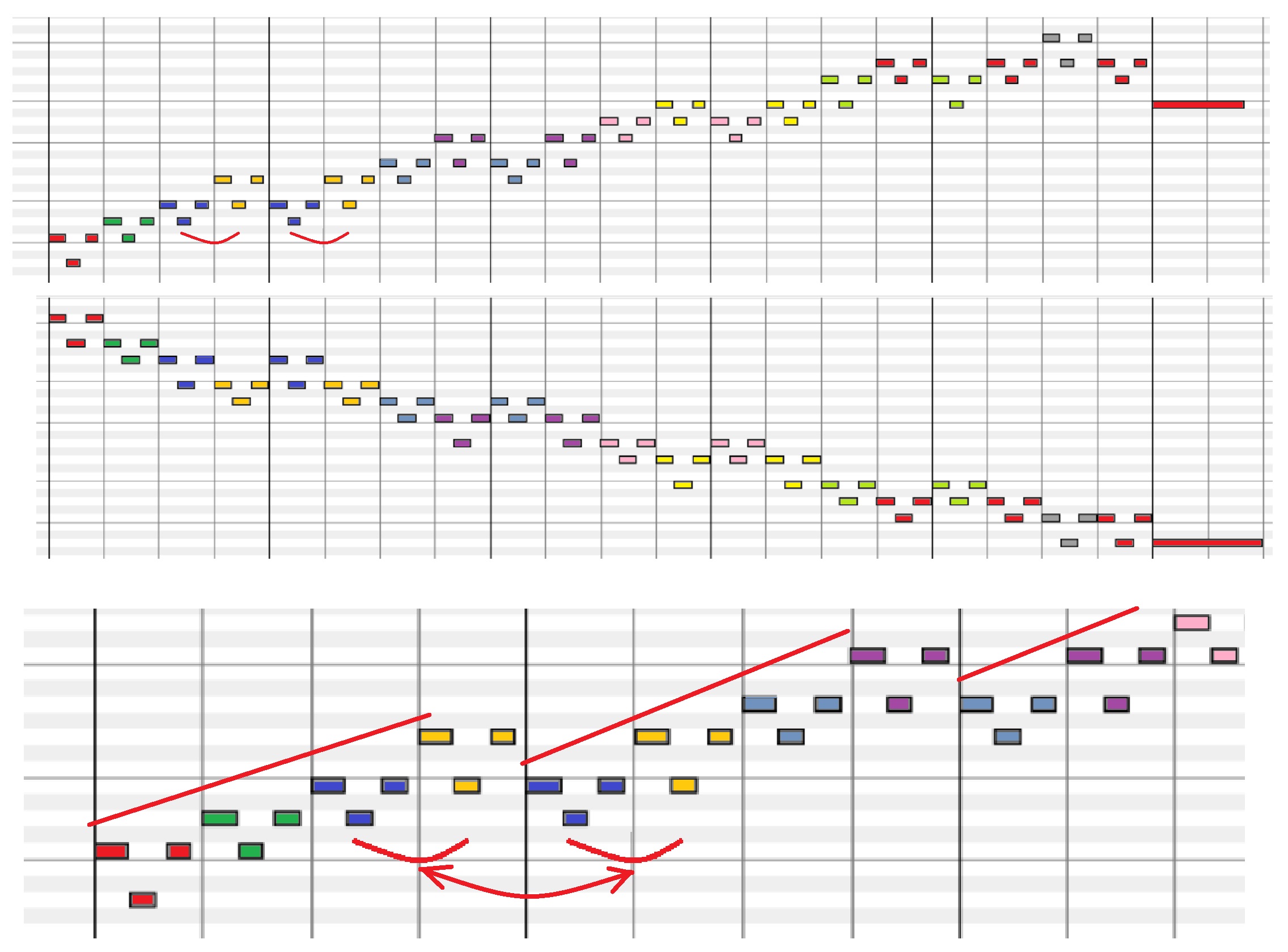
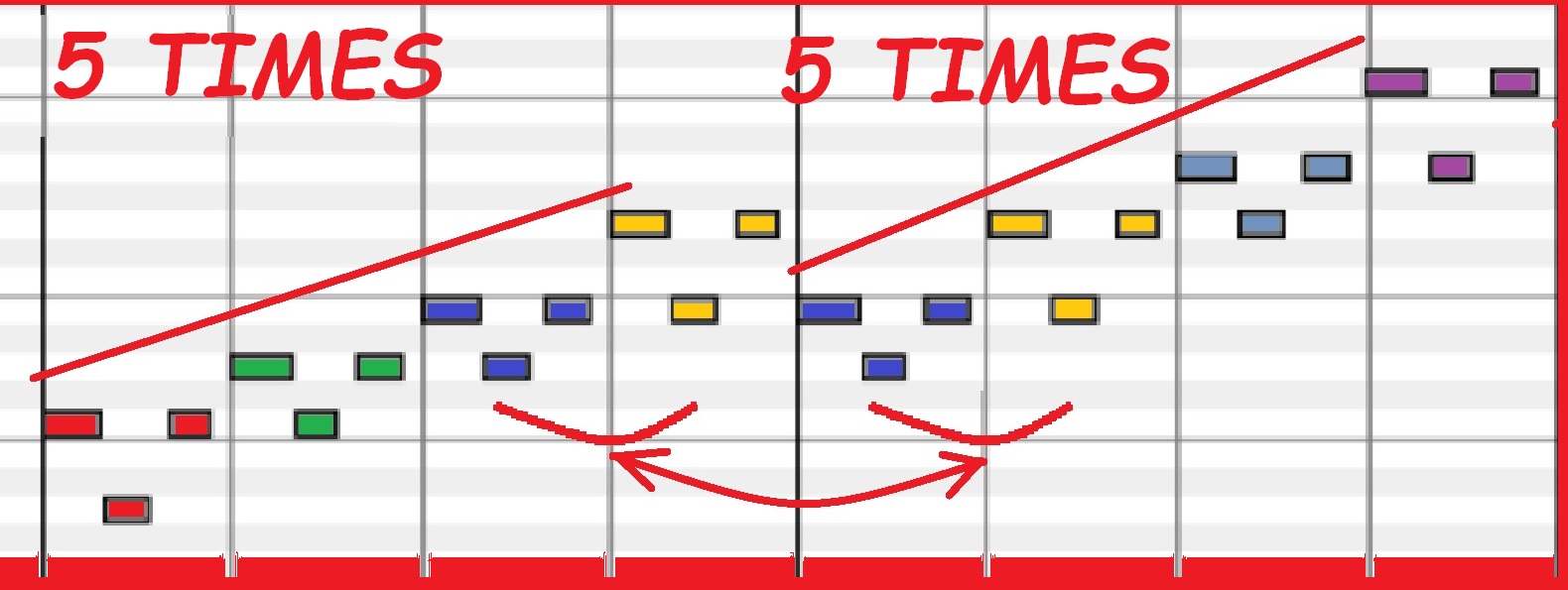
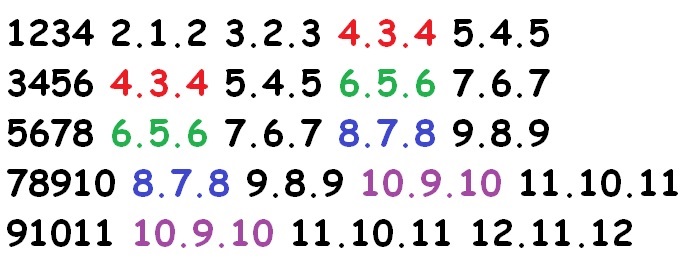
So . . . Play the 1st 4 sets of 3-notes, 5 times. 212 323 434 545.
Move down one set and repeat 5 times. 434 545 656 767. Drop down 1,
repeat the pattern all the way up. Each set of 4 plays 5 times.
NOTE: Set "91011" repeats 11.10.11. Only 3 notes in this set. So play:
10.9.10 11.10.11 12.11.12 11.10.11
UP 5X EACH
DOWN 5X EACH
Going up, play each set of 3 notes ONCE,
then move up to the next set.
UP TOGETHER
Going down, play each set of 3 notes ONCE,
then move down to the next set.
DOWN TOGETHER
Play the ENTIRE scale up once, then back down.
UP DOWN %
Back down to The BIG ENDING!
~~~~~~~~~~~~~~~~~~~~~~~~~~~~~~
Scale a ton. Right? Especially now that you have more positions and
phrases in your lick library!
But did you know that you can add just ONE note to the Pentatonic
Scale, and turn it into a super cool scale! Again, this isn't a theory
based workshop. You can read more about the How & Why in my
Tritones Tutorial. But I need to cover just a little now.
The Blues Scale is a 6-note scale. It's the Pentatonic Scale, plus
ONE NOTE! The Tritone! That's the note that's exactly in the middle
of the scale, and not played in the scale . . . USUALLY!
One cool thing about adding this note is, it's EASY to do! It falls
right between the 3rd and 4th note.
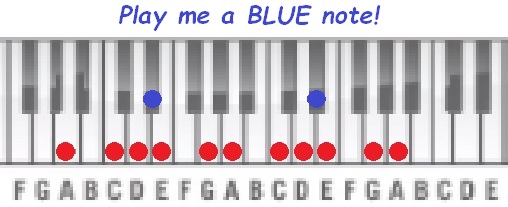
Am Pentatonic, then Am Blues Scale
Note: You don't use this note as a "landing" note. As in, you don't end
a phrase or hold this note. It's a passing tone!
I'm covering the Blues Scale for 2 reasons.
1). Because of the similariy to the 5-note scale. Similar in structure,
and in useage.
2). Because it's used by every pro player I ever heard of!
Only one drill for this one because it should be a quick learn! But I'm
doing something different with this scale. First you'll play it really SLOW!
Until you get it!
SOUNDS LIKE
You'll hear a little bit of clashing in the tracks. Mainly because I just
play the scale straight, INCLUDING the b5 Tritone. So there's a shift in
how you'd usually play it. More on that in a bit. Work on it as is for now!
The graphic below shows the note names, the finger patterns, and the strings!
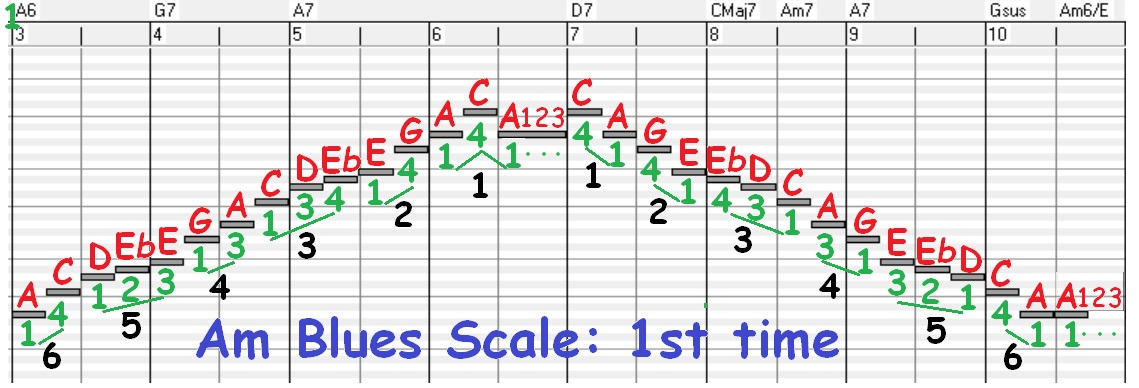
Blues scale over Blues track. Play it up, then back down.
Then . . .
Click on the Jam Track links, and play along with them yourself! No scale
played in the Jam tracks!
12-bar Am jAM track: Am Dm Em
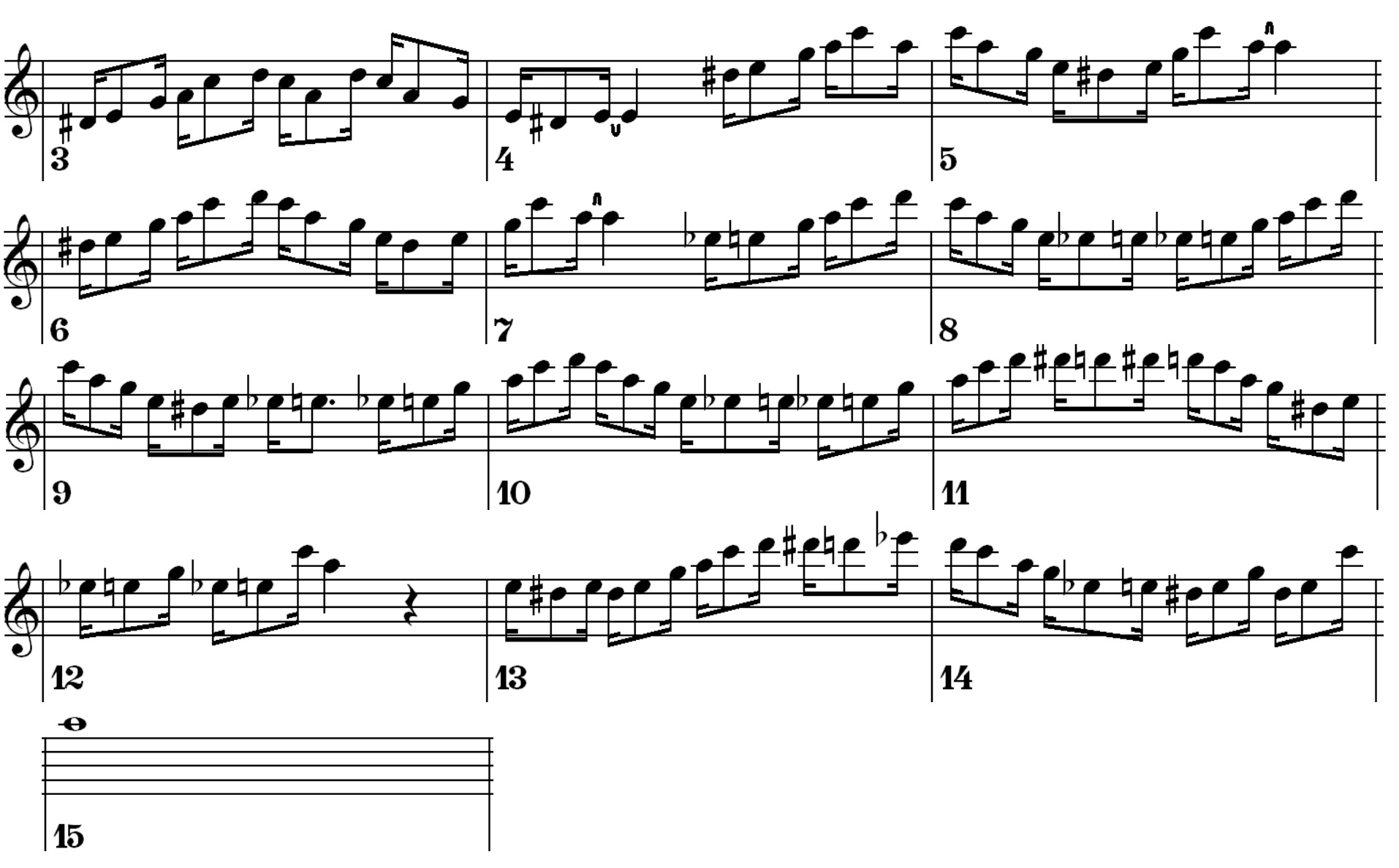
This it the first SOLO we're going to build. So I'm going to chart out
exactly how the scale is used in the drill track. Learn it, note for note,
measure for measure. The only variation will be where one scale, going up
ties in with the scale going down.
NOTE: There's a 3-count snare 123 in between each direction change. So,
when you hear 123, the next count it the 1st note of the scale going the other way!
This is an important step! Because we'll learn other solos the same way.
The first time through the 12 bars, the scale is played exacxtly as above.
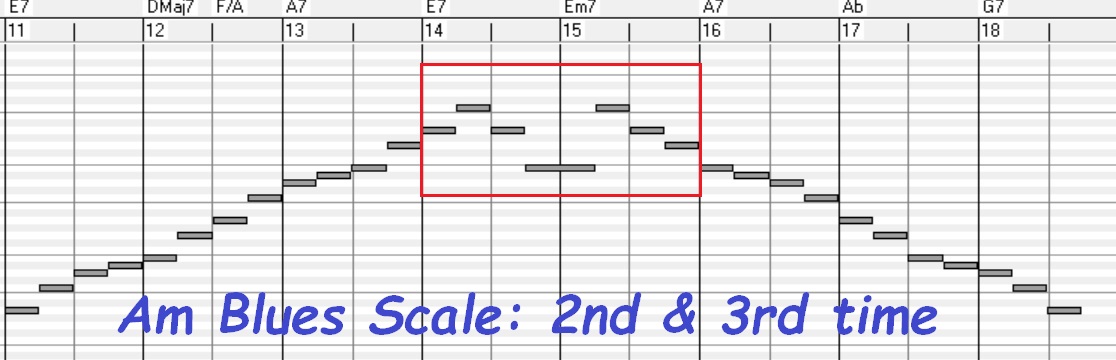
Learn this exactly! The following track plays this 1st verse version 4 times
Verse 2 and 3 are the same. Only slightly different from Verse 1.
The variations are only during the UP to DOWN transitions.
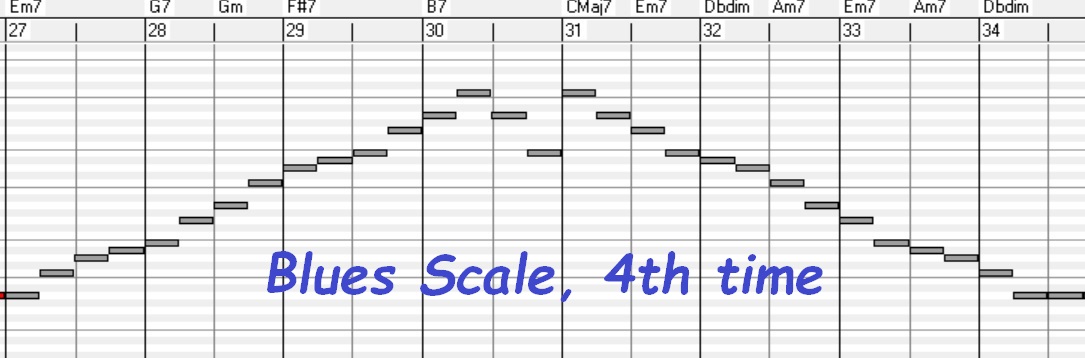
Verse 4, only varies slightly different from Verse 1.
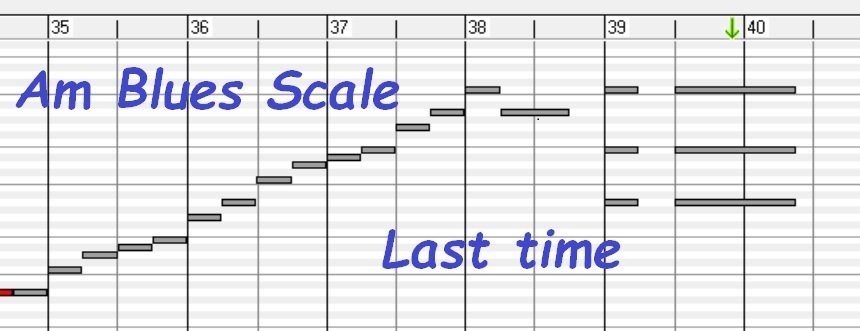
There is a bit of an ending after the last verse.
Verse 2 and 3 are the same. Only slightly different from Verse 1.
OK, put it to work! You need to do two things now.
The following jam track is the same one you've been playing along to
in the above solo tracks. It's a straight 12-bar Blues in Am.
Am ''' Am ''' Am ''' Am '''
Dm ''' Dm ''' Am ''' Am '''
Em ''' Dm ''' Am ''' E7 ''' %
1). Playing the JAM track below, well, you know. PLAY IT! Play the solo!
There is no melody in the jam track. If you can't play it with little to
no difficulty, go back up and do the practice verses again.
Now, play the track again, but this time . . .
2). JAM! Make something up! PLAY! Try not to think of the scale shapes.
Just play! What ever your muscle memory digs up! Have some fun with it!
You might have a little bit of difficulty "opening up". Trying to formulate
a solo on your own. And at this point, that's OK! But after the NEXT section,
you're going to have a lot more phrases added to your riffs and licks library!
So hang in there! It's about to get gooder and gooder! :)
Have at it. Let's see whatcha got!
~~~~~~~~~~~~~~~~~~~~~~~~~~~~~~~~~~~~~~~~~
~~~~~~~~~~~~~~~~~~~~~~~~~~~~~~~~~~~~~~~~~~~~~~~~~~~
~~~~~~~~~~~~~~~~~~~~~~~~~~~~~~~~~~~~~~~~~
The Albert King Box
WAY TO GO! We've come a long way. And now it's starting to pull together!
By now you're getting the scale down pretty solid! If you've been doing
Part 1 EVERY SESSION as directed, you have the 5 positions down!
Remember the BB King Box? We started the Am scale starting on E. EGACDC
Cool, right! Well, it gets cooler! How'bout we learn the Albert King Box!
It's almost the same. But he adds ONE NOTE to BB's Box. And you should know
what note that is by now. The Tritone, b5!
You know the "notes". But it's what you DO with them that counts! We've been
playing some shapes that start on the root, A. And some that started on G.
And some starting on E. But most of the ones you've worked on so far played
the shape with the notes in order. So they can end up sounding like you're
playing scales, not phrases. Like when we played the BB Box, but played it
in order. GACDED, etc.
We're going to use some solo ideas from one of my favorite artists.
Albert King. Major Blues player! And he uses the Blues scale a ton! So,
we're going to create a bunch of cool phrases using the same scale.
Throughout the following group of exercises, we're going to play the Am
Blues scale, but start it on the Tritone! The Eb. And it's gonna
start opening some doors! These are creative! Not blah Am scales!
You don't need much "instruction". You know the drills by now. Here come
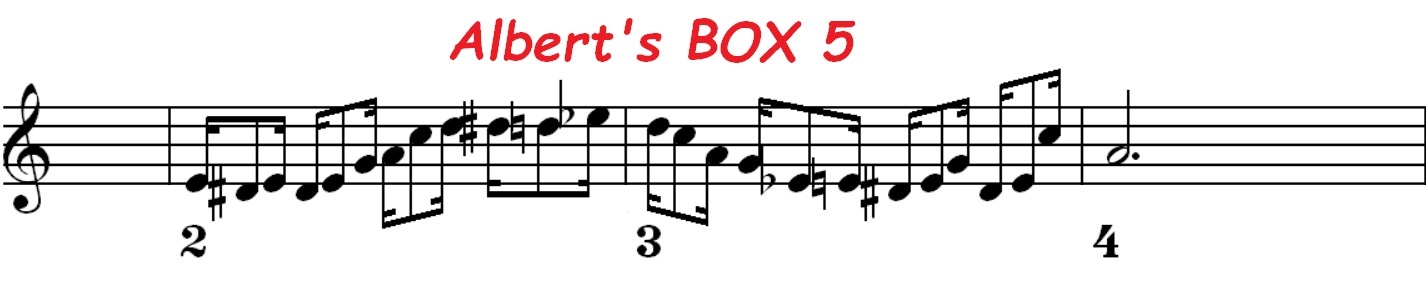
5 really cool phrases! Here they are all together so you get an idea
what they sound like.
I was just noodling here and came up with these phrases. You play
each one 2 octaves. I just charted one octave for each.
Notice how much these DON'T sound like Am scales!
Play'm till you mess up. Start the track over, 3 times!
Riff 1: 2 OCTAVES, 6X
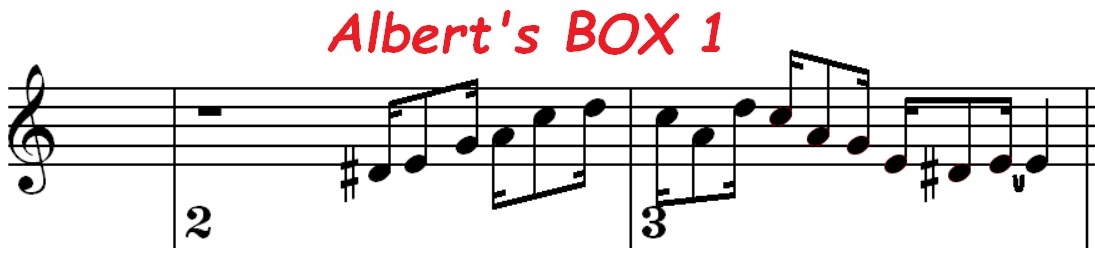
Riff 2: 2 OCTAVES, 6X
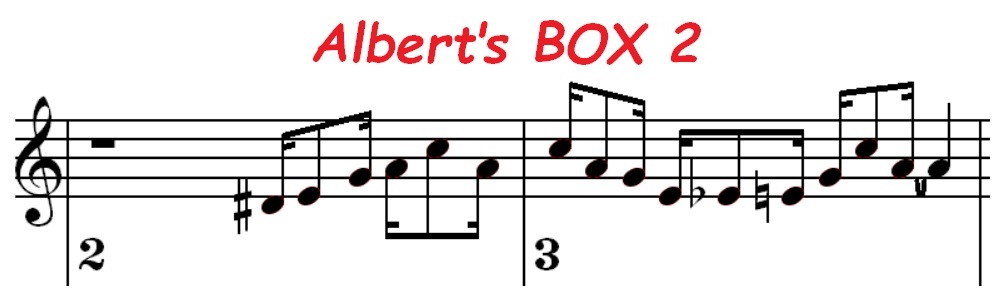
Riff 3: 2 OCTAVES, 6X
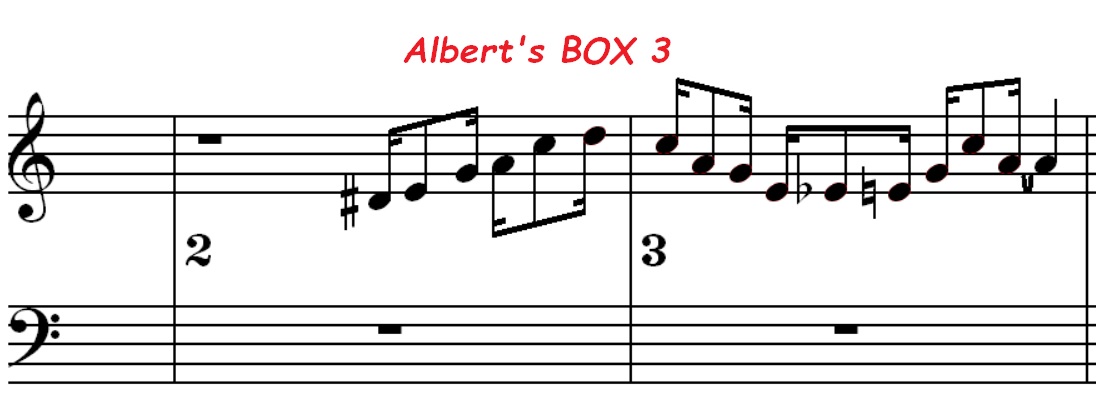
Riff 4: 2 OCTAVES, 6X
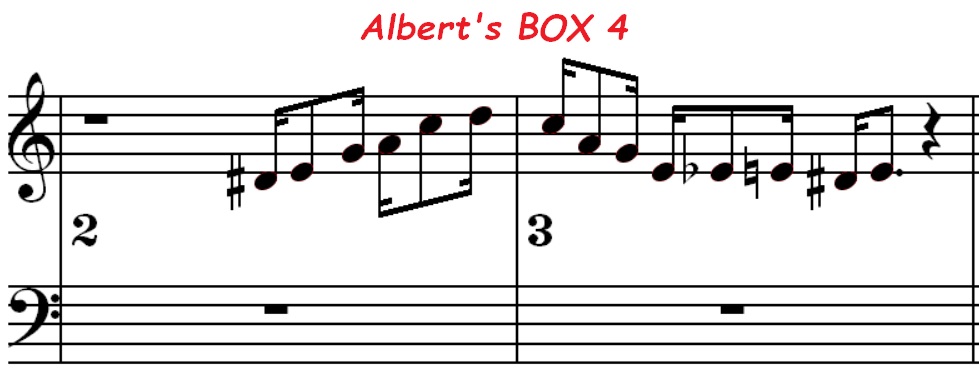
I love this next one!
Riff 5: 2 OCTAVES, 6X
~~~~~~~~~~~~~~~~~~~~~~~~~~~~~~~~~~~~~~~~~
~~~~~~~~~~~~~~~~~~~~~~~~~~~~~~~~~~~~~~~~~~~~~~~~~~~
~~~~~~~~~~~~~~~~~~~~~~~~~~~~~~~~~~~~~~~~~

So, you keep asking WHY! Why are you working on these little snips
and riffs? How will they really become solos, not SCALES! Well, it's
all gonna start to make sense!
12-BAR
What I'm about to do, to help you break away from just running scales up and
down to make solos is . . . give you some scales to run up and down and play
as solos!
WHAT!?! Yup. But within just the next few minutes, you'll finally . . .
GET IT! Trust me!

The light is about to go ON!
~
~
~
~
~
~
~
~
~
~
~
~
So we start with something you know pretty well by now. Simple Am Blues Scale.
Followed by the 4th, flat 5 and 5th notes, D Eb E. Then Eb E G, the Tritone,
5th and 7th. (This isn't "IT". IT is coming!

You're thinking this could never be a cool part of any solo! OK, get ready
for that light to go on!
Two things we generally do to make a solo are to play riffs that come from
the scales over the chords we're playing over, OR . . . we "emulate" the melody!
Maybe sometimes, just playing the melody works. But your solo would need to
be just once through the verse, or chorsu, or bridge. It'd get boring to just
play the melody, STRAIGHT! You need to add some dynamics to pull it off!
Here's an exampled. An old tune everyone knows! The 1st time through it's the
straight melody. But the second time is a lot closer to the killer solo we
all remember! (It's close! LOL)
In the 2nd solo, the melody is the "theme" of the solo. But listen to the
added notes. Listen to the 2nd phrase! It JUMPS UP an octave for dynamics.
And then . . . listen to the NEXT PART!
MELODY VS. DYNAMICS
TRITONES
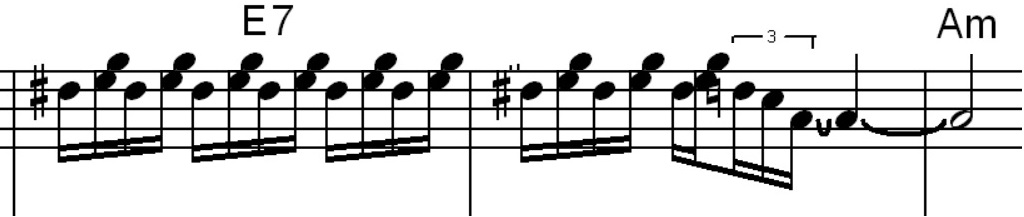
That middle part is SO COOL! Right?!?
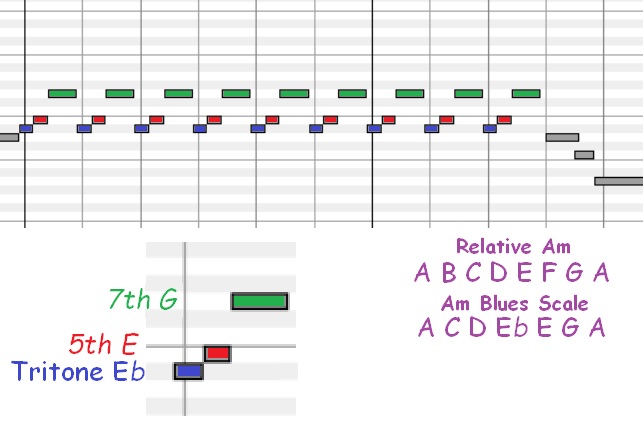
Guess what those trills are playing? Eb E G. The Triton, 5th and 7th!
BREAKDOWN
The DRILL . . . Play it th... um, you know!
~~~~~~~~~~~~~
Progress happens when you keep moving, and stay in motion.
OK, now can you see how short phrases can build into killer solos?!?
~~~~~~~~~~~~~~~~~~~~~~~~~~~~~~~~~~~~~~~~~
Well, you'll either love this next exercise, or hate it! Ha! But it's a
You need to start thinking ahead. Start thinking in terms of longer riffs.
~~~~~~~~~~~~~~~~~~~~~~~~~~~~~~~~~~~~~~~~~
Now we'll take those Albert King phrases from above, and put them into
simple (but cool!) 12-bar progressions! THIS is the workout!
NOTE: Remember earlier I said you don't stick on, or land on Tritones. They
are passing tones. Hit'm and get off'm! Well, in these exercises, playing
each phrase over the 12 bars, that Tritone doesn't fit over the Dm! So it will
clash a little. If you were playing these phrases in an actual solo, you'd
skip the Tritones over the Dm! But we'll use them for now!
You know the drill. Play'm till you mess up. Start the track over, 3 times!
Riff 1: 12 BARS
Riff 2: 12 BARS
Riff 3: 12 BARS
Riff 4: 12 BARS
Riff 5: 12 BARS
ALL 5 RiffS: 12 BARS
~~~~~~~~~~~~~~~~~~~~~~~~~~~~~~~~~~~~~~~~~~~~~~~~~~~
~~~~~~~~~~~~~~~~~~~~~~~~~~~~~~~~~~~~~~~~~
More Licks 'n Riffs
building block! And adds some more phrases that'll all work into the solos
we're going to be building!
The solo will sound like this. But a lot cooler when played faster!
Yeah, a solo IS a bunch of short phrases, all played together. Kinda Sorta!
But not really! Sure, we learn a long solo a snip at a time. We work on a
small phrase until we get it. Then add another, etc. But, those bits and
pieces end up being long phrases, complete thoughts.
When we talk, we don't spell the words. We say them. We might have learned
some of the word a letter at a time. But when it come to communicating, I
want to hear you talk in intelligent sentences. THAT'S how you solo!
OK, I'll break down the 4 riffs you'll be playing. You could build a 12-bar
solo just from these phrases, played together! I want you to learn a
complete sentence this time. Not a few words!
~~~~~~~~~~~~~~~~~~~~~~~~~~~~~~~~~~~~~~~~~
Riff 1

LOOKS LIKE
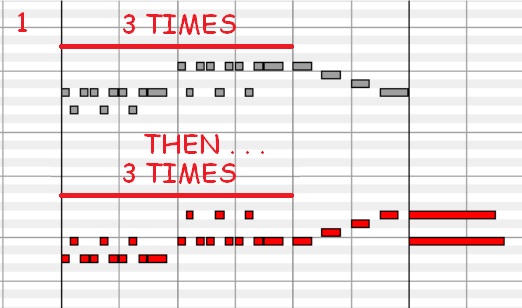
SOUNDS LIKE
THE DRILL (3 times as usual!)
~~~~~~~~~~~~~~~~~~~~~~~~~~~~~~~~~~~~~~~~~
Riff 2

LOOKS LIKE
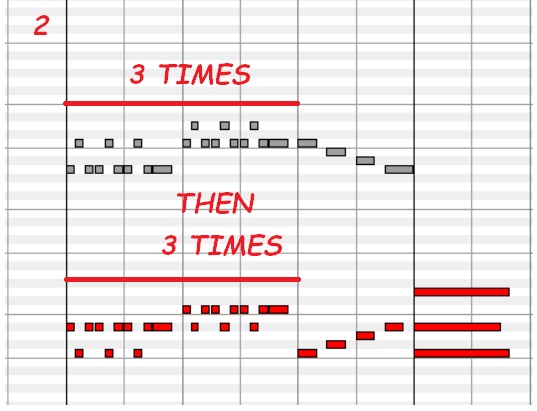
SOUNDS LIKE
THE DRILL (3 times as usual!)
~~~~~~~~~~~~~~~~~~~~~~~~~~~~~~~~~~~~~~~~~
Riff 3
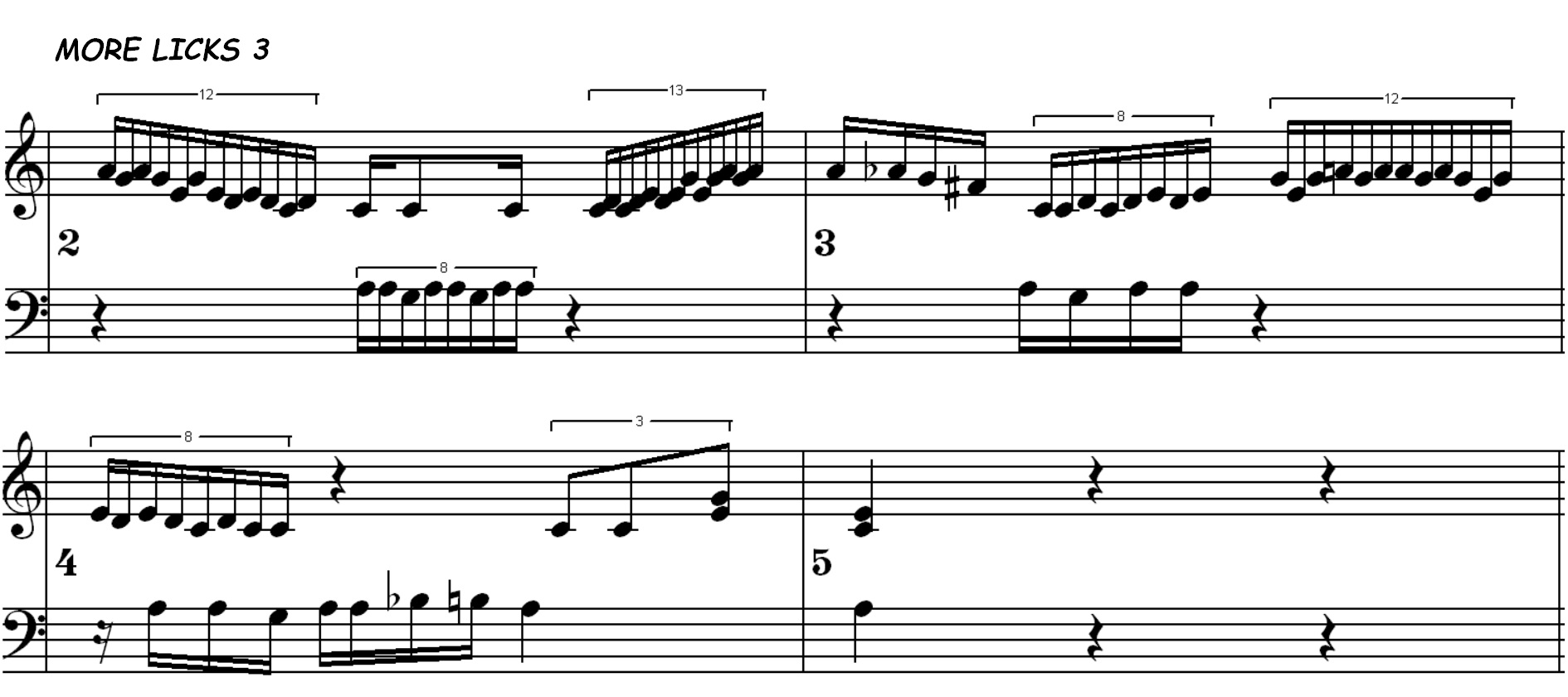
LOOKS LIKE
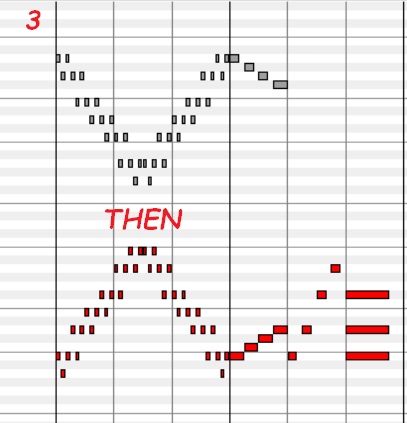
SOUNDS LIKE
THE DRILL (3 times as usual!)
~~~~~~~~~~~~~~~~~~~~~~~~~~~~~~~~~~~~~~~~~
Riff 4
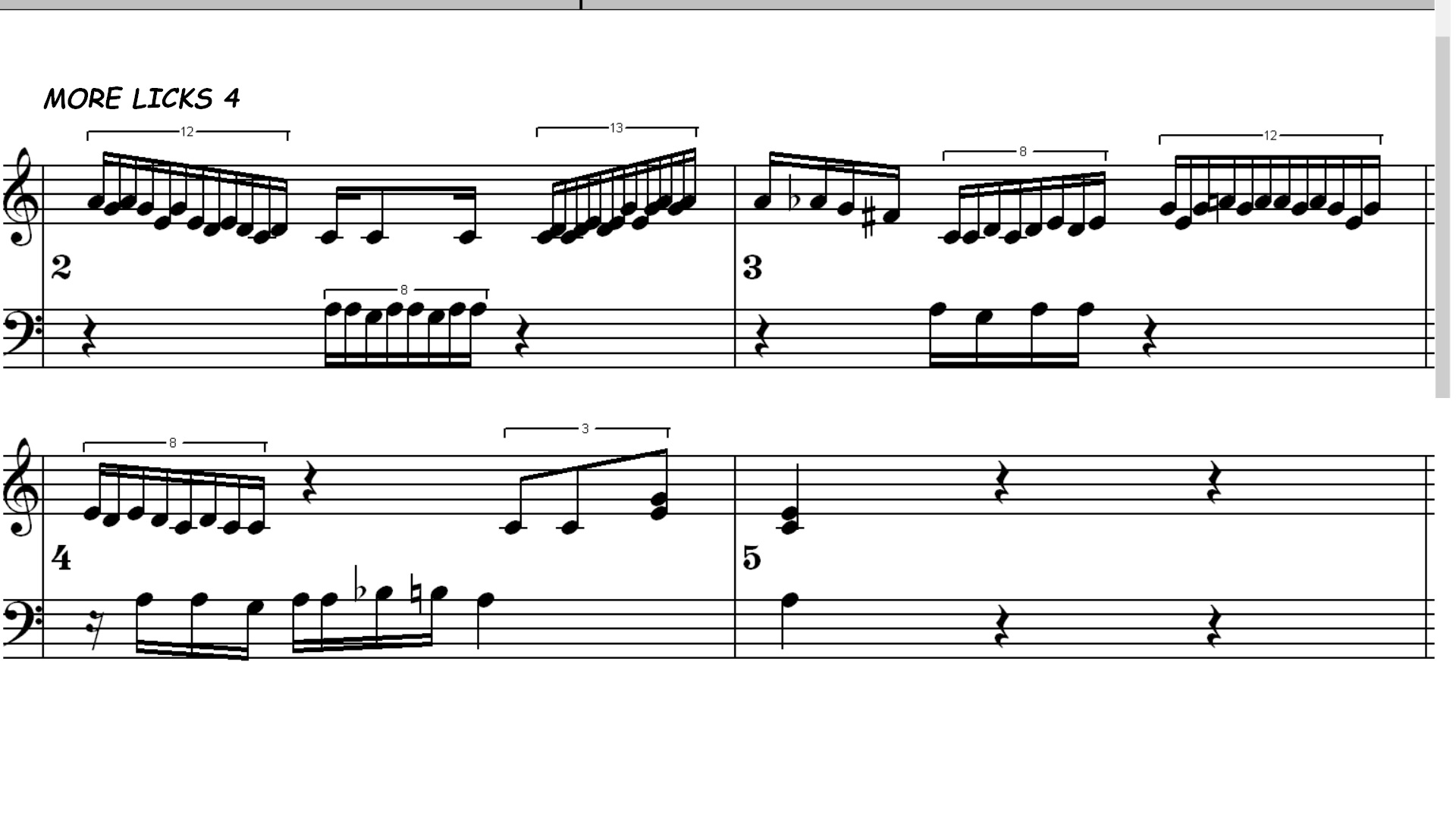
LOOKS LIKE
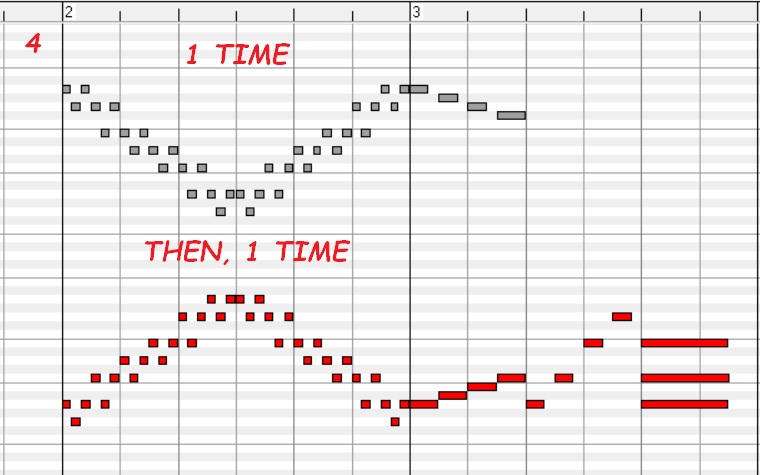
SOUNDS LIKE
THE DRILL (3 times as usual!)
~~~~~~~~~~~~~~~~~~~~~~~~~~~~~~~~~~~~~~~~~~~~~~~~~~~
~~~~~~~~~~~~~~~~~~~~~~~~~~~~~~~~~~~~~~~~~
OK, let's put it all together!
This one is a bit redundant. But repetition is what you need! Hit this
one 3 times as usual. Then it's gonna get cool.
(The "E" notes look like "F". But they are Es!
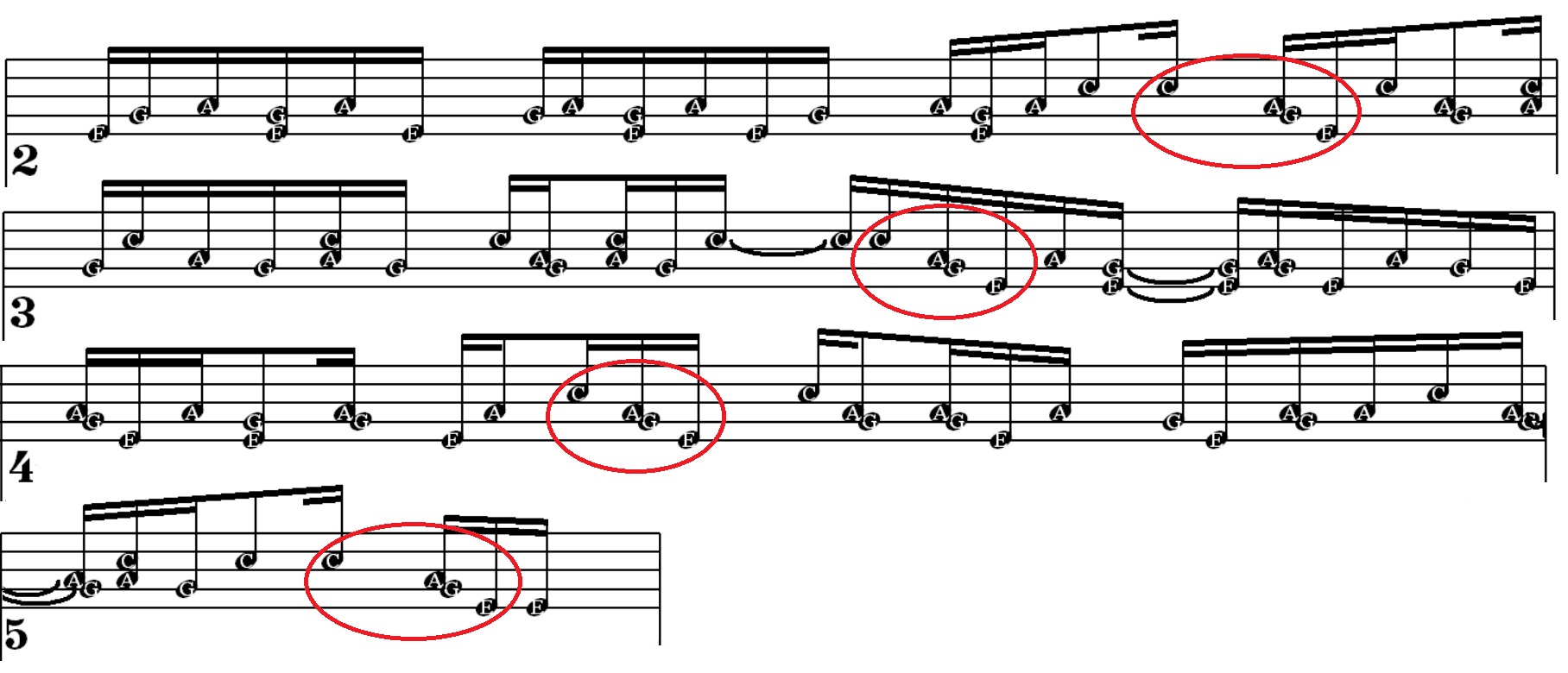
LOOKS LIKE . . .

~~~~~~~~~~~
Now let's WORK the above track! 3 files. Stay on the slow track until you
NAIL IT! Then skip it next session and work on the fast track. When
you can get through it, work on the BLAZING FAST track!. It's gonna be a
while before you can play that fast. And quite honestly, you might not
even want to! YOU decide when you're ready to move on to the next
workshop. That one plays the same tracks as this one, except in ALL KEYS!
SOUNDS LIKE
SLOW TRACK
FAST
BLAZING!
JAM TRACKS! Have a go! LET'S JAM! TRACKS
Just jam! Don't do the "drills". Use them, but make something up!
Am track. No chord changes
~~~~~~~~~~~~~~~~~~~~~~~~~~~~~~~~~~~~~~~~~
~~~~~~~~~~~~~~~~~~~~~~~~~~~~~~~~~~~~~~~~~~~~~~~~~~~
~~~~~~~~~~~~~~~~~~~~~~~~~~~~~~~~~~~~~~~~~
Wrapping It All Up
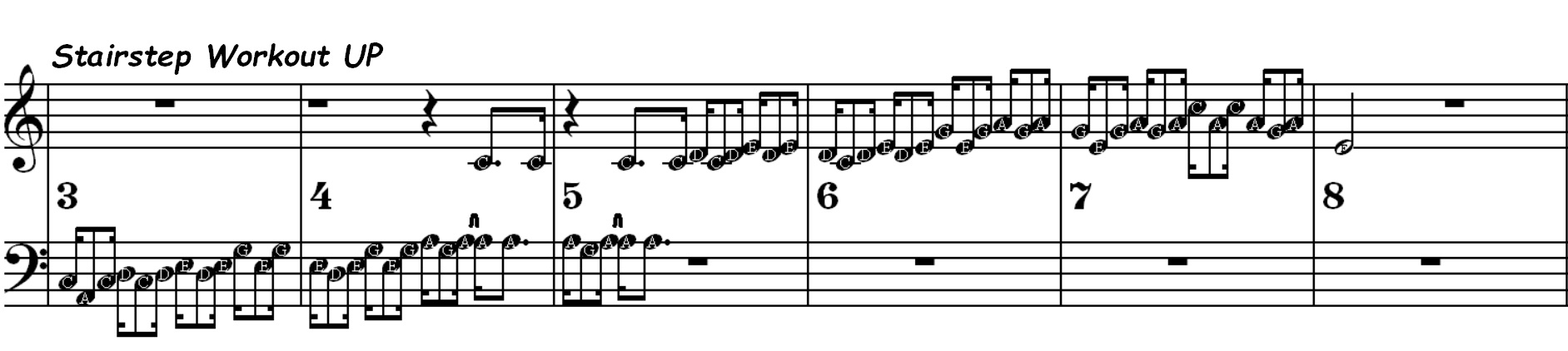
The Extensions a crutial! You need to be able to get part way through all three
BEFORE working on this Stairstep Drill. They are the total culmnination and
destination of this journey! Don't cut it short now!
Work the Extended Drills until you nail them!!
Stairstep Workout UP
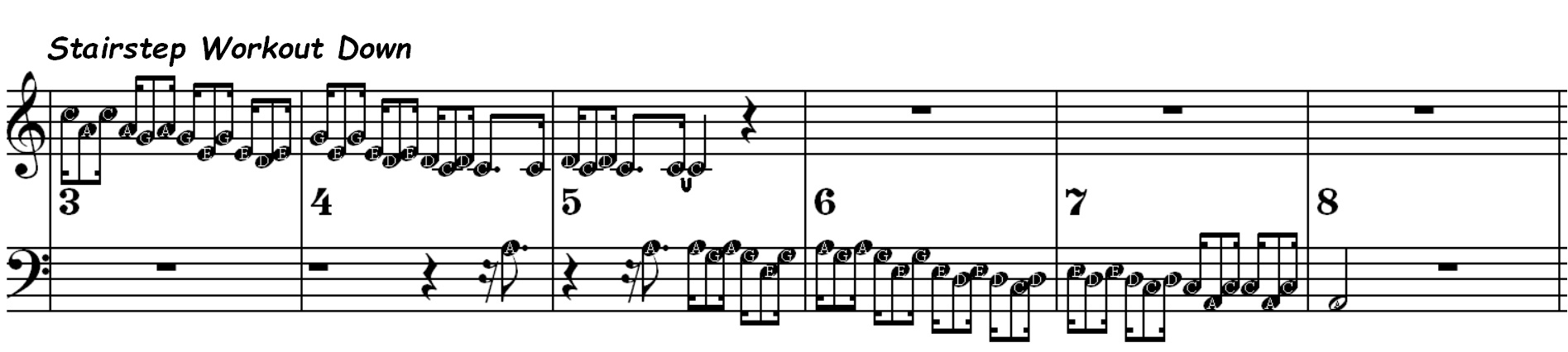
Stairstep Workout DOWN! - FAST
And the Grand Finale ! ! !
UP & DOWN Together (SLOW'ISH! Ha!)
This Is IT! What you've been working for!

WAY . . . TO . . . GO!
OK, here's a jam track to use to make use of your new skill sets! See what you
can come up with now! Also, check out the Jam Tracks page! (Link below)
16-Bar Blues Track
So, what's next?
1). Go to the Jam Tracks Page and work on what you've learned over
some great jam tracks! Take a break and have some FUN!
JAM TRACKS PAGE
2). You go back to Part 2! When you get through it, do Part 3 again. Keep
Please consider making a small donation to help us keep MidKar
alternating until you can get through ALL of the track, OR . . .
until you've succeeded as far as you'd like to!
There is no correct speed. No correct level. It's all about what YOU want!
If you'd like to be even better than you are now, KEEP WORKING!
3). Your next BIG step - Working in ALL KEYS! When you're ready, start
working the "ALL KEYS" workshop! This one is different. Mainly the same
Drill tracks you've been working on here. But in all keys. Very little
text. Little to no instructions. Easy to maneuver! Simply pick the drill,
riff or key you want to work on for each session. Click the link to the
one you choose. Simple!
All Keys Pentatonic Workshop
Obviously, there's more to learn than just Am Pentatonics. If you have a
workshop idea . . . let me know!
Email me any time! ~/~
Wayne on Facebook
Contact me any time! Got a question? Ask me! Or request a workshop topic!
Email me any time! ~/~
Wayne on Facebook
I hope this was a great journey for you! Wayne
Go back to main DIRECTORY page
DIRECTORY Index Page
Check out my MUSICIAN'S AND PERFORMER'S LEARNING
& backing tracks / MIDI support group!
I Just Wanna Play The Darn Thing support group
Visit my main website. Over 260 pages! Nearly 44,000 backing tracks! Plus
SoundFont, MIDI players and editors. All freely distributed!
MidKar Website
online. MidKar relies on your help because we are not monetized!
Membership, and all of the MIDIs, KARs and BIAB files, and ALL
of the Tutorials and Workshops are FREE!
Thank you for your support! Wayne
Click the PayPal link if you'd like to help!