Diminished Chords Easy Workshop
This isn't a tutorial. It's a simple, short Workshop for those
who want to be able to play Diminished chords better! And see
how and where to use them.
Read it all just once. When you come back to work on the drill tracks,
click the link at the very TOP of this page to go directly to that section.
There are only 4 exercise/drill tracks in this workshop. As with
most workshops, you play each one, until you mess up. Then STOP!
Start the track over. Do this 3 times. Then go on to the next one.
Do NOT practice sloppy! Your speed will increase each time you run
through them! You'll be able to get all the way through each one in
a lot less time than you think!
You can learn more about Diminished chords and scales in my
Music Theory 101 Overview. Diminished chords are part of that
tutorial. What they are and how to make them, use them, etc.
Music Theory 101 Overview
I'm also working on a full Diminished Chord tutorial. Maybe a workshop.
One short theory note. Diminished chords are symmetrical. Each
note is the same distance from the next. As in, they are all
equal intervals. Each note is a step and a half, 3 half steps
from each other. Stacked minor 3rds.

As a result of the equally spaced intervals, each note can be used as
the root. So, if you play one Diminished chord, on guitar, on any fret,
you can slide the chord up, or down 3 frets and the chord literally
repeats! It's simply a different voicing of the same chord.
NOTE: Technically, when I use the note "A" in the Cdim7,
you should know that it's actually a Bbb. Double flatted B. I'm
not going into this in this workshop. Bbb and A are the same note.
The bb is the "7th" in the Dim7 chords.
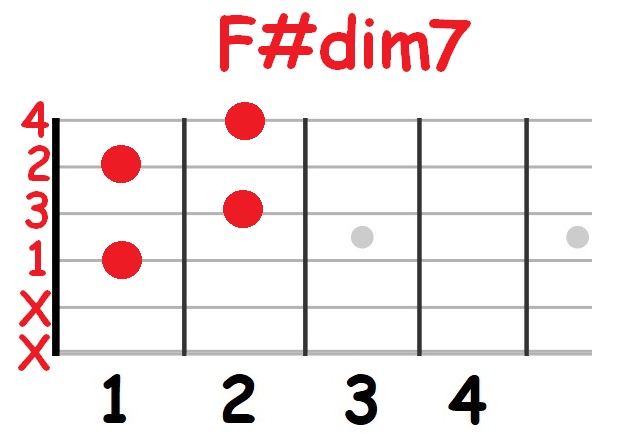
EX: A Cdim7 chord consists of C D# F# A. Adim7, D#dim7 (Ebdim7),
and F#dim7 have the same notes. If you play the chord shape on the
2nd fret, the "root" can be any of these 4 notes. As in, play it on
fret 2 and it can be any of the 4 chords. So, if you slide it up to
fret 5, it's still the same notes, different order, or chord voicing.
5th fret, is it an F#dim7, or Adim7?
ANSWER: YES! Either/and/or!
The Dim7 chord is used to resolve to another chord. And because of this
interval spacing, you can resolve to any major or minor chord a half-step
up, or down from any of the notes in the chord.
F#dim7 CHORD WITH MAJORS
F#dim7 F F#dim7 G
F#dim7 G# F#dim7 A#
F#dim7 B F#dim7 C#
F#dim7 D F#dim7 E
4 CHORDS WITH MAJORS
F#dim7 F F#dim7 G
Adim7 G# Adim7 A#
Cdim7 B Cdim7 C#
D#dim7 D D#dim7 E
1 CHORD WITH MINORS
F#dim7 Fm F#dim7 Gm
F#dim7 G#m F#dim7 A#m
F#dim7 Bm F#dim7 C#m
F#dim7 Dm F#dim7 Em
4 CHORDS WITH MINORS
F#dim7 Fm F#dim7 Gm
Adim7 G#m Adim7 A#m
Cdim7 Bm Cdim7 C#m
D#dim7 Dm D#dim7 Em
In this workshop, we'll be using the Dim7 chords. If we stack FOUR
notes instead of only 3, we get a Dim7. Cdim is C Eb, Gb. Add the Bbb,
or, A, you have Cdim7.
That, in turn, means if you play a Diminished 7th chord on just 3
consecutive frets, say, frets 2, 3 and 4, you have literally
played all 12 Diminished 7th chords!
There are 3 main Dim7 chord shapes, each based off of one string. 6, 5 and 4.
We'll use just one very common, and very easy to play form in this workshop.
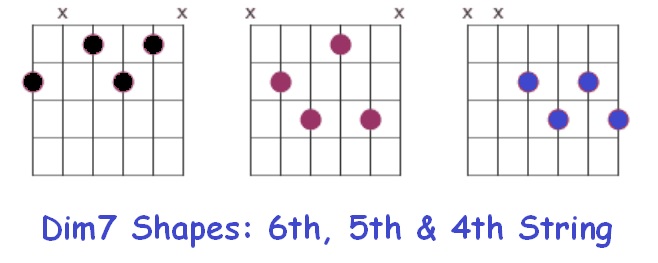
And here's some REALLY cool news! Learn this "shape", and you literally get
2 chords in each fret! Just play the "shape" on the next set of lower strings
and you get a really sweet chord form, the m7b5! Minor 7 flat 5! It's a TWOFER!

NOTE: The m7b5 is not symmetrical. But it's the same "shape" as this Dim7.
I'll cover this more in the new tutorial/workshop.
If you lower any note of a Dim7 chord a half-step, you get a Dom7 chord.
Drop D# to D: D#dim7 D7 D7 G
Drop A to G#: Adim7 G#7 G#7 C#
Drop C to B: Cdim7 B7 B7 E
Drop F# to F: F#dim7 F7 F7 Bb
I'll also cover this in detail in the new Dim tutorial that's in the works.
In this workshop we'll use 1 chord shape, starting on the 2nd fret.


In the exercises below, you play the major chords using the 4
string "F" shape. 3rd and 15th frets.
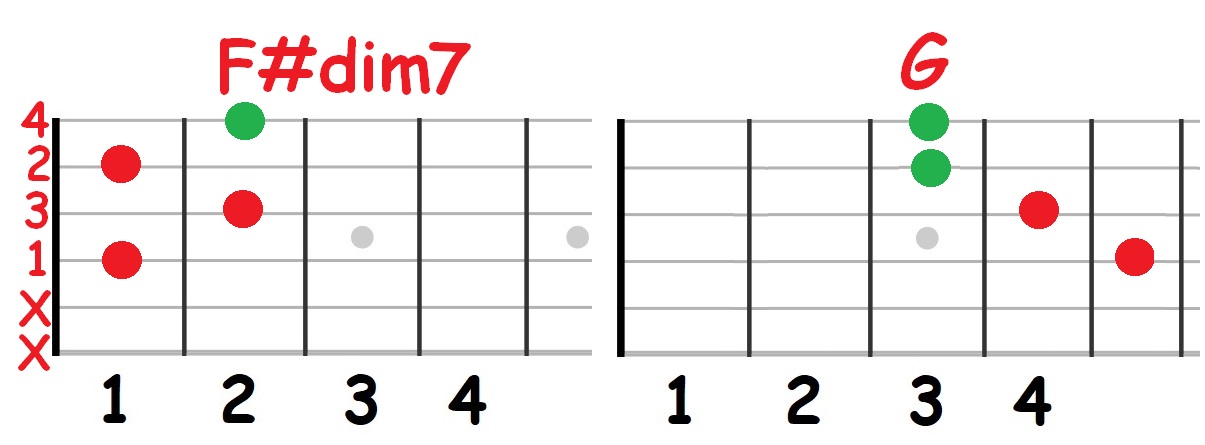
Ex #1: F#dim7 Adim7 Cdim7 Ebdim7 F#dim7 G ! Then back down.
EX #2, same as #1 but gets progressively faster. UP then DOWN.
EX #3: Strum 2 measures of F#dim7, then play G and hold it.
Then slide up to Adim7 for 2 measures, then strum and hold Bb.
Contiunue to Cdim7 / Db, Ebdim7 / E and F#dim7, G hold . . .
Each time you repeat the 5 chord pattern, you "cut it in half"!
Strum ONE measure of F#dim7 G hold, etc. Next iteration, strum
F#dim7 G in ONE measure. Last iteration, play all 5 dim7 chords
2 per measure.
F#7dim ''' '''' G hold '''
Adim7 ''' '''' Bb hold '''
Cdim7 ''' '''' Db hold '''
Ebdim7 ''' '''' E hold '''
F#dim7 234 G hold 234 1234
F#dim7 ''' G hold '''
Adim7 ''' Bb hold '''
Cdim7 ''' Db hold '''
Ebdim7 ''' E hold '''
F#dim7 234 G hold 234 1234
F#dim7 ' G hold '
Adim7 ' Bb hold '
Cdim7 ' Db hold '
Ebdim7 ' E hold '
F#dim7 ' G hold '
1234
F#dim7 ' Adim7 '
Cdim7 ' Ebdim7 '
F#dim7 ''' G hold
Ex 3:
Ex #4 is like the beginning of Ex #3, except you arpeggiate
each chord the 1st measure, strum the next. 3 iterations,
each increasing in tempo.
Sounds like . . .
Ex #4:
ARPEGGIOS: Play it in all 5 positions
Workout Section
Ex #1: F#dim7 Adim7 Cdim7 Ebdim7 F#dim7 G ! Then back down.
EX #2, same as #1 but gets progressively faster. UP then DOWN.
Ex 3:
Ex #4:
ARPEGGIOS: Play it in all 5 positions
to drop me a line. Email me, or drop me a PM on Facebook!
Email me any time! ~/~ Wayne on Facebook
Tutorials & Workshops Home Page
My Band and Personal Website
Check out my Support Group
Musicians and Performers Support Group
My main Backing Tracks Support Website with over 43,813
free MIDI, KAR and BIAB bacing tracks! SoundFont, MIDI
editors and players and more! 260+ WEB PAGES!
All distributed for free!

Visit the MidKar website!
Please consider making a small donation to help us keep MidKar
online. MidKar relies on your help because we are not monetized!
Membership, and all 43K MIDIs, KARs and BIAB files are FREE! As
are the tutorials & workshops. Thank you for your support! Wayne
Click the PayPal link if you'd like to help!