
Key of C / Am Summary!
C is the easiest key to work in, because it has no sharps or flats.
Recognizing intervals, and chord phrases and progressions!
~~~~~~~~~~~~~~~~~~~~~~~~~~~~~~~~~~~~~~~~~~~~~~~~~~
There are 12 notes. And a "key" is simply 7 of these notes.

The Chromatic scale is nothing more than all 12 of
the keys on a keyboard.

Read it and say it out loud now! C Dflat D Eflat, etc.! 3 TIMES!
C Db D Eb EF Gb G Ab A Bb BC
Guitar, or other fretted instruments, have the same repeating
pattern on every string! But the pattern starts on a different
note on each string.

This isn't a "key". It's simply all of the notes.
2 places where there is no black key between white keys B&C, and E&F.
These notes are one half step apart.

A half step, or half tone is one note up or down to the next note.
On guitar, or a fretted instrument, it's one fret up, or one fret down.
An interval is the distance between notes. Like a half step, or a
whole step. Listen to some half and whole steps.
Here are 2 notes, a half step apart. C and B. BCBCB CBCBC
And here are two notes a whole step apart. C and D. CDCDC DCDCD
OK, key of C . . . the white notes on the piano!
Starting from C, go up the white keys until you get to C again.
The Relative Minor
Add just one more chord, the ii, or 2nd chord of the scale, we can
Nearly all songs written in the key of C will only have these
Most of the notes in the melody and in the harmony will be contained
There are two specific chord scales. One is a 3 note, triad chord scale.
With that in mind, going back to the regular 3 note triads. The 5th
It's done so often, most people think there is a G7 in a regular
You're going to be one happy camper if you followed my instructions!
So, starting with G, moving up using the pattern, you will get . . .
Each chord position has a name, and a number! The positions are
BOOKMARK this page! Take a week or two, and hit this summary every day!
If you want to do this, and understand it a bit better, if you want to
Please help keep us online with a small donation!
Much of what you will do is based on both major 3rds and minor 3rds.
All melodies and chords are made up of a small number of notes, all
spaced "mathematically" to create a specific feel. Up or down? Happy
or sad? Excided or bored?
Major chords, major scales, major 3rds are "UP". Minor chords, minor scales,
minor 3rds are "DOWN". The actual word "minor" implies "less than". Or
"lower than". Just like a half step is lower, or less than a whole step.
A 3rd is the 3rd note in a scale. C D
EF G A BC is a C Major scale.
In the key of C, if we want to refer to Eb, which isn't a note in the scale,
we'd call it a minor 3rd because it's a half step down from E. It's Eb!
Minor chords have minor 3rds! (This should be an "AaaHaa Moment"!)
A C major chord is 3 notes: C E G. A Cm chord, you guessed it! C Eb G!
C Major & C minor chords
READ IT 3 TIMES OUT LOUD!
C Db D Eb EF Gb G Ab A Bb BC
C to E, moving from the 1st note C, past the 2nd note D, to the 3rd note,
E! Going from C to D is a major 2nd.
If we join two whole steps, we get a major 3rd. C Db D is 3 notes. Each is
a half step apart. So C to D is a whole step, Then D Eb E is 3 notes,
a half step apart. So, D to E is a whole step. Therefore, C to E is 2 whole
steps! C D EF G A BC. C to E is moving from the 1st to the 3rd. A major 3rd!
If we join a whole step with a half step, we get a minor 3rd. Let's move
from the E to the G. E F Gb G. E to F is a half step. (No E# or Fb).
F to G is a whole step. (F, skip Gb, to G). So, E to G is a minor 3rd!
READ IT 3 TIMES OUT LOUD!
C Db D Eb EF Gb G Ab A Bb BC
YOU'RE ONLY CHEATING YOURSELF IF YOU DON'T DO THIS!
The clip plays a series of half and whole steps, minor and major 3rds.

All chords are just stacked 3rds! Major chords have major and minor 3rds.
C D E F G A B C C Major scale. To make a chord, just start with a note in
the major scale, and go every other note. C skip D to E. E skip F to G.
CEG is a C major chord. Start on D, go evey other note, D F A, Dm.
This holds true for moving chords as well. Play a full E form, 6th string
root barre chord on the 8th fret, it's a C chord. Now move it a major 3rd,
or 4 frets, and it's an E chord!
A melody is just a combination of intervals!
The first part of this tutorial is all about the major scale. Everything
in music comes from the major scale.
Here is another example of whole steps and half steps, but played
together in sequence, so you can hear a whole and half step together.
CDC CDbC CDC CDbC DED DEbD DED DEbD
Listen to the difference between a C major and a C minor chord.
The difference between them is just one half step. The C major
chord is C E G. Cm is C Eb G.
There are 4 Qualities of a chord. Major, minor, Diminished and Augmented.
A C major chord is the 1st, 3rd and 5th note of the C major Scale. CEG
A Cm would be the 1st, FLATTED 3rd, or minor 3rd, and the 5th. CEbG. A
Listen to the C major and C minor chords again. Now you know
the notes you're listening to are C E G & C Eb G.
More on this later. I just want you to hear the difference now.
So, what makes a key, a KEY is the space between each note! Most of the
notes in the major scale are a whole step, or whole tone apart. But 2
sets of notes are only a half step apart. B & C, and E & F.
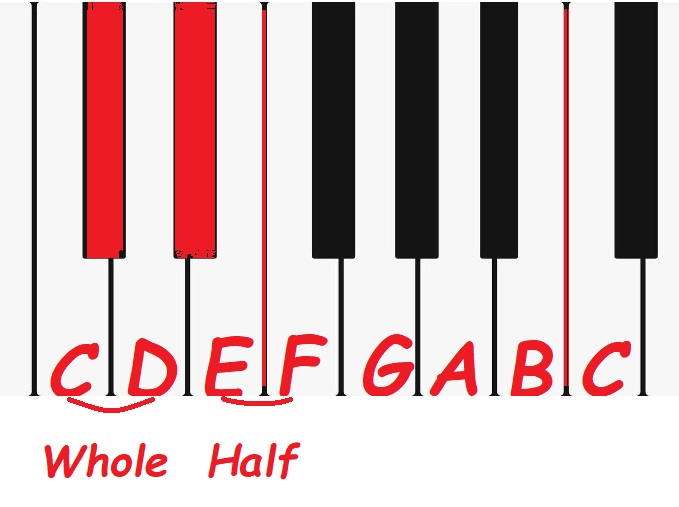

This is your first "pattern" or formula to learn. In a major scale,
there is a half step between the 3rd and 4th, and the 7th and 8th
notes of the scale. There is a whole step between the others.
A C major scale is C D EF G A BC. There is a whole step between
C and D. There is a black key between them. So going from C to D,
you skip a note. The black key. Going from D to E, same thing. There
is a black key between D and E.
Now look at E to F. NO BLACK KEY BETWEEN THEM! There is a
half step between E and F. No note in between them!
F to G. Whole step. G to A whole step. A to B whole step. B to C, no
black key between them. There's a half step between B and C.
In C, the half steps naturally fall on the 3rd & 4th, and 7th & 8th
notes! The key of C has no sharps or flats. All other keys have at least
1 sharp or flat!.
Learn this pattern. Say it over and over! WWH WWWH:
WHOLE WHOLE HALF WHOLE WHOLE WHOLE HALF!
Here's the major scale, but broken up a bit. It plays in groups of 2.
So you hear the intervals between each set of notes.
The audio plays like this . . .
CDC (W) DED (W) EFE (H) FGF (W) GAG (W) ABA (W) BCB (H) CDC (W)
Look at the picture again!
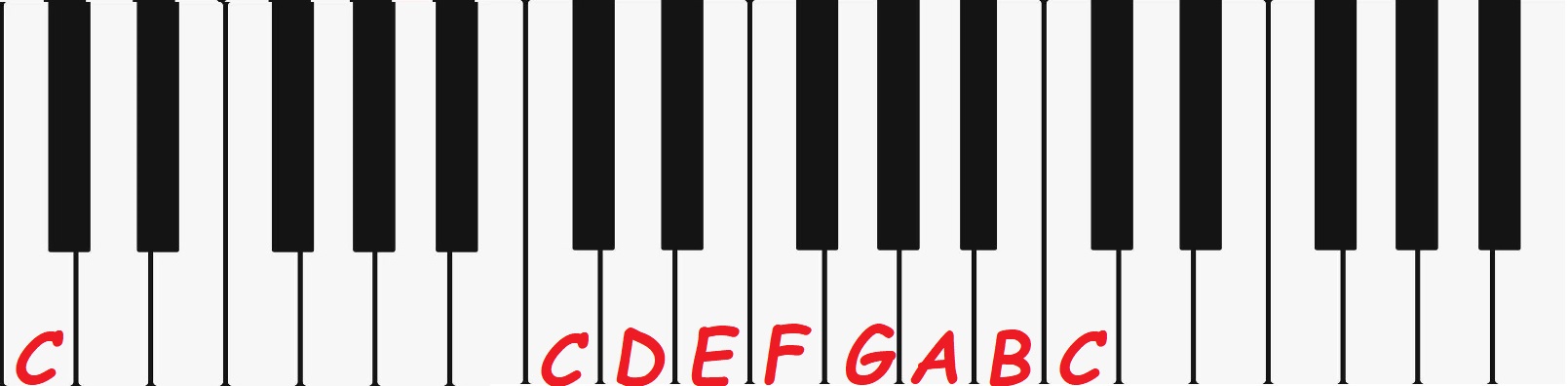
From these 7 notes . . . EVERYTHING IN MUSIC is built! All of the chords
come from these 7 keys, 7 letters! 7 notes.
The notes in the key of C are: C D EF G A BC That's it! Hum them, it
should sound familiar! do re mi fa so la ti do Remember
singing that as a kid in school?
Chord Scales: Play the "do re mi" notes as chords. C Dm Em F G Am Bdim
(diminished). All songs in the key of C will use some of these 7 chords.
Once you determine what key the song is in, you just need to figure out
the chords from a list of 7 chords, not dozens! The chords will usually
be in the key's chord scale!
This is a C major chord scale. C Dm Em F G Am Bdim
It's important to learn the sound of chord patterns, the most basic
progressions used in most songs!
The three most common progressions: The I IV V (145) is the 1st, 4th and
5th chord in the chord scale. In C, it's C F G. Keys have 3 major chords.
It can be played many different ways. This is just one. Followed by
a I vi IV V (1645), then a I vi ii V (1625). We just added the 6th and
2nd chords of the chord scale.
The clip plays as follows: C F G F C F G F C ~ C Am F G C Am F G C and
C Am Dm G C Am Dm G C. Then it plays them in simple form. Followed
by just the 4 and 2, F Dm. F Dm F Dm C.
LEARN TO HEAR THE PATTERNS!
Every key has one scale that shares the same notes as the root scale.
It's called the Relative Minor. In C, it's Am! There is an Am scale
"inside" of the C major scale!
C D EF G A BC D EF G A BC
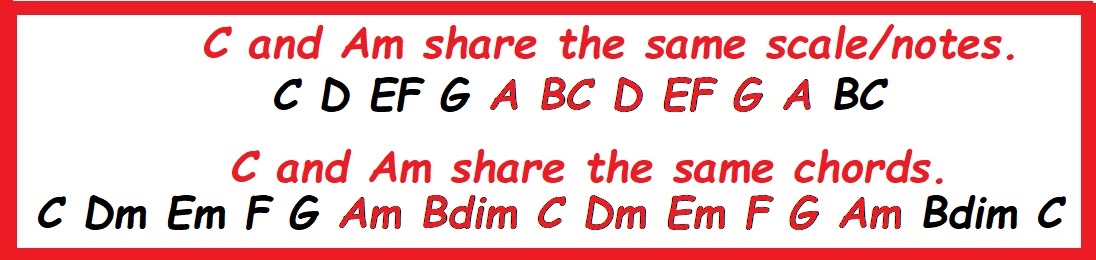
Most songs are either in a major key, or in a MODE of the key.
Some modes are major, some are minor. The most common songs will
have the 3 major chords of the key. And MANY will also have the
Relative Minor chord! Am is the 6th chord in the C chord scale.
In C, the major chords are C F G. A Bazzilion songs have been
written using just the 3 major chords of a key. These chords are
the 1st, 4th and 5th chords of the key's chord scale. Thus, we have
what's called a I IV V (1 4 5) chord progression! The most common progression.
Country, Folk, Gospel, Blues, Rock! Almost all music genres have
some, if not mostly 145 songs! Here's a Swing example.
This is a Swing I IV V in E. The key of E has E A & B. The progression
is a straight I IV V, standard format.
[E '''] [E '''] [E '''] [E ''']
[A '''] [A '''] [E '''] [E ''']
[B '''] [A '''] [E '''] [B ''']
Many songs have 4 chords. Two progressions are used more than any others.
In the key of C, Am and Dm are the most common. Em is also common.
C Am F G and C Am Dm G are the most common progressions, going back
as far as history was recorded!
So, adding to the exceedingly common I IV V, is the addition of the
6, expressed as vi. Lower case Roman Numeral 6, because it's a minor.
C Am F G is a I vi IV V (1 6 4 5). The trick to being able to hear a
song, and being able to play the song before it even finishes is . . .
Recognizing chord progression "patterns"! So, now, when you hear a
song, you will start to recognize I IV V and I vi IV V chord patterns!
The progression here is C Am F G
literally play 100s and 100s of songs! In C, the 2 chord, or 2nd
degree of C is . . . Dm. If we substitute the ii chord for the IV chord,
we get . . . C Am Dm G. A 1 6 2 5. And THIS is one of the most common
progressions ever used!
It's actually called . . . The 50's progression! C Am Dm G
7 notes. With a few exceptions. Straight out Jazz and songs with
a lot of chords will often have notes outside of the key. And we
sometimes "alter" a note in the key to make some chords.
The major scale pattern is WWH WWWH. Let's build a C major
scale, without looking at the piano keyboard above. Don't cheat!
You haven't yet memorized the full Chromatic Scale. So if I say
"Go up a whole step from C", you won't know what note is a
whole step up. SO . . . Let's use the Chromatic Scale.
Chromatic Scale using flats . . . 2 OCTAVES!
Say it out loud, forward and backwards!
C Db D Eb EF Gb G Ab A Bb BC Db D Eb EF Gb G Ab A Bb BC
Now, using the W W H W W W H pattern, we'll start with C, and
build a C major scale!
C, up a Whole Step: C Db D. D, up a WS: D Eb E. E up a HS: EF.
F up a WS: F Gb G. G up a WS: G Ab A. A up a WS: A Bb B. B up a HS: BC.
OK, now let's see what we can do with the major scale! How about . . .
Building Chords!
in the major scale the song is in. So if you're trying to figure out
the notes to play on guitar, trying to figure out the melody, you
now know that the notes will be C D EF G A BC if the song is in C!
Same for the notes for a harmony. The harmony notes are ALSO all in
the major scale! You just need to learn where the harmony comes from!
Building a C Major Harmony Chord Scale!
The other is a 4 note, with 7ths, Jazz chord scale. You build them both
the same identical way! Let's do a triad chord scale!
It's technically called "stacking 3rds". You just skip every other note!
We start with the major scale, then use every other note to make our
chords! C D EF G A BC
START WITH C, THEN GO UP EVERY OTHER NOTE, 2 TIMES! This is what you get!
C (skip D) E (skip F) G. CEG is a C major chord! Now go to D and repeat.
D (slip E) F (skip G) A. DFA is a Dm chord! Go to E!
E (skip F) G (skip A) B. EGB is an Em chord! Go to F!
F (skip G) A (skip B) C. FAC is an F chord! Now go to G.
G (skip A) B (skip C) D. GBD is a G chord! Now go to A.
A (skip B) C (skip D) E. ACE is an Am chord! Now go to the odd ball! B!
B (skip C) D (skip E) F. BDF is a B diminished chord! Bdim.
If you played the chords C D E F G A B C, and sang the notes of the
C major scale, it would sound really bad! Some notes would match,
but others would clash badly! Because of the intervals. If you sang
the major scale over the chord scale, it would sound PERFECT!
C Dm Em F G Am Bdim. These are the chords that will match up to
the notes in just about any song you can imagine! If you know
the chords in a song, the melody notes will usually be in whatever
chord is being played during that note! And the harmony will be one
of the other notes in the chord!
If you're singing over an Am chord, the melody notes will most
likely be an A, C or E. The other 2 notes will be your harmony!
NOTE: The notes COULD be one of the other notes in the scale!
Now we'll make some really cool chords! We do this exactly the
same way as above, EXCEPT we do it 4 times! We simply go one more
time, to get the 7ths! And in the process, we'll cover that ONE
EXCEPTION I mentioned earlier! The Jazz Chord Scale!
Start again with C, and make our C major chord, then go one step
further, and make a Cmaj7!
C skip D to E. E skip to G. CEG is a C major chord. Now go one more
time! G skip A to B. CEGB is a Cmaj7 chord! It's a pretty, jazzy
version of the C major chord.
Now do it for the D. You get DFA like before. Then one step more,
and you get: A skip B to C. This is a Dmin7! Now keep going for
the rest of the chord scale.
This is building the 4 note, with 7ths Jazz chord scale. The
chords are a lot prettier! Cool sounding! And this is the scale
you get when you do them all!
Cmaj7 Dm7 Em7 Fmaj7 Gdom7 Am7 Bm7b5. Now for the exception!
You can substitue any of the chords from one scale to the other.
It just depends on how you want the song or progression to sound.
Jazz it up. Take a simple ballad using triads, and substitute the
chords from the Jazz scale, and you get something a lot sweeter!
C Am Dm G becomes Cmaj7 Am7 Dm7 G7. And it sounds SO much cooler!
C Cmaj7 Am Am7 Dm Dm7 G G7 C Cmaj7
chord of the C major chord scale is a G major. A very common switch,
almost done in every song, is to substitute the 5 chord of the triad
scale, in this case, a G major, with the 5th chord of the Jazz scale!
Again, in this case, the G7!
THE DIFFERENCE IS SUBTLE, BUT MORE SATISFYING.
G ' C G7 ' C G ' C G7 ' C
3 note C major chord scale. There is not. The reason we usually
substitute the G7 for the G is because G7 resolves back to the C
major chord much better than a plain old G triad!
You now can make any chord scale you want. Albeit, you'll need to
know the Chromatic Scale written with flats, too! It's the same
exact notes. The black keys simply each have 2 names! And the name
100% is determined by the KEY you're in! Like the G above, using F#,
instead of Gb!

So here it is!
Yup . . . Say it 3 times, forward and backwards! C Csharp D etc.
C C# D D# EF F# G G# A A# BC C# D D# EF F# G G# A A# BC
~~~~~~~~~~~~~~~~~~~~~~~~~~~~~~~~~~~~~~~~~~~~~~~~~~
Once you nail the Chromatic Scale, there is another simpler way
write out scales, chord scales, etc. But you need to fully have
the Chromatic Scale nailed down!
To write out any major scale, just start with the root, the key you want,
and simply write out each of the music letters, A through G!. Let's do
the key of D!
START THERE. JUST WRITE OUT ALL OF THE "LETTERS".
D E F G A B C D. Then apply the WWH WWWH pattern to the letters/notes!
D to E is a whole step. Cool. E to F is only a half step! So we make
the F an F#! F# to G is a half step. Cool. G to A is a whole step.
Also cool. A to B is a whole step. Cool! B to C is a half step. NOPE!
So make the C a C#. C# to D is a half step. PERFECT! WWH WWWH!
D E F# G A B C# D

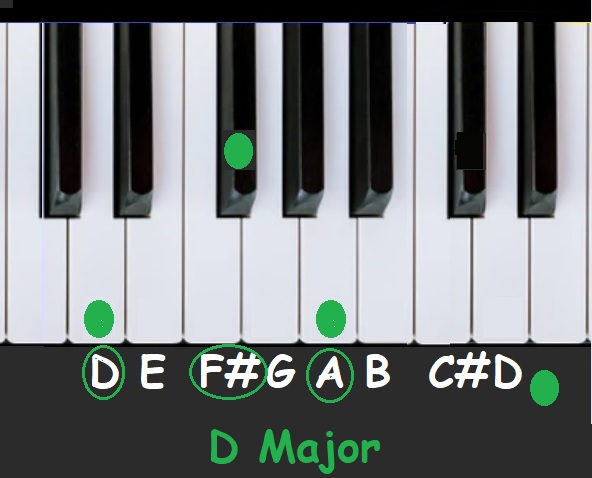
Now simply apply the chord pattern, and you'll have a D major chord
scale! Maj min min Maj Maj min Dim.
D Em F#m G A Bm C#dim D! BINGO!
This isn't rocket science. It's just knowing and understanding some
basic patterns and formulae.
~~~~~~~~~~~~~~~~~~~~~~~~~~~~~~~~~~~~~~~~~~~~~~~~~~
I want to cover just one more important thing now. Using a number
system to know what chords to play.
There is no beginning nor end to the Chromatic Scale. You start from
any place in the scale, and use the WWH WWWH pattern, just like C.
It's a LOOP! And goes round and round and round! So let's start with G!
Because G is a "sharp" key, I'd usually use the sharps version of the scale.
But I'm going to stick with the flats version this time so I can show you
something you will need from time to time! Mainly when you're trying to
transpose a song to a different key! So . . .
Say it out loud, forward and backwards!
C Db D Eb EF Gb G Ab A Bb BC Db D Eb EF Gb G Ab A Bb BC
Because by now you're getting the Chromatic Scale planted in the old
cranium! And in a few minutes, you're going to find out how to use it
to totally change your current level! Almost INSTANTLY!
How would you like to know every note on your fretboard without taking
forever and a day to learn it! Well, you will soon!
Key Of G Scale and Chords!
G A B C D E Gb G. But we make the Gb an F#, because you cannot have
2 of the same letter in a major scale. Ever! And F# is the same note,
same black key as Gb. Some keys have sharps, some have flats. And THIS
is the reason why! You can't have a Gb and a G in the same major scale!
NOTE: This is one of the iron clad, no exception rules. You must have
one of each of the 7 letters in your major scale. But ONLY one! They
can be flats, or sharps or not. But you must have ONE A B C D E F & G
IN YOUR MAJOR SCALE!
So . . . now you have a G major scale. You make the chord scale the
same way! Start on G, and go every other note. GBD is a G major. Then
go to the A, and you get ACE, Am.
Or simply apply the chord pattern to the G scale! The chord pattern
will always be the same! Maj min min Maj Maj Min Dim.
So . . . G Am Bm C D Em F#dim is your chord scale! And it's exactly
the same for ALL keys! You do it exactly the same way!
OK, so you decide to learn a song you've wanted to play for a long time,
but couldn't figure out the chords. So you listen, keys, or guitar in
hand. You figure out the tonal center, and determine you're in the key
of A. NO PROBLEM!
You know the Chromatic Scale. You know WWH WWWH! And guess what?
You ALSO RECOGNIZE THE CHORD PROGRESSION PATTERN NOW!
This time when you listened to it, you recognized and knew INSTANTLY
that it's a I vi ii V (1625) in A! So now, because you know the
Chromatic Scale, you just start from A. Mentally apply WWH WWWH,
write down . . .
A Bm C#m D E F#m G#dim. Then you circle A F#m Bm E. But you want to
make it sweeter! So you decide to use the Jazz scale! . . .
Amaj7 Bm7 C#m7 Dmaj7 E7 F#m7 G#m7b5. DONE!!!
Getting ready for band rehearsal, you take about 2 minutes and figure
out the harmony "Ahhhs" and "Oooos" for the other guys. You write down
Amaj7: A C# E G#. F#m7: F# A C# E. Bm7: B D F# A. E7: E G# B D. BINGO!
See how this all works!

Roman Numeral Number System
called Scale Degrees. As in, the 2nd chord in C is Dm. Dm is the TWO
of C. The 2nd degree of C. The ii.
We use Roman Numerals to name the chord positions as a way to be able
to identify the chords of one key, and substitute them, pretty much
without thinking, to another key!
Major chords use upper case Roman Numerals. Minor chords use lower case.
So, a C major chord scale could be written out like this . . .
I ii iii IV V vi vii°. If you're in the key of C, the most common chord
progression in all music is a I IV V. (1 4 5) The 1st, 4th and 5th chords
in the chord scale. Basically, the 3 major chords. In C, that'd be . . .
C F G! And if you learn the number system, C is I. F is IV. G is V. If
you want to change the key to say, the key of A, you have . . .
A Bm C#m D E F#m G#dim. A I IV V would be A D E. Or maybe it's a ballad,
and has some minor chords. Most common progressions are I vi IV V (1645)
and I vi ii V, 1 6 2 5. In A, that would be A F#m D E or A F#m Bm E.
Now change it back to the key of C. C F G, C Am F G and C Am Dm G.
So, if I said, it's a I vi ii V in G, you would think . . .
G Am Bm C D Em F#dim G: G Em Am D.
Ever wonder how some of your buddies can hear a song, and figure it out
while it's playing, and have it all worked out by the time the record
finishes? THAT IS HOW! We recognize PATTERNS! We listen, and hear the
progression "pattern"! The song starts. I quickly figure out it's in the
key of D. And I hear the pattern. Maybe it's a I vi ii V. So I know the
chords are going to be . . . D Bm Em A. EZPZ!
But all songs aren't simply I IV V, or I vi ii V progressions! And what
about choruses, and bridges! How about intros and outros!
It's the same thing. Chord patterns. INTERVALS! I hear 2 chords. One
is a major and the other is a minor. I'm in the key of C. So I know
the minor is most likely Am. Might also be Dm or Em. So I listen to the
interval. I hear the major chord, and it's C. And I listen. A Dm will
be a major 2nd from C. 2 frets up. Em will be a major 3rd, 4 frets.
And an Am will be a minor 3rd DOWN 3 frets. (same as 5 up).
It will take time, and practice. But now the confusion is GONE! You
now know what's going on "musically"! Put it to work!
I hope this was useful! And I hope you read it over, and over! Until you
get it! Because once you do, you will start learning SO MUCH faster! You'll
hear a song playing and almost immediately know the key it's in. You will be
able to figure out the most likely chords in the song. And start playing
the song before it's even finished playing!
It will also help you if you like to write songs!
I'm going to stop here! Once you get a handle on this one, jump over to
the key of G. It's going to be MUCH shorter! MUCH shorter
than this shorter summary! And super easy to digest. It's all the same!
Same patterns! Same notes. Just a different key!
So I won't need to do much explaining. I'll assume you read this one first!
There's a LOT less text!
One more thing. Yeah, this was long. And the full C tutorial was longer!
But there's a LOT of really cool stuff I left out! Really cool chord
progressions! More detail about how chords are made. Like, when I said
in the key of C, the 2nd chord was a Dm. WHY! And there's info about how
keys "overlap"! You'll see when and how some keys have sharps, others
have flats! And how to know which have what! And it's not difficult!
I strongly recommend spending time reading that full overview! Once you get
past a few more keys. Or even now! If this one makes sence to you, then just
move to the full Music Theoey 101 Overview tutorial now! It will totally
eliminate any questions you still have!
Music Theory 101 Overview
~~~~~~~~~~~~~~~~~~~~~~~~~~~~~~~~~~~~~~~~~~~~~~~~~~
THEN . . . move on the G!
Again, the other tutorials are WAY SHORTER!
Click here to go to The Key Of G Page!
Key of G/Em EZPZ Page
Click here to go back to the Select a KEY page!
Select A Key Page
~~~~~~~~~~~~~~~~~~~~~~~~~~~~~~~~~~~~~~~~~~~~~~~~~~
understand all of the "why it works" stuff, then check out the full
Fretboard 101 tutorial!
Fretboard 101
~~~~~~~~~~~~~~~~~~~~~~~~~~~~~~~~~~~~~~~~~~~~~~~~~~
Hope you found this interesting. If you did, please feel welcome
to drop me a line. Email me, or drop me a PM on Facebook!
Email me any time! ~/~
Wayne on Facebook
Go here for the summary!
Back to HOME Page
COMING SOON! The Key Of G Page!
Key of G/Em EZPZ Page
Click here to go back to the Select a KEY page!
Select A Key Page
Check out my Backing Track Support Group
MidKar-BackTrax-MIDI-Website-Group
My main Backing Tracks Support Website with over 43,813
free bacing tracks! SoundFont, MIDI editors and players and
more! 260+ WEB PAGES! All distributed for free!

Visit my MidKar websie!
This site is free for all. The tutorials, workshops. 43,813 MIDI, KAR &
BIAB backing tracks files, 23 BIAB User Styles. A FREE SoundFont,
Timbres of Heaven. Free MIDI players and editor!
The fees for a site this large (Nearly 200 pages with over 50K files)
is pretty high, as you can imagine.
Please consider making a small donation to help keep us online. It
would help so much! Thanks! Wayne
PS: I pay for the site and all hosting, security and domain related
expenses out of pocket. Donations appreciated. Please click the link below.