HOW WOULD YOU LIKE TO BE ABLE TO PLAY ANY SONG, IN ANY KEY!?!
Nail this workshop, and guess what? You WILL!
If you WORK this tutorial, follow it as detailed, do not skip parts, and practice
it totally, within a short time you will master the key of F! Actually, master is a bit
strong! That will depend on how much you work it! But you will see dramatic
improvement within a few short weeks!
There are 5 sections to this tutorial. 1 through 5. Each one should be worked on
until it’s fairly easy for you to play it! SLOWLY! With a metronome set to SLOW.
Slow enough for you to be able to play each measure on time! Smoothly!
You do not need to be able to play it fast! Only slowly and accurately, in time!
Each one of the 5 could take you days, maybe a couple weeks! Don’t rush it!
One more time . . . Don’t go on to #2 until you can do #1 smoothly, and in time!
Same with the others. Do these one at a time!
NOTE: Once you get to where you can do #4, it REALLY STARTS TO GET
FUN! 5 is cool!
The Key of F. Every key has 7 notes in the major scale, and 7 harmony chords.
Everything you will ever do in music comes from the major scale! You need to
be able to play it mindelessly! On auto pilot! Cleanly!
The 1st step in this workshop is nailing the major scale! This is a warm up
for you to do, over and over and over, every day, many times a day! Every
time you walk past your keyboard, PLAY THE MAJOR SCALE, up, and
down, a few times.
The following audio clips are 10 exercises. Each one is the same, except
for the tempo! Each starts at one tempo, and each time you start to play
the scale again, the tempo increases slightly! The scale will play 8
to 12 times, depending on the exercise. and the tempo is noticeably
faster the last time. Each exercise stars a bit slower than the previous
one. And gets a bit faster than where you were in the previous one,
after a few reps of the scale.
Start on the 1st one. If it's too slow for your present skill level, play
it through once anyway! Then move on to the 2nd one. If you can play
it perfectly, in time, and the speed is still too slow for you, when
you finish playing it, move on to the next.
When you come to one that you didn't NAIL perfectly, one that's maybe just
a little to fast for you to get through the whole thing, STAY ON THAT ONE!
You work on that one over the course of the next few days, or practice
sessions, until you can play it 100% accurately, and in time with the track!
Then move on to the next. It sould take you a few months to be able to get
through #10! Actually, #10 might take you considerably longer! Same with
8 and 9! Just keep working on them!
You can download all 10 by downloading the "10 MS Finger Exercises" zip
file! And play them on your PC or laptop. Or BOOKMARK this page, and
work them online!
You can also download any one of them by clicking on the 3 vertical dots
on the right side of the audio players.
 Left Click to "SAVE", Right Click to "SAVE AS"!
Click Here 10 MS EXES.zip Click Here
Here we go! Find which exercise you need to work on, and play it as
a warm up to the rest of the exercises below. NOTE: They get pretty
quick once you get to the cut time exercises, after 1 through 3!
1 FMS1 108-160 BPM
2 FMS2 128-198 BPM
3 FMS3 170-254 BPM
4 FMS4 CT 108-178 BPM
5 FMS5 CT 152-236 BPM
6 FMS6 CT 221-298 BPM
7 FMS7 CT2 136-270 BPM
8 FMS8 CT2 162-295 BPM
9 FMS9 CT2 190-355 BPM
10 FMS10 CT3 230-406 BPM
There is a diatonic chord scale and a Jazz 4 note harmony scale that include the
7ths. The chords are built on 3rds, meaning you start with one note, then go up
a 3rd to the next note, then continue on. Essentially, every other note!
Left Click to "SAVE", Right Click to "SAVE AS"!
Click Here 10 MS EXES.zip Click Here
Here we go! Find which exercise you need to work on, and play it as
a warm up to the rest of the exercises below. NOTE: They get pretty
quick once you get to the cut time exercises, after 1 through 3!
1 FMS1 108-160 BPM
2 FMS2 128-198 BPM
3 FMS3 170-254 BPM
4 FMS4 CT 108-178 BPM
5 FMS5 CT 152-236 BPM
6 FMS6 CT 221-298 BPM
7 FMS7 CT2 136-270 BPM
8 FMS8 CT2 162-295 BPM
9 FMS9 CT2 190-355 BPM
10 FMS10 CT3 230-406 BPM
There is a diatonic chord scale and a Jazz 4 note harmony scale that include the
7ths. The chords are built on 3rds, meaning you start with one note, then go up
a 3rd to the next note, then continue on. Essentially, every other note!
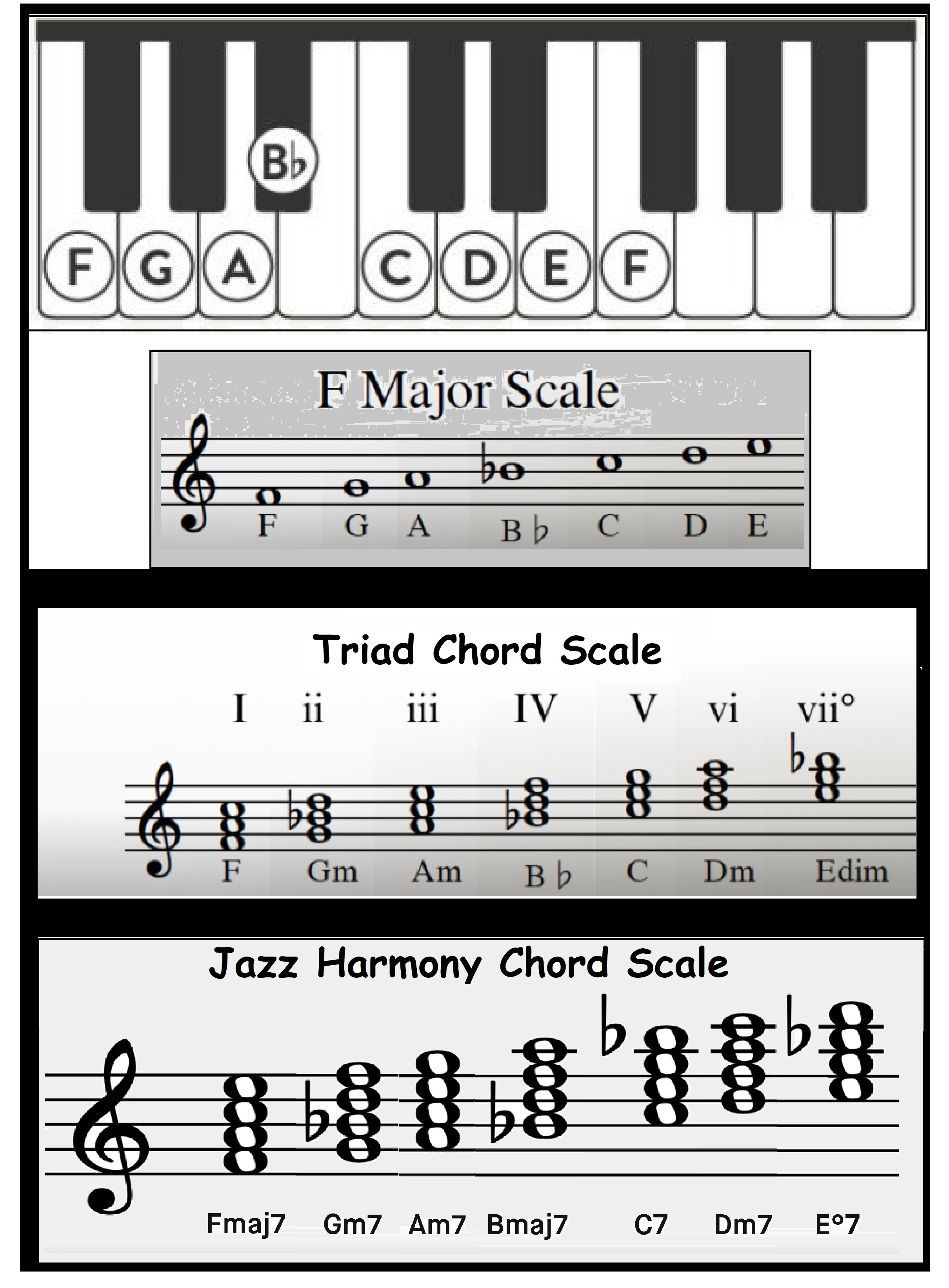 Play the F Major Scale now, and play it OFTEN! Every chance you get,
play it! Until you can play it smoothly, accurately! Every time you walk
past your keyboard, PLAY THE F MAJOR SCALE!
Play the F Major Scale now, and play it OFTEN! Every chance you get,
play it! Until you can play it smoothly, accurately! Every time you walk
past your keyboard, PLAY THE F MAJOR SCALE!


F G A Bb C D E F is an F Major scale. Start on F, skip up a 3rd to A, then one more
time to C. FAC is an F major chord. Go up one more 3rd to E. FACE is an F major 7th.
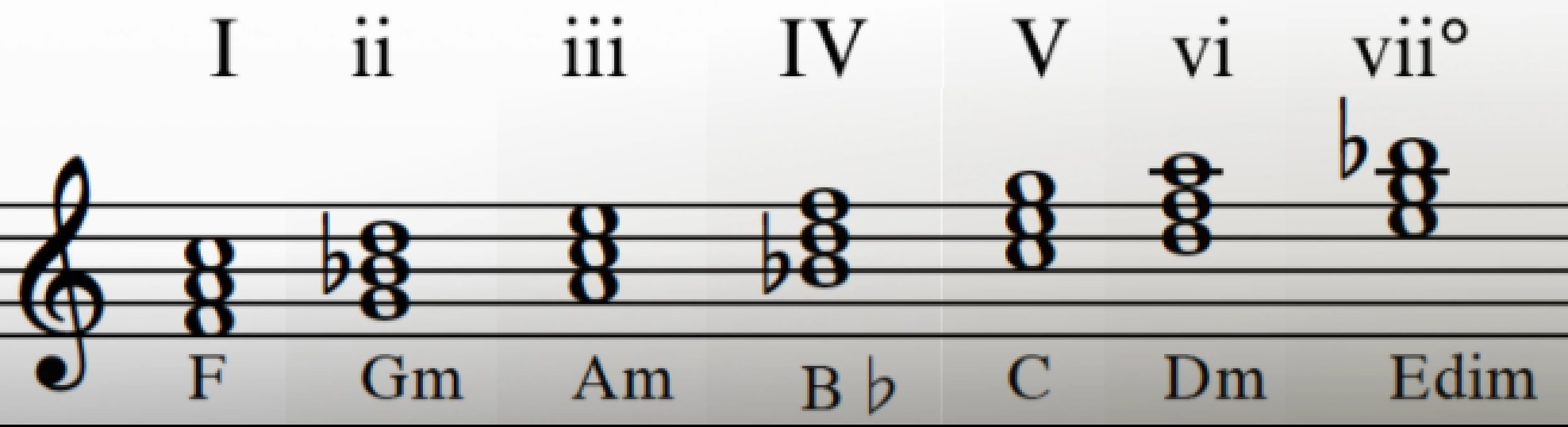
NOTE: We use Roman Numerals to number the 7 degrees of a scale. See the upper
graphic! Upper case for major, lower case for minor! I ii iii IV V vi vii
If you flat the 7th note to Eb, it becomes a Dominant 7th. FACEb is an F Fdom7.
Major 7ths have a Jazzy sound. Dom7ths have a Bluesy sound. Listen to the
audio clip below. It plays F Fmaj7 Fdom7 Bbm Fmaj7 Note: Bbm is not a chord
in the key of F. We sometimes “borrow” chords from the parallel key! So, we
play Bbm instead of Bb.
To get the next chord, go to the 2nd note, G, and go up every other note the same way you did for F. You get G Bb D, a Gm Start on A, same thing, A C E is an Am. Continue the same way for each of the 7 notes! Bb C Dm Edim. Practice Routine: Warm-Up The first thing you do before starting your practice routing is PLAY THE F MAJOR SCALE! Play it a dozen times to get warmed up. Play it 3 or 4 octaves! 12 times! THEN . . . Start with the diatonic chords in F Major: F (I), Gm (ii), Am (iii), Bb (IV), C (V), Dm (vi), and Edim (vii°). Use these chords as the foundation of your progressions. The notes for each chord are here . . . F: F G A Bb C D E F G A Bb C D E F FAC Gm: F G A Bb C D E F G A Bb C D E F GBbD Am: F G A Bb C D E F G A Bb C D E F ACE Bb: F G A Bb C D E F G A Bb C D E F BbDF C: F G A Bb C D E F G A Bb C D E F CEG Dm: F G A Bb C D E F G A Bb C D E F DFA Edim: G A Bb C D E F G A Bb C D E F EGBb The Jazz, 4 note chords in F Major: Fmaj7 (I), Gm7 (ii), Am7 (iii), Bbmaj7 (IV), Cdom7 (V), Dm7 (vi), and Em7b5 Fmaj7: F G A Bb C D E F G A Bb C D E F FACE Gm7: F G A Bb C D E F G A Bb C D E F GBbDF Am7: F G A Bb C D E F G A Bb C D E F ACEG Bbmaj7: F G A Bb C D E F G A Bb C D E F BbDFA Cdom7: F G A Bb C D E F G A Bb C D E F CEGBb Dm7: F G A Bb C D E F G A Bb C D E F DFAC Em7b5: G A Bb C D E F G A Bb C D E F EGBbD Chord Progressions
All songs consist of variations of the chords of the scale. The melodies dictate which chord is used. Some notes that aren’t in the chord can usually be added to the chord, making it an extended chord. For instance, in the key of F, if the chord for the measure is F, and a G note is sung, you could add a G note to the Fmaj chord. A G is the 9th note. F A C G is an F(add9). There are only so many combinations of 7 chords, creating a variety of chord phrases. Learning the most common “phrases”, or combinations of chords will pretty much have you playing most songs in any key. Therefore, you need to practice ALL combinations of ALL chords in whatever key you’re working on! The following are the most common chord combinations you need to work on, in an organized routine. You start by playing the diatonic chord scale up, then down, Root on the bottom). As in for Fmaj you play F A C. An inversion is the order the notes of a chord are played. Just as FAC is an F major, so is ACF or CFA. The 3 notes create an Fmaj. There could be other chords created by playing an inverted chord. For instance, playing an Fmaj7, FACE, then playing the 1st inversion ACEF could be a form of an A minor chord with an F on top. F is the 6th of an Am scale. And the same notes, FACE could be an Am (ACE) with an F bass note. Am/F. When a chord shares the same notes as another chord, C6 and Am/C for example, you would name the chord based on the context in which it is used. So, to start, play F Gm Am Bb C Dm Edim F, in 4/4 time, 4 counts per chord, one chord per measure. 1: Major Chord Scale [: [F ‘’’] [Gm ‘’’] [Am ‘’’] [Bb ‘’’] [C ‘’’] [Dm ‘’’] [Edim ‘’’] [F ‘’’] [F ‘’’] [Edim ‘’’] [Dm ‘’’] [C ‘’’] [Bb ‘’’] [Am ‘’’] [Gm ‘’’] [F ‘’’] :] Repeat from the beginning
This is your warm up, play it several times. Do not move on to #2 until you can play this! Set the metronome to SLOW! So you can play each measure in time! When you can, move on to #2. 2: Major Scale, chords and arpeggios An arpeggio is just playing the notes of a chord singularly. The first thing you need to do is know all of the notes in each of the chords in the scale. The notes of each chord are IN the scale! We simply start with the ONE chord, F, then use every other note, skipping one note each time. So F major will be . . . F G A Bb C D E F FAC F major7 is just adding the 7th note to the chord, E. FACE is Fmaj7. To get a Dominant 7th, we FLAT the 7th note a half step! So E becomes Eb! FACEb. is F7. Gm: F G A Bb C D E F G A Bb C D E F Am: F G A Bb C D E F G A Bb C D E F Bb: F G A Bb C D E F G A Bb C D E F C: F G A Bb C D E F G A Bb C D E F Dm: F G A Bb C D E F G A Bb C D E F Edim: G A Bb C D E F G A Bb C D E F Play the chord scale again, playing the NOTES of each chord, and the chord. Like this . . . [1 2 3 4 . . . .1 2 3 4 [f a c F] [g bb d Gm] . . . ETC. Play the entire scale like this, UP then back DOWN! [c a f F] [e g bb Edim] . . . ETC.
Play this several times as well! It’s going to be the basis on which all of the progressions are built! If you cannot play this 100% smoothly, in time, each measure on count (use a metronome!) then don’t move on to the next part! Spend time on this! Don’t RUSH IT! You might work on this one for several week. Doesn’t matter! This is a building block! Set the metronome for as slow as you need it to be able to play the scale up then down. Until you can do this, moving forward will only result in you practicing the following exercises incorrectly, which will force you to develop bad habits! So, play 1 & 2 above for as many days, or practice sessions as needed!!! This alone is going to improve your game! When you can play 1 & 2 SMOOTHLY, and in time, and you KNOW the chords, move on to #3. 3: Major Chord scales with 7ths (Jazz Harmony Scale.) Play this the same way you played #1, but with 4 notes, adding the 7ths! NOTE: Chords 1 & 4 will always be a MAJ7th! Chord 5 will always be a DOM7th! Dom 7ths resolve back to the root better than Maj 7ths! Now play the scale! [: [Fmaj7 ‘’’] [Gm7 ‘’’] [Am7 ‘’’] [Bbmaj7 ‘’’] [Cdom7 ‘’’] [Dm7 ‘’’] [Em7b5 ‘’’] [Fmaj7 ‘’’] [Fmaj7 ‘’’] [Em7b5 ‘’’] [Dm7 ‘’’] [Cdom7 ‘’’] [Bbmaj7 ‘’’] [Am7 ‘’’] [Gm7 ‘’’] [Fmaj7 ‘’’] :] Repeat from the beginning – MANY TIMES!
When you can play #3 SMOOTHLY, and in time, and you KNOW the chords, move on to #4.
4: Major Scale with 7ths, arpeggiated!
Play the scale again, playing the NOTES of each chord and the chord. Like this . . .
[1 2 3 4 .1 2 3 4 . . . 1 2 3 4 .. 1 2 3 4
[f a c e] [Fmaj7 ‘’’] [g bb d f] [Gm ‘’’] . . . ETC. Play the entire scale like this, UP then back DOWN!
[e c a f] [Fmaj] [d bb g e] [Em7b5 ‘’’] . . . ETC.
You can download all 5 of the chord scale clips here.
Click Here Major Scale EXES.zip Click Here
5: Chord Progressions! FINALLY!!!
OK, you now have SOLID TOOLS to work with. Now it gets FUN! We’re going to play a bunch
of chord progressions. Each one of the progressions are literally 100s of songs!
Progressions are usually defined using the Roman Numerals. Like a I IV V (145) means
the 1st, 4th and 5th chord in the chord scale. In F, that would be F Bb C. There are really only a
small handful of combinations used to play most songs! We’re going to work on each of them.
Some of the following progressions will literally be whole songs, just playing the progression
over and over.
Some of them are “parts” of songs. Chord phrases used in many songs, or endings to songs.
The most common progressions used are: I IV V (1 4 5), I V IV (1 5 4), I vi IV V (1 6 4 5),
I vi ii V ( 1 6 2 5), and V IV I I (5 4 1 1).
Common short phrases used a lot are: ii V I (2 5 1) and I ii iii biii (1 2 3 b3)
There are several common song or verse endings. We’ll cover most of them in the exercises below!
 Part of learning is doing. I’m going to do some of these in detail. Then you will need
to plug the chords into the progressions based on the chord numbers.
There are many variations to a I IV V chord progression. Most will be 12 bars long.
They use chords F Bb and C in the key of F. Also note, the 5 chord is generally a Dom7!
Some will only be 8 bars. Some 16, some 24! Depends on the song. For example, a
straight Blues song like Confessing The Blues is 12 bars. Check YouTube to hear it.
A popular 8 bar is It Hurts Me Too. A 16 bar is generally a 12 bar, but you play the 1st 4 bars
twice. Like Hoochie Coochie Man. And an example of a 24 bar would be Mustang Sally.
A I V IV is very similar to a I IV V, it just switches the IV and V in the progression. These are
commonly only 8 bar progressions.
I vi IV V progressions and I vi ii V progressions are very similar! I vi IV V is a common progression
for ballads, and a lot of 50s & 6os songs. Many folk songs like Where Have All The Flowers Gone.
Similarly, a I vi ii V is more popular in Rock, and a prettier progression for ballads, Country,
Rock, and TONS of Doo Wap songs from the 50’s and early 60s use a 1625! Listen to Oh, Donna
by Ritchie Valens, or This Boy by the Beatles.
OK, that’s it for Part 1. Part 2 is the FUN STUFF! There are 31 chord progressions in Part 2!
And each one has an audio clip to practice to! Like the ones above, you will be able to
download them ALL!
Most of them are entire songs! Some shorter progressions are actually songs that simply
repeat the same 3 or 4 chords through the whole song.
Go here for Part 2 and play some fun songs!
Click Here ~ YOU CAN PLAY 100'S OF SONGS HERE! ~ Click Here
Part of learning is doing. I’m going to do some of these in detail. Then you will need
to plug the chords into the progressions based on the chord numbers.
There are many variations to a I IV V chord progression. Most will be 12 bars long.
They use chords F Bb and C in the key of F. Also note, the 5 chord is generally a Dom7!
Some will only be 8 bars. Some 16, some 24! Depends on the song. For example, a
straight Blues song like Confessing The Blues is 12 bars. Check YouTube to hear it.
A popular 8 bar is It Hurts Me Too. A 16 bar is generally a 12 bar, but you play the 1st 4 bars
twice. Like Hoochie Coochie Man. And an example of a 24 bar would be Mustang Sally.
A I V IV is very similar to a I IV V, it just switches the IV and V in the progression. These are
commonly only 8 bar progressions.
I vi IV V progressions and I vi ii V progressions are very similar! I vi IV V is a common progression
for ballads, and a lot of 50s & 6os songs. Many folk songs like Where Have All The Flowers Gone.
Similarly, a I vi ii V is more popular in Rock, and a prettier progression for ballads, Country,
Rock, and TONS of Doo Wap songs from the 50’s and early 60s use a 1625! Listen to Oh, Donna
by Ritchie Valens, or This Boy by the Beatles.
OK, that’s it for Part 1. Part 2 is the FUN STUFF! There are 31 chord progressions in Part 2!
And each one has an audio clip to practice to! Like the ones above, you will be able to
download them ALL!
Most of them are entire songs! Some shorter progressions are actually songs that simply
repeat the same 3 or 4 chords through the whole song.
Go here for Part 2 and play some fun songs!
Click Here ~ YOU CAN PLAY 100'S OF SONGS HERE! ~ Click Here
~ ~ ~ ~ ~ ~ ~ ~ ~ ~ ~ ~ ~ ~ ~ ~ ~ ~ ~ ~ ~ ~ ~ ~ ~ ~ ~ ~ ~ ~ ~ ~ ~ ~ ~ ~ ~ ~ ~ ~
The start of becoming better starts by doing the things you skipped, or started
and didn't finish! So start here!
But THIS TIME . . . FINISH IT!!!
~ You need to read this! ~
Theory 101 Overview
This is an easy to follow "soup to nutz" overview of the whole shebang!
How chords are made. How to build a killer chord progression! How to
spice up your Blues progressions! All the things you get frustrated about
because it doesn't make sense! It will, just by reading this tutorial!
~ So do it RIGHT NOW! ~
Then keep going! Check out the other tutorials and . . .
Do the workshops!
TUTORIALS and WORKSHOPS Directory Page
Hope you found this interesting. If you did, please feel welcome
to drop me a line. Email me, or drop me a PM on Facebook!
Email me any time! ~/~Wayne on Facebook
"I Just Wanna Play The Darn Thing" on Facebook
My Band & Personal Website, Route 66
Check out my Support Group
Wayne's Corner Support Group
The MidKar Website, 260+ pages! With over 43,800 FREE
bacing tracks! SoundFont, MIDI editors and players and
more! All FREELY distributed!
Visit The MidKar Main Portal HOME Page
MidKar Portal Home Page

Please help keep us online with a small donation!
This site is free for all. The tutorials, workshops. 43,813 MIDI, KAR &
BIAB backing tracks files, 23 BIAB User Styles. A FREE SoundFont,
Timbres of Heaven. Free MIDI players and editor!
The fees for a site this large (Nearly 200 pages with over 50K files)
is pretty high, as you can imagine.
Please consider making a small donation to help keep us online. It
would help so much! Thanks! Wayne
PS: I pay for the site and all hosting, security and domain related
expenses out of pocket. Donations appreciated. Please click the link below.