A word about the remaining parts of this workshop.
I wrote this tutorial, parts 2 through 5, all in one sitting. I wrote the
tutorial as I wrote the supporting song. Going back and forth between
Word and my MIDI editor. Creating the text, and the audio as I went
along, in real time.
But by completion, I realized it’s simply too long for someone to go
through the whole thing at one time. Too much to absorb!
So, I broke it up into multiple tutorials. As you work through it, it
might seem like this was done over a longer period of time. But it
was literally done over a short time. About 3 or 4 hours.
Note that all parts of this tutorial have an audio MP3 to play. And
there's a special audio at the end!
Part 2: Creating A Melody
Part 2 will be more about using inspiration to write. For example,
when a melody comes to mind, what do you do ‘physically’ to
write the song? When a chord progression, a combination of a
couple chords, or sometimes . . . just the sound when you strummed
one chord gives you a ‘feeling’, what do you do? Or, when a phrase
hits you! Or a word someone said, or you said . . . or maybe just a
thought . . . what do you do!
I’m just gonna make up something, let’s say your kids, wife, husband,
a friend or partner says . . . Hey, let’s go for a walk in the park!
And BAM! Something hits you! And you studied Part 1, took a minute . . .
and thought about that phrase, you create a moment!
You think about what you’re feeling. The words or phrase, or maybe
the meter, or rhythm of the phrase!
One thing you will be doing often when writing a song is to form a
question, then form an answer. Not like words actually asking something.
But in a melodic phrase. And the following phrase. The meter of one line
will be different from the next line.
Let’s analyze the phrase ‘let’s go for a walk in the park’.
Question and Answer using a different rhythm … Q: Let’s go for a walk in the park: Da Da - DaDa - DaDaDaDa … … A: Da - DaDaDa – Da Daaaaa
So, what could that answer be? Be – fore it gets – darker! (‘darker’ will
become an operative.) But there’s the meter. Maybe it’ll be ‘before it
gets later’, or colder, or …
… Da da dada da … ‘like we used to do’. Or … ‘or maybe to the zoo’!
Maybe this cadence hit you … Da DaDa Daaa … Just me and you! How
about DaDaaa - Da - Da – Daa – Da Daaa . We could . use the . ex-er-cise!
Maybe no one just said that, but they DID some time ago. Maybe
it’s something a passed love one said. Maybe no one ‘said’ it! Maybe
your dog just came up to you and gave you a knowing look! And YOU
said . . . Let’s go for a walk in the park, before it gets darker!
Maybe you just heard a really old song, and something about it just created
a moment. Something about the song title. Maybe just one word of the title.
Maybe the ‘meter’ of the title. How it rolled off your tongue!
Maybe the melody, or a specific meter is what you’re feeling. Go with it!
That’s going to help inspire the lyrics. But if it’s a melody, or a meter, a
rhythm you’re feeling, it would be a good idea to RECORD it! ASAP!
On your cell phone, PC, tape deck. Whatever you use to record! Get that
melody, the timing, rhythm recorded!
Then pick up your guitar, or sit at your keyboard, find the key, and figure
out the melody! Note for note! It might be in an unfamiliar key. Don’t change the key now! Find the notes! THEN theory kicks in! (Sorry!)
Write out the notes! It doesn’t have to be in music notation! it can
just be the name of the notes. Let’s use the 1st examples to build a song!
Q Let’s go for a walk in the park: Da Da - DaDa - DaDaDaDa … A before it gets darker: Da - DaDaDa – Da Daaaaa
Keep in mind I’m making this song up as we go! So I just came up with a
melody that matched the words.
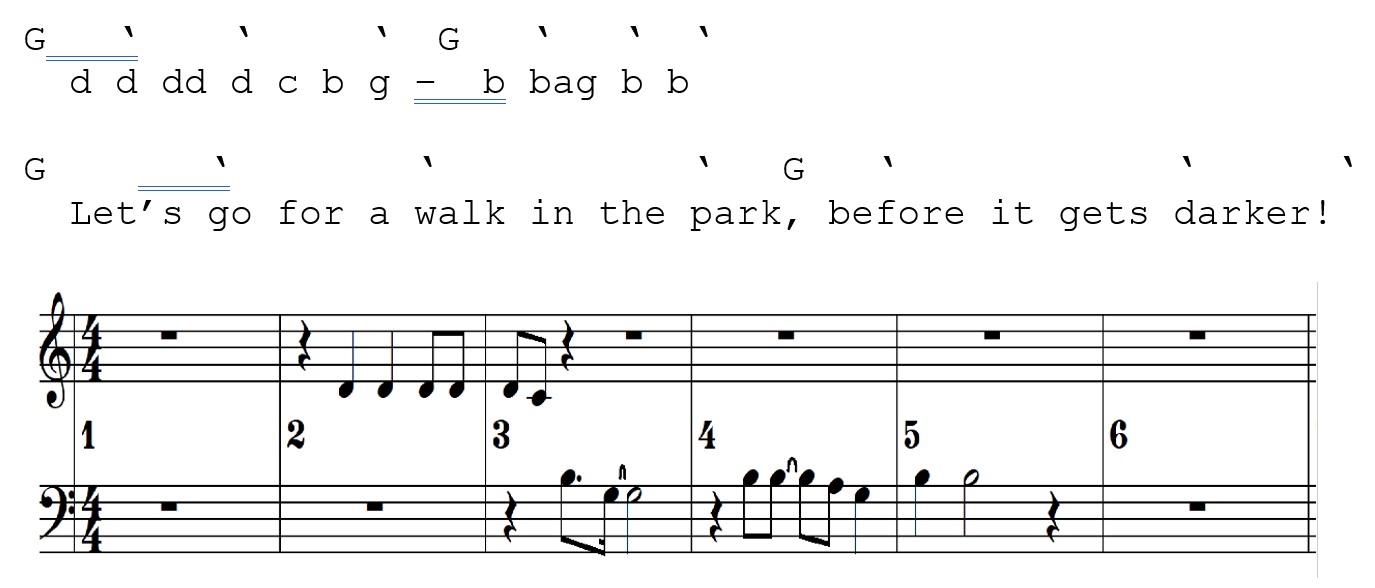
d d dd d c b g – b bag b b Listen to the 1st audio example.
Click the play button below to play a sample MP3
OK, so you have it recorded. It’s the start! In Part 3, we’re going to build this
one simple question and answer into a complete song, albeit, I won’t focus
on writing lyrics for the whole song!
THEEND! If you didn't read Part 1, you won't get the joke!
Part 3: Creating The Music Around Your Melodic Phrase
OK, so you have the melody for the 1st Q & A recorded. Now, we’re
going to build this one simple question and answer into a complete
song!
Here’s where it gets convoluted. There are many ways to continue!
You could simply continue working on the lyrics. A verse will most
likely be longer than just the one Q & A above. Probably a 2nd Q & A.
Then maybe a chord change. Hmmm! What format are you thinking?
What feel, or genre? Are you feeling a Country song or maybe a Pop
song?
After some thought, I realized the melody could work for many genres! But
not anything ‘heavy’! Like Heavy Metal, aggressive Punk or RAP! Can’t
work for those because there aren’t any syllables left for all of the required
expletives! (I digress! HA!)
Maybe no other lyrics are coming to mind yet. So maybe work on the
chords, and song structure. I’m going to keep this as simple as I can, so
I’ll use a standard Country Rock kinda feel, and use a basic 12 bar format.
And I’ll continue to call the 2 parts the ‘Q & A’.
OK, let’s go with working on the song structure, because I’m not planning
to write lyrics for the whole song. BUT . . . that’s the thing. My ‘plan’ is to
simply show you the steps. What you do to get the inspiration! And in the
process, I might think of some lyrics to go with it. I really don’t know at
this point!
SO . . . I’m going to write the music for the song. Not the notation! Just figure
out the chords that will match the melody for the 1st 4 bars. The Q & A is 4 bars
long. I plan to build a I IV V (1 4 5) basic 12 bar, so I’ll need a 2nd Q & A for bars
5 through 8. Then I can build the remaining 4 bars.
SIDEBAR: As I started actually putting this together, I realized it’s not going to
work out as a 12 bar. Keep in mind, I’m writing this tutorial, and the song, in
real time! END SIDEBAR
OK, I literally just wrote out the 1st Q & A, and quickly realized this will not be
a 12 bar! It’ll be a 24 bar! The Q & A fits better played in standard time, 4/4,
and the Q is 4 bars. And the A is 4 bars. I had to decide whether to just have
one Q & A then change chords. But the 2nd Q & A will also be 8 bars. And it’s
not practical to try to ‘jam’ this into 12 bars. I could! I mean, I’m writing the
song, right! But it would change the whole flow of the melody in my head!
OK, so I’m going to build a basic 24 bar progression. The only difference between
a 12 bar and a 24 bar is, each section is doubled! At least in this case!
So, I have to do a few things. First, figure out the key! Then figure out the mode,
if the melody isn’t fitting into something more straight forward. (Spoiler Alert:
It is! So, no mode theory in this one! Ha!) Turns out it’s a simple Ionian progression!
That’s the root, or key mode. G major. So it’s straight forward.
So, I see quickly that the melody will fit perfectly over a G major. The notes,
and how the melody resolves, tells me it’s most likely a G major. G is G B D.
In the melody, there’s only one note not in a G major chord, the A. But there IS an
A in the key of G major, right! G A BC D E F#G. If the melody had that A on a beat,
I would try playing an Am for that count, because ‘A’ in the key of G is an Am.
G Am Bm C D Em F#dim But the A is just a quick note in the melody. So it doesn’t
‘clash’ with the G major.
Listen to the melody played over a G major chord …
Click the play button below to play a sample MP3
In part 4, we’ll turn the 4 bars into a full 24 bar progression. Creating the melody
for the whole song!
THEEND!
Part 4: Turning A Short Melodic Phrase Into A Full Song – Imitation Phrasing
OK, we have our ‘theme’. Our melodic phrase. We know it fits over a G major
chord. Now we need to build the rest of the chord progression. Again, we’re
going to build a fairly simple 24 bar progression.
Here are the notes again. Note that the melody starts on the 2, not 1! So you
count ‘1 2 3 4 1 Lets’
I just included the notation for those who read music. If you don’t, the steps are
the same! So just skip it! (Or maybe try to work it out!)
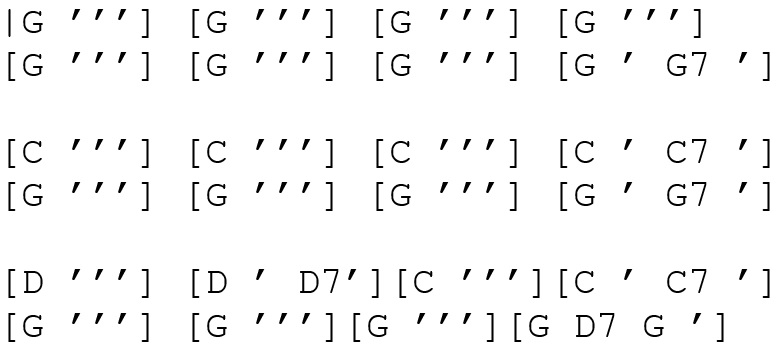
OK, next step is to simply build the 24 bars. I know it’s the key of G. So G C D. I
could have gone a totally different route! Making this a more involved progression.
I could make it into something modal. Make it a minor key. And we’ll be doing that
in another part of this workshop!
But we decided on a straightforward 24 bar.
OK, this might or might not be your next step. If you are a MIDI sequencer, then
this is a great time to start adding your other instruments! For this fairly simple
song, I’m only going to add some drums and bass guitar. But I could easily change
the feel, or the style of the song by adding horns! Change the drums and bass
pattern. Make it more of an R and B or Pop tune!
I might do that just for kicks! I’ll let you know below. Don’t forget, I’m actually
doing this while typing out the tutorial! I’m literally going back and forth between
Word and my MIDI editor, and writing the song as we go.
For those of you who use apps like Band In A Box, at this point, you could enter
in the 24 bars, and find a style you like. BINGO! The chords, drums and bass are
there! I use BIAB occasionally. Sometimes it’s just to find a style that adds to
what I’m feeling. I mostly use BIAB for writing lessons. But for this song, I used
my basic MIDI editor, and built the song a step at a time, as I wrote the tutorial.
OK, I added the bass and drums. Nothing fancy. No drum fills, etc. And I added an
outro. If this was a full song, there’d be more verses, maybe a bridge. Maybe a
chorus. But it’s one verse, so I added the outro. In part 6 I’ll cover the parts of songs.
How to write a bridge, or pre-chorus, choruses, intros and outros, etc.
I’ll also take this song, and turn it into something completely different! No 12 or 24
bar format! And use more chords to change the whole feel of the song.
So, listen to the 24 bars, just the music. I still have to write the melody for the other
chord changes.
Now that the music is finished, I have 2 choices. I can write the lyrics to the
rest of the verse, or I can apply some basic logic, and a bit of theory, and/or
just imagination, and create the remaining melody for the chord changes.
Because again, I don’t plan to write more lyrics at this time, I’ll complete
the melody.
OK, melody is finished! So, you can listen to the finished track. I didn’t spend
much time ‘engineering’ the finished tracks. Just got a basic, decent mix, and
that’s as far as I’ll go.
Have a listen to the finished music, with melody. (And a bit of harmony.)
THEEND!
Part 5: Creating lyrics, finding words that rhyme!
The ideas below are for the song Let’s Go For A Walk In The Park. But
you’ll get the point! You write down a lot of idea provoking questions
relating to the theme of the song you’re writing.
Then you write down ANY phrases/answers to the questions you ask!
So, you’re stuck on words! Start thinking about things like …
Qs: What happened when you were getting ready to leave? What time did you
leave? Did you in fact, actually go to the park?
As: The dog kept barking, or running to the door. I couldn’t find her or his leash!
Last time you went to the park you met a lady who ‘seemed’ to love the dog’s
sweater. Maybe she’ll be there again! Man, you gotta find that sweater! It’s
getting late! Almost 5:00 o’clock! Maybe we shouldn’t go? Should we!?!
Qs: What happened on the way to the park? Did you walk there? Drive?
Who did you meet while walking to the park?
As: I fell off the porch, broke my leg! I stopped at the bake shop on the way
for pepperoni rolls and peanut butter doggie treats! It was a longer walk than
I remembered. But it was a nice walk! The dog loves this walk! Was gonna drive,
but decided I needed the exercise. Met a bunch of kids who loved my dog. Also
met a lady walking to the park with her dog! Her name was Sarah.
Hey! What the heck is your dog’s name! If his name is Barker or Parker,
there’s your rhyme word for DARKER! Maybe go to the park with your
life partner, and take the dog! ‘We’ll take our dog, Parker!’ It fits!
Qs: What happened when you first got to the park? What happened while you
were there? What did you actually do there? What did you see there? Who
did you meet!
As: The park was closed. There was a fair going on! We went on some rides! I
ate a pepperoni roll and Parker ate his treats! I met a lady who was hungry and
I gave her a pepperoni roll! She had a dog, so I gave her some doggie treats.
What was her dog’s name! You’re going to need a couple short lines for thee turn
-a-round, each verse. So maybe her dog’s name was Ruby?
Her name was Ruby. Bit a kid, smokin’ a doobie!
What was her name! Maybe it was Darla!
Her name is Darla, gonna see her tomora (poetic license)
Qs: How long did you stay? What time did you leave? What happened when
you were leaving? Who did you meet on the way home?
As: We stayed until dark. We left around se-ven! They locked the gate as we were
leavin’ The bakery was closed. Saw those kids again! It started to rain
Another short turn-a-round came to mind!
What a day in the park. We stayed..way past dark!
We left around seven, it was like … bein’ in Heaven!
Write this stuff down! Write down ALL of the answers! They will spark ideas!
But you’ll need to work on phrasing to match the song’s meter!
Once you get this far, the rest will require listening to your track, over and over,
until a ‘story’ develops. Until more phrases come to mind. One thing I do when
I get stuck is to make a list of words that rhyme with my ending words. As in, the
1st Q & A ends with darker. So, I make a list of words that are 2 syllables, and end
with ‘er’. Hey, it’s a start! How you do it …
Let’s do an easy one first. Make a list of words that rhyme with park.
ark bark dark hark lark mark park quark stark
Let’s do a harder one. 2 syllables. Darker!
First see if you get lucky. Start with A, and go through the whole alphabet, and
add it to ‘ arker’. Make a 2nd list as you go of similar words you come up with. Barker, darker, marker, parker. And harder came to mind as similar. THEN,
Start from A, and say A-er, and ah-er. Then, staying on the A, add a B. Au-ber,
Au-cer, Au-der, Au-fer (After sticks) Au-ger, Au-her, etc. Then go to B.
Ba-er Then Be-er, Bi-er, Bo-er, Bu-er. Buyer could work. So, you have some
maybes now. But nothing sparked any ideas with me, so I’ll keep going.
C’s, going through it really quickly, there are a few maybes. Crier, Choir.
So, now you have a list of maybes. Here’s the partial list we have so far.
after auger barker marker parker harder crier choir …
OK, this is a bit lame, but it’ll get my point across. Keep working on it. Some-
times you write down a phrase that ‘fits’ but you know you could do better.
That’s OK! Put down what comes to mind, and keep going! Then once you
have all the ‘lines’ in, you start from the beginning, and as you work through
what you have, sing what you have, see if you can refine, tweak, change, but
keep going until you get it!
So, here’s ‘something’. I just put down what came to mind as I went along.
I put SOMETHING down that at least fits the timing. The syllables, and at least
kinda sorta rhymes.
G
Let’s go for a walk in the park, before it gets darker!
Watch all of the people go by, listen to the choir
C
It’s been such a long crazy day, a break would be smarter.
G
Maybe grab a hotdog or two, and get one for Parker!
D
All I know is it’s time for a break.
C
Maybe take a walk by the lake. Or …
G
Let’s take a walk in the park, just me and you.
SIDEBAR: As I wrote this, I came up with ‘or maybe a burger’ Then
when I proof read the song, I came up with ‘And get one for Parker!’
Like I said, it’s a process! If you think of a phrase, WRITE IT DOWN!
Continue until something POPS! Then you can move on to another line
you’re having trouble getting the right ending word for.
So by putting something there, getting the timing correct, you have a
great start! In my lyrics above, I kept the syllables correct, and maintained
a ‘theme'. But there’s a lot of room for improvement.
As you work on it, as you sing it, you’ll think of changes! You’ll make it
better! And eventually . . . You wrote a song!
One more thing to keep in mind. You can change your mind about some
lyrics any time! So maybe ‘darker’ is the wrong word to end the 1st Q & A
line. Maybe change it to later, or colder. Or cold out. Or maybe change the
‘A’ to ‘or maybe the zoo-oo! Or ‘It’s been such a long day!’ ‘It’s been quite
a wh-ile’.
Remember when I said in Part 1 . . . Every melody has been sung.
Every chord progression has been played.
Every word has been sung!
Well, guess what? Every song has not been written!
It’s a process!
Let’s change it up!
OK, I decided to change it up a bit. I increased the tempo from 138 BPM to 168.
Changed the drums and bass line. And added some horns. Totally different feel!
More of a Pop or R and B kinda thing. Have a listen …
OK, in Part 6, I’ll break down what songs consist of. Intros, verses, pre-choruses,
choruses, bridges, outros! Plus, I’ll turn this song into something totally different!
My main Backing Tracks Support Website with over 43,813
free bacing tracks! SoundFont, MIDI editors and players and
more! 260+ WEB PAGES! All distributed for free! Visit my MidKar website!
Please help keep us online with a small donation!
This site is free for all. The tutorials, workshops. 43,813 MIDI, KAR &
BIAB backing tracks files, 23 BIAB User Styles. A FREE SoundFont,
Timbres of Heaven. Free MIDI players and editor!
The fees for a site this large (260+ pages with over 50K files)
is pretty high, as you can imagine.
Please consider making a small donation to help keep us online. It
would help so much! Thanks! Wayne
PS: I pay for the site and all hosting, security and domain related
expenses out of pocket. Donations appreciated. Please click the link below.