
“Blues” isn’t a single genre. It has many subgenres and styles,
like Country Blues, Chicago Blues, Delta blues, Texas Swing
Blues, etc. Here are some examples:
Boogie-Woogie: A blues style characterized by a fast, driving
rhythm, and often featuring piano playing.
Boogie: A Boogie is similar to a Boogie-Woogie. Rather,
it CAN be similar! But for the most part, a Boogie isn’t
formatted like a BW. The one chord is played basically, for
the whole song. It might have a turn-a-round, might not! A
song like Bad To The Bone is an example.
British Blues: A blues style that emerged in Britain, often
drawing inspiration from American blues, and often featuring a
rock and roll influence.
Chicago Blues: An urban blues style that emerged in Chicago,
characterized by the use of electric instruments, especially
the electric guitar, and often incorporating elements of rhythm and blues.
Country Blues: A foundational style characterized by acoustic guitar,
often with slide guitar, and vocals with a raw, personal style.
Delta Blues: A regional variant of country blues, originating in the
Mississippi Delta, known for its distinctive guitar and harmonica playing,
and often featuring slide guitar.
Memphis Blues: A blues style that emerged in Memphis, Tennessee, known
for its soulful vocals and bluesy guitar playing.
Texas Blues: A blues style originating in Texas, known for its upbeat and
danceable rhythms, and often featuring a prominent role for the electric guitar.
West Coast Blues: A blues style that emerged on the West Coast, often
incorporating elements of jazz and rhythm and blues.
Other Subgenres: Jump Blues, Blues Rock, Soul Blues, and Psychedelic
Blues are other examples of blues subgenres.
It should also be mentioned that the title ‘Blues’ is subjective!
If you just decide you want to write a Blues song, there are many
questions that need to be answered if you want a guide through
the process. A far better plan would be, wait for a “moment”!
And move on that moment! Again, this is completely described,
in detail, in the 101 workshop!
So, what genre? Tempo? Do you plan to write a Blues in a major
key, or would you like to write a Blues in a minor key? Do you
want to write an 8-bar Blues, 12-bar Blues, 16? 24?
What “feeling”? Do you have a title in mind, or some lyrics
floating around in your head you’d like to make into a Blues
song?
You need some sort of idea about the above before delving into
the mechanics of writing any song, including Blues.
Maybe you heard a specific chord progression that triggers your
“moment”! or maybe it’s as simple as a bass line that keeps popping
up in your mind.
Assuming you’ve given the above adequate thought, let’s look
at the mechanics.
Nothing says you have to follow any generally used “rules”
when you build your chord progression, but there are some.
And they will help you, not deter you! You can start with
something “standard”, and then change it up how ever you
want. I mean, YOU are writing the song!
I have to assume you understand some basics here. If I
say you’re going to write a 12-bar I IV V or a vi iv v
in A or Am, and you don’t understand what I mean, I would
strongly suggest reading the Theory 101 Overview tutorial.
If you really want to become a song writer, you need to
know the basics. And this tutorial will get you to where
you need to be. But you can still work through this tutorial!
As an added bonus, the theory tutorial leans heavily toward
building Blues chord progressions!
Maybe work through this one. Then set some time aside, and
read “UPDATED: Music Theory 101 Overview” here . . .
For those who aren’t yet familiar with some of the basic
terminology, I’ll cover just a small bit now. But I’m not
going to belabor it.
In any key, you have 7 chords. They will follow a pattern that’s
the same for every key. And each chord is numbered, 1 through 7,
generally using Roman Numerals. I’ll use the key of C as an example.
C Dm Em F G Am Bdim So M m m M M7 m dim
In a Jazz harmony chord scale, (4 note chords with 7ths) the chords are:
Cmaj7 Dm7 Em7 Fmaj7 G7 Am7 Bm7b5 (B minor 7 flat 5)
The chords are numbers as shown, 1 through 7.
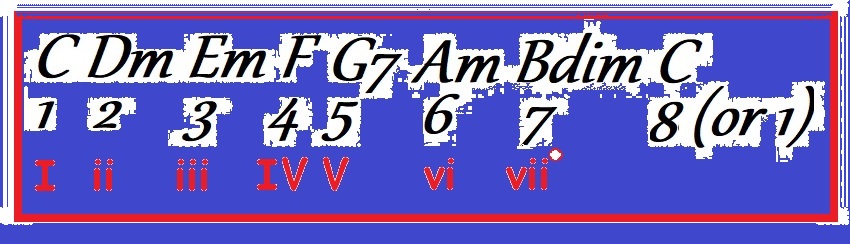 Upper case Numerals are major chords. Lower case are minors. If
you want to play one of the major chords as a minor, you would
use the same number, but use lower case. For example, if you
wanted to play a progression with the chords above, but wanted
the Dm to be a D, you would write it II instead of ii. Or if
you wanted the F to be an Fm, you’d write iv instead of IV.
So if I said . . . 12-bar in C, you would assume the chords
will be the 1st, 4th and 5th chord in the scale. I IV V. So
I could just as well said . . . it’s a I IV V in C, and you’d
assume the same thing. Assuming it’s a 12-bar because I said
nothing to distinguish it from the “norm”.
So, it would be a 12-bar in C, using C, F & G. The exact format
can vary a LOT! But the general progression would therefore be . . .
C ‘’’ C ‘’’ C ‘’’ C ‘’’ F ‘’’ F ‘’’ C ‘’’ C ‘’’ G ‘’’ F ‘’’ C ‘’’ G ‘’’
OK, back to the Blues tutorial!
So, what kind of progression are you thinking? Major key?
I IV V, I V IV, 8-bar, 12-bar, 16 or 24?
An 8-bar is just a shortened 12-bar, without the middle 4 bars.
C ‘’’ C ‘’’ C ‘’’ C ‘’’ G ‘’’ F ‘’’ C ‘’’ G ‘’’
Another common progression is the I V IV. Similar to the I IV V
except you switch the IV and V.
C ‘’’ G ‘’’ C ‘’’ F ‘’’
I showed you a basic 12-bar above. Another common progression is
called a “quik change”. It replaces the 2nd measure of the 12-bar’s
one chord with the four chord. mainly because it’s pretty boring
to always have 4 measures of the same chord. Depends on the rhythm,
song dynamics, etc.
C ‘’’ F ‘’’ C ‘’’ C ‘’’ F ‘’’ F ‘’’ C ‘’’ C ‘’’ G ‘’’ F ‘’’ C ‘’’ G ‘’’
Usually, a 16 bar just has 8 measures of the one chord, then the
rest of the progression is the same.
C ‘’’ C ‘’’ C ‘’’ C ‘’’ C ‘’’ C ‘’’ C ‘’’ C ‘’’
F ‘’’ F ‘’’ C ‘’’ C ‘’’ G ‘’’ F ‘’’ C ‘’’ G ‘’’
A slow Blues might be 24 bars. (Not only slow! Mustang Sally
is a 24-bar.) It’s the same as a 12-bar, but each chord is
played twice.
C ‘’’ C ‘’’ C ‘’’ C ‘’’ C ‘’’ C ‘’’ C ‘’’ C ‘’’
F ‘’’ F ‘’’ F ‘’’ F ‘’’ C ‘’’ C ‘’’ C ‘’’ C ‘’’
G ‘’’ G ‘’’ F ‘’’ F ‘’’ C ‘’’ C ‘’’ C ‘’’ C ‘’’
There are many variations of the above progressions. it all
depends on the phrasing, the lyrics, and/or the feel you’re
going for. It’s common to add some 7ths! Or 9ths! And
sometimes you substitute a measure with other chords.
One common substitution would be changing the 5th and 6th
measure from one chord (F in this example) to . . .
Fm ‘ Fm/E ‘ Fm/Eb ‘ F9 ‘.
Another cool substitution would be in measures 7 and 8.
Instead of playing the 2 (more) bars of C, we could play . . .
C ‘ Dm ‘ Em ‘ Eb ‘
But this is a starting point! Deciding on the format you
want to use.
OR . . . Or maybe you have the lyrics! You already wrote them.
And now you need to figure out what chord progression will ‘fit’!
That’s a whole new topic! Basically, if you have a song that’s
‘UP’, maybe it’s a rockin’ Blues! And you know it’ll be in a
major key! Then just go over the above progression formats.
Does one fit better than the others? Is one close enough, and
you can adjust the lyrics a bit to make them fit?
or maybe it’s a ‘DOWNER’! And you want it to be in a minor key!
Maybe something like The Thrill Is Gone? or maybe you’re really
into Gary Moore, and want something along the lines of his
Blues songs!
Minor Blues is a lot different, albeit, there are many similari-
ties! If it’s going to be a basic 12-bar, the things you need to
decide on are which chords will be major and which will be minor!
You have choices! Here are some . . .
Just like the chord subs I used above for measures 5 and 6, you
can use the same kind of chord cadence as your ONE chord! EX:
If you’re writing something with an Am cadence, you could have
the 1st four measures . . . Am ‘’’ Am ‘’’ Am ‘’’ Am ‘’’.
OR . . . you could have,
[Am ‘ Am/G# ’] [Am/G ’ Am/F# ’] [Am ‘ Am/G# ’] [Am/G ’ Am/F# ’]
Measures 5 and 6 could be Dm ‘’’ Dm ‘’’ or . . .
[Dm ‘ Dm/Db ’] [Dm/C ’ Dm/B ‘].
The turn-a-round can be something standard, just using Am and E7,
or to match this jazzy progression, maybe do something like this . . .
[E ‘’’] [F ‘ E ‘] [Am ‘ E ‘] [Am ‘ E7 ‘] You could change that
last E7 to an E7#9. (The Jimi chord!) Or something really cool!
Change it to an Eaug! E G# C The E and the C in that chord
resolves really cool to Am! A C E And the G# is a half step
below the A root. That gives the chord change a cool, upward motion.
[Am ‘ Am/G# ’] [Am/G ’ Am/F# ’] [Am ‘ Am/G# ’] [Am/G ’ Am/F# ’]
[Dm ‘ Dm/C# ’] [Dm/C ’ Dm/B ‘] [Am ‘ Am/G# ’] [Am/G ’ Am/F# ’]
[E ‘ E7 ’] [Dm ‘ Dm7 ’] [Am ‘ Dm ‘] [Am ‘ Eaug ‘] [Eaug ‘ E7 ‘] [Am ‘’’]
Ok, so what we did above was use slash chords, right? Changing
the bass notes of the chord to create a downward movement in
the progression. Chromatically going down in half steps. But
there are many ways we could create a minor Blues! One is to
just follow the basic 12-bar format, using minor chords. (And
maybe some majors, depends!)
When we think about Gary Moore’s Blues ballads, we can hear a
definite downward moving chord progression. He often uses some-
thing done a lot in many styles of music. Building a chord
progression on 4ths!
Take a song lime Still Got The Blues For You. it’s in C.
(Yes, C, not Am!)
He starts from the two chord, Dm7, progresses down to the
root chord, Am. He moves in 4ths. Like this . . .
[Dm7 ‘ G7 ‘] [Cmaj7 ‘ Fmaj7 ‘] [Bm7b5 ‘ E7 ‘] [Am7 ‘ Am7 ‘]
[Dm7 ‘ G7 ‘] [Cmaj7 ‘ Fmaj7 ‘] [Bm7b5 ’’’] [E7 ‘’’]
There are a BUNCH of songs that use this chord progression.
A bunch! Europa, Fly Me To The Moon, many more. It's actually
fairly common.
There are MANY camps re how many keys there are. I’m not
going there now. So let’s say this . . .
Am is the relative minor of C, right? So it has the same
notes and chords as C. And this song literally uses all
of the chords in a major (or A relative minor) 4 note
Jazz chord scale! With one exception!
Something commonly done in songs with a minor cadence:
The 5 chord of an Am scale would be Em. But we commonly
substitute an E7 because it resolves better to the Am.
But we don’t HAVE to use E7! Em sounds good, too.
Depends on the sound YOU want!
Cmaj7 Dm7 Em7 Fmaj7 G7 Am7 Bm7b5 are the chords in the
C major scale, right. If we re-write that scale, starting
from the 2, and continue jumping up in 4ths, we get the
chords in the song.
Dm7, up a 4th to G7, up a 4th to Cmaj7, up a 4th to Fmaj7.
Up a 4th to Bm7b5. And up a 4th to E7!
Note: An Am chord scale is the same as a C major scale. You
simply start on the 6th degree of C, Am.
Upper case Numerals are major chords. Lower case are minors. If
you want to play one of the major chords as a minor, you would
use the same number, but use lower case. For example, if you
wanted to play a progression with the chords above, but wanted
the Dm to be a D, you would write it II instead of ii. Or if
you wanted the F to be an Fm, you’d write iv instead of IV.
So if I said . . . 12-bar in C, you would assume the chords
will be the 1st, 4th and 5th chord in the scale. I IV V. So
I could just as well said . . . it’s a I IV V in C, and you’d
assume the same thing. Assuming it’s a 12-bar because I said
nothing to distinguish it from the “norm”.
So, it would be a 12-bar in C, using C, F & G. The exact format
can vary a LOT! But the general progression would therefore be . . .
C ‘’’ C ‘’’ C ‘’’ C ‘’’ F ‘’’ F ‘’’ C ‘’’ C ‘’’ G ‘’’ F ‘’’ C ‘’’ G ‘’’
OK, back to the Blues tutorial!
So, what kind of progression are you thinking? Major key?
I IV V, I V IV, 8-bar, 12-bar, 16 or 24?
An 8-bar is just a shortened 12-bar, without the middle 4 bars.
C ‘’’ C ‘’’ C ‘’’ C ‘’’ G ‘’’ F ‘’’ C ‘’’ G ‘’’
Another common progression is the I V IV. Similar to the I IV V
except you switch the IV and V.
C ‘’’ G ‘’’ C ‘’’ F ‘’’
I showed you a basic 12-bar above. Another common progression is
called a “quik change”. It replaces the 2nd measure of the 12-bar’s
one chord with the four chord. mainly because it’s pretty boring
to always have 4 measures of the same chord. Depends on the rhythm,
song dynamics, etc.
C ‘’’ F ‘’’ C ‘’’ C ‘’’ F ‘’’ F ‘’’ C ‘’’ C ‘’’ G ‘’’ F ‘’’ C ‘’’ G ‘’’
Usually, a 16 bar just has 8 measures of the one chord, then the
rest of the progression is the same.
C ‘’’ C ‘’’ C ‘’’ C ‘’’ C ‘’’ C ‘’’ C ‘’’ C ‘’’
F ‘’’ F ‘’’ C ‘’’ C ‘’’ G ‘’’ F ‘’’ C ‘’’ G ‘’’
A slow Blues might be 24 bars. (Not only slow! Mustang Sally
is a 24-bar.) It’s the same as a 12-bar, but each chord is
played twice.
C ‘’’ C ‘’’ C ‘’’ C ‘’’ C ‘’’ C ‘’’ C ‘’’ C ‘’’
F ‘’’ F ‘’’ F ‘’’ F ‘’’ C ‘’’ C ‘’’ C ‘’’ C ‘’’
G ‘’’ G ‘’’ F ‘’’ F ‘’’ C ‘’’ C ‘’’ C ‘’’ C ‘’’
There are many variations of the above progressions. it all
depends on the phrasing, the lyrics, and/or the feel you’re
going for. It’s common to add some 7ths! Or 9ths! And
sometimes you substitute a measure with other chords.
One common substitution would be changing the 5th and 6th
measure from one chord (F in this example) to . . .
Fm ‘ Fm/E ‘ Fm/Eb ‘ F9 ‘.
Another cool substitution would be in measures 7 and 8.
Instead of playing the 2 (more) bars of C, we could play . . .
C ‘ Dm ‘ Em ‘ Eb ‘
But this is a starting point! Deciding on the format you
want to use.
OR . . . Or maybe you have the lyrics! You already wrote them.
And now you need to figure out what chord progression will ‘fit’!
That’s a whole new topic! Basically, if you have a song that’s
‘UP’, maybe it’s a rockin’ Blues! And you know it’ll be in a
major key! Then just go over the above progression formats.
Does one fit better than the others? Is one close enough, and
you can adjust the lyrics a bit to make them fit?
or maybe it’s a ‘DOWNER’! And you want it to be in a minor key!
Maybe something like The Thrill Is Gone? or maybe you’re really
into Gary Moore, and want something along the lines of his
Blues songs!
Minor Blues is a lot different, albeit, there are many similari-
ties! If it’s going to be a basic 12-bar, the things you need to
decide on are which chords will be major and which will be minor!
You have choices! Here are some . . .
Just like the chord subs I used above for measures 5 and 6, you
can use the same kind of chord cadence as your ONE chord! EX:
If you’re writing something with an Am cadence, you could have
the 1st four measures . . . Am ‘’’ Am ‘’’ Am ‘’’ Am ‘’’.
OR . . . you could have,
[Am ‘ Am/G# ’] [Am/G ’ Am/F# ’] [Am ‘ Am/G# ’] [Am/G ’ Am/F# ’]
Measures 5 and 6 could be Dm ‘’’ Dm ‘’’ or . . .
[Dm ‘ Dm/Db ’] [Dm/C ’ Dm/B ‘].
The turn-a-round can be something standard, just using Am and E7,
or to match this jazzy progression, maybe do something like this . . .
[E ‘’’] [F ‘ E ‘] [Am ‘ E ‘] [Am ‘ E7 ‘] You could change that
last E7 to an E7#9. (The Jimi chord!) Or something really cool!
Change it to an Eaug! E G# C The E and the C in that chord
resolves really cool to Am! A C E And the G# is a half step
below the A root. That gives the chord change a cool, upward motion.
[Am ‘ Am/G# ’] [Am/G ’ Am/F# ’] [Am ‘ Am/G# ’] [Am/G ’ Am/F# ’]
[Dm ‘ Dm/C# ’] [Dm/C ’ Dm/B ‘] [Am ‘ Am/G# ’] [Am/G ’ Am/F# ’]
[E ‘ E7 ’] [Dm ‘ Dm7 ’] [Am ‘ Dm ‘] [Am ‘ Eaug ‘] [Eaug ‘ E7 ‘] [Am ‘’’]
Ok, so what we did above was use slash chords, right? Changing
the bass notes of the chord to create a downward movement in
the progression. Chromatically going down in half steps. But
there are many ways we could create a minor Blues! One is to
just follow the basic 12-bar format, using minor chords. (And
maybe some majors, depends!)
When we think about Gary Moore’s Blues ballads, we can hear a
definite downward moving chord progression. He often uses some-
thing done a lot in many styles of music. Building a chord
progression on 4ths!
Take a song lime Still Got The Blues For You. it’s in C.
(Yes, C, not Am!)
He starts from the two chord, Dm7, progresses down to the
root chord, Am. He moves in 4ths. Like this . . .
[Dm7 ‘ G7 ‘] [Cmaj7 ‘ Fmaj7 ‘] [Bm7b5 ‘ E7 ‘] [Am7 ‘ Am7 ‘]
[Dm7 ‘ G7 ‘] [Cmaj7 ‘ Fmaj7 ‘] [Bm7b5 ’’’] [E7 ‘’’]
There are a BUNCH of songs that use this chord progression.
A bunch! Europa, Fly Me To The Moon, many more. It's actually
fairly common.
There are MANY camps re how many keys there are. I’m not
going there now. So let’s say this . . .
Am is the relative minor of C, right? So it has the same
notes and chords as C. And this song literally uses all
of the chords in a major (or A relative minor) 4 note
Jazz chord scale! With one exception!
Something commonly done in songs with a minor cadence:
The 5 chord of an Am scale would be Em. But we commonly
substitute an E7 because it resolves better to the Am.
But we don’t HAVE to use E7! Em sounds good, too.
Depends on the sound YOU want!
Cmaj7 Dm7 Em7 Fmaj7 G7 Am7 Bm7b5 are the chords in the
C major scale, right. If we re-write that scale, starting
from the 2, and continue jumping up in 4ths, we get the
chords in the song.
Dm7, up a 4th to G7, up a 4th to Cmaj7, up a 4th to Fmaj7.
Up a 4th to Bm7b5. And up a 4th to E7!
Note: An Am chord scale is the same as a C major scale. You
simply start on the 6th degree of C, Am.
 Tutorials and Workshops Directory
Wayne (Reed) Knazek ~ Email Me Here! ~ My personal Web site
Tutorials and Workshops Directory
Wayne (Reed) Knazek ~ Email Me Here! ~ My personal Web site