CLICK HERE to go to workout section!
Pentatonic Master Class Workshop
for Keyboard and Horn players!
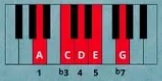
Part 2: Playing each position together
This section is the heart of the whole workshop!
The DRILLS!
Make those scales sound like solos and melodies!
It's unlikely you'll do ALL of Part 2 in any one session. If you
can, you're gonna set the world on fire!
Just do as much as you can each session. But I strongly
recommend sticking with this as your MAIN practice session,
at least until you get through it once!
Do what you can each session, and pick up where you left off
the session before.
Once you can play Part 1 & Part 2, then you should start playing some
of the JAMS! There are no instructions for these jams. Just figger it out! Ha!
THE PATTERNS! It's all about PATTERNS! Now you know the 5
positions. The patterns, shapes. Let's get them sounding like music!
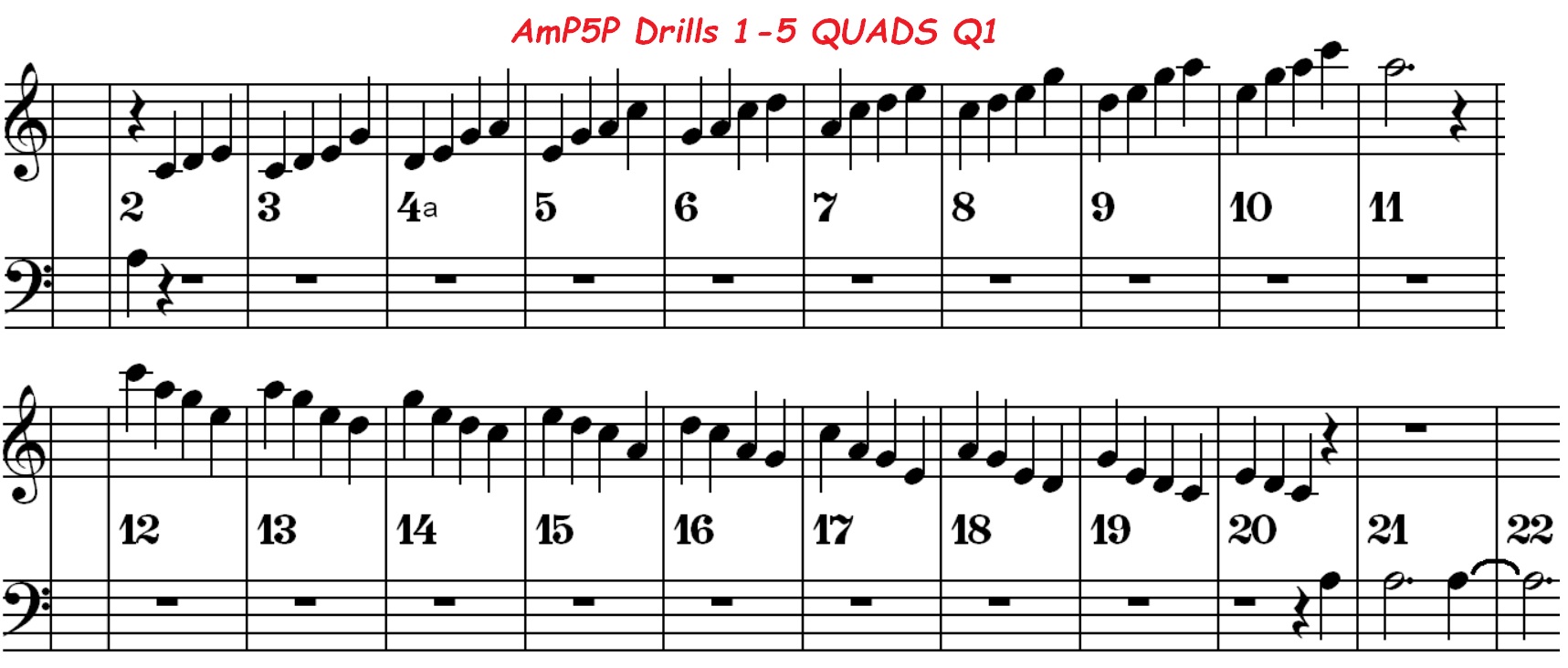
Here's how the Drills work. The 1st group is in 4s, or quads.
You play the 1st 4 notes. A C D E. Then the 2nd 4 notes. C D E G.
Then the 3rd 4 notes. D E G A. Etc.
These are called Spider Drills, or Crawl Drills. You just keep moving
to the next note as the 1st note of 4.
I won't TAB all of these exercises. At least not completely. Because
you should be able to figure them out quickly. I WILL describe the
PATTERN! And THAT'S what you need to know.
Keep in mind, after only a short time, these will become easier to play.
You will start to see dramatic improvement daily! And not just on these
exercises. But IN EVERYTHING YOU PLAY! Chords, scales, solos!
Objective: Be able to play all tracks, to the end, without much,
if any difficulty! Smoothly, accurately!
So, how long will it take? Guess who STILL does these drills! Yeah, ME!
All of the exercizes will become a LOT easier once you know the scales
and patterns. They're only a tad confusing at first. Trust me!
And guess what? Most of those cool solos you want to play use these
EXACT PATTERNS! Once you get'm, you got'm!
Here we go!... This is where you jump to if you
click the link at the very top of the page!
~~~~~~~~~~~~~~~~~~~~~~~~~~~
When you mess up, STOP! Start the track again.
Do each track 3 times - JUST TILL YOU MESS UP!
DO NOT PRACTICE SLOPPY!
NOTE: You can play each of these more than 3 times!
The Drills are the heart of this workshop! THIS is where
you start getting GOOD! It's up to you.
~~~~~~~~~~~~~~~~~~~~~~~~~~~~~~~~~~~~~~~~~~~
Let's Get Warmed up!
If you're RETURNING to this workshop for ANOTHER session,
~~~~~~~~~~~~~~~~~~~~~~~~~~~~~~~~~~~~~~~~~~~ Now it's gonna get funner and funner!
and if you're already warmed up, you can skip this section.
But you need to do it the 1st time you're here!
CLICK HERE to skip the warm up and jump to the workout section!
NOTE: Some scales are written an octave lower than played
simply to make it easier to read. Most patterns play 2 octaves,
so just play the lower octave on your horn. Keys, pick an octave!
The 1st exercise below has 4 patterns. Numbered 1, 2, 3 and 4.
(Scroll down a bit and take a look!)
The first one plays the full 2 octave scale up, then down in 1st
position. IE: A C D E G, etc. 1 UP, then 2 DOWN. Play Pos 1, Up
then Down, 1 time . . .
Then you play 2nd position the same way. IE: C D E G A, etc. 3 UP
then 4 DOWN. Play Pos 2, Up then Down, 1 time . . .
Now play them both together, 1, 2, 3 then 4.
Repeat!
But there's a TWIST! The first cycle (A then C) you play Am from
A, up and back down, over an Am chord progression. Then you play
from C, over a C major chord progression. Then . . .
You play the same cycle again, A then C, but this time you play
both scales over Am! Then . . .
You play it a 3rd time, this time both scales over a C major
progression! So the progressions for the 3 cycles are . . .
Am C ~ Am Am ~ C C. You'll hear each scale seem to "change"
as you play over different chords! The "feel" will be different!
This is kinda your introduction to playing in modes! Each cycle gets
progressively faster, as always!
Am - CM Pentatonic Drills 1
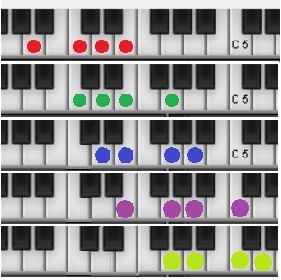
Pos 1 Pos 2
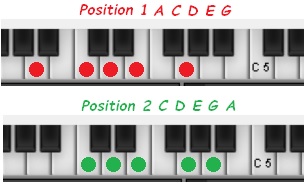
Alternate between the 4 scale shapes.
1 UP 2 DOWN 3 UP 4 DOWN ~ Repeat
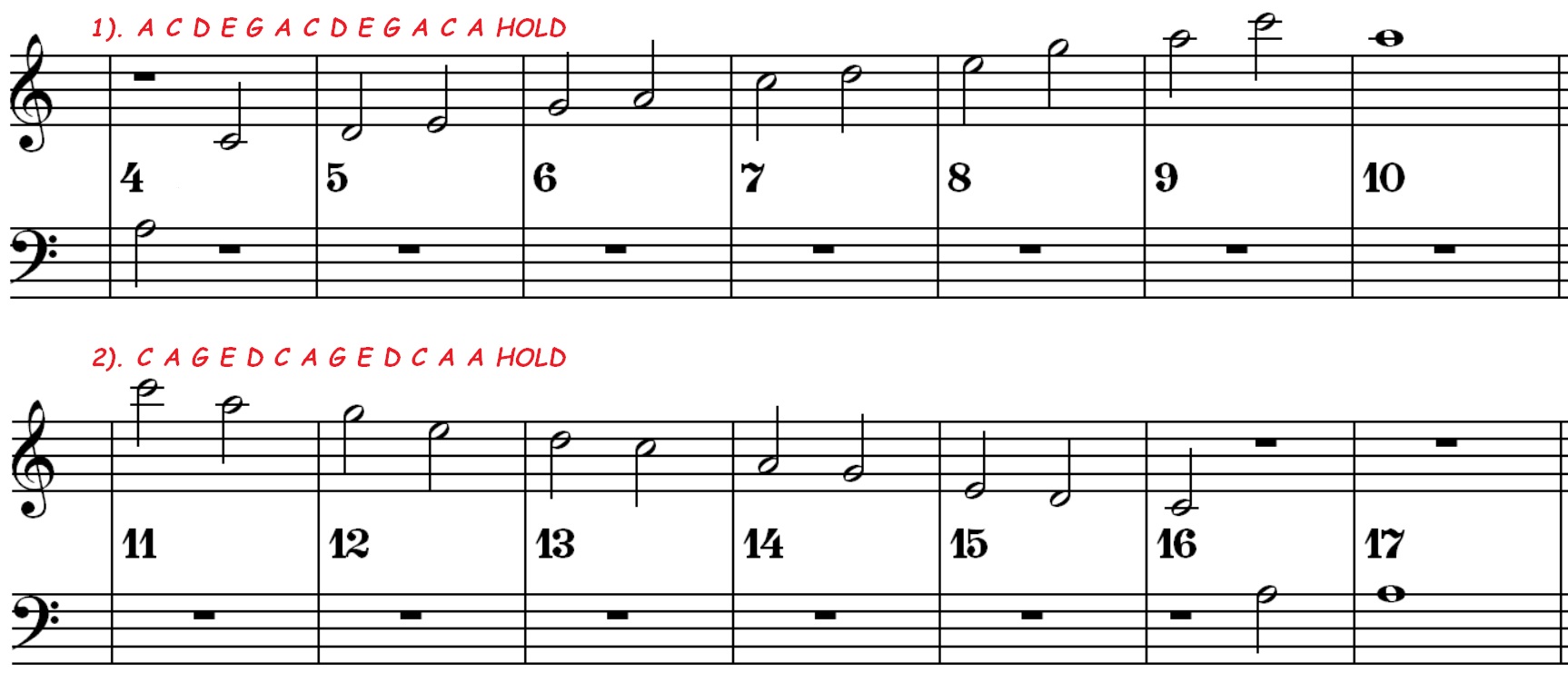
1). A C D E G A C D E G A C A HOLD
2). C A G E D C A G E D C A A HOLD
3). C D E G A C D E G A C A C HOLD
4). C A G E D C A G E D C A C HOLD
1 UP 2 DOWN
3 UP 4 DOWN
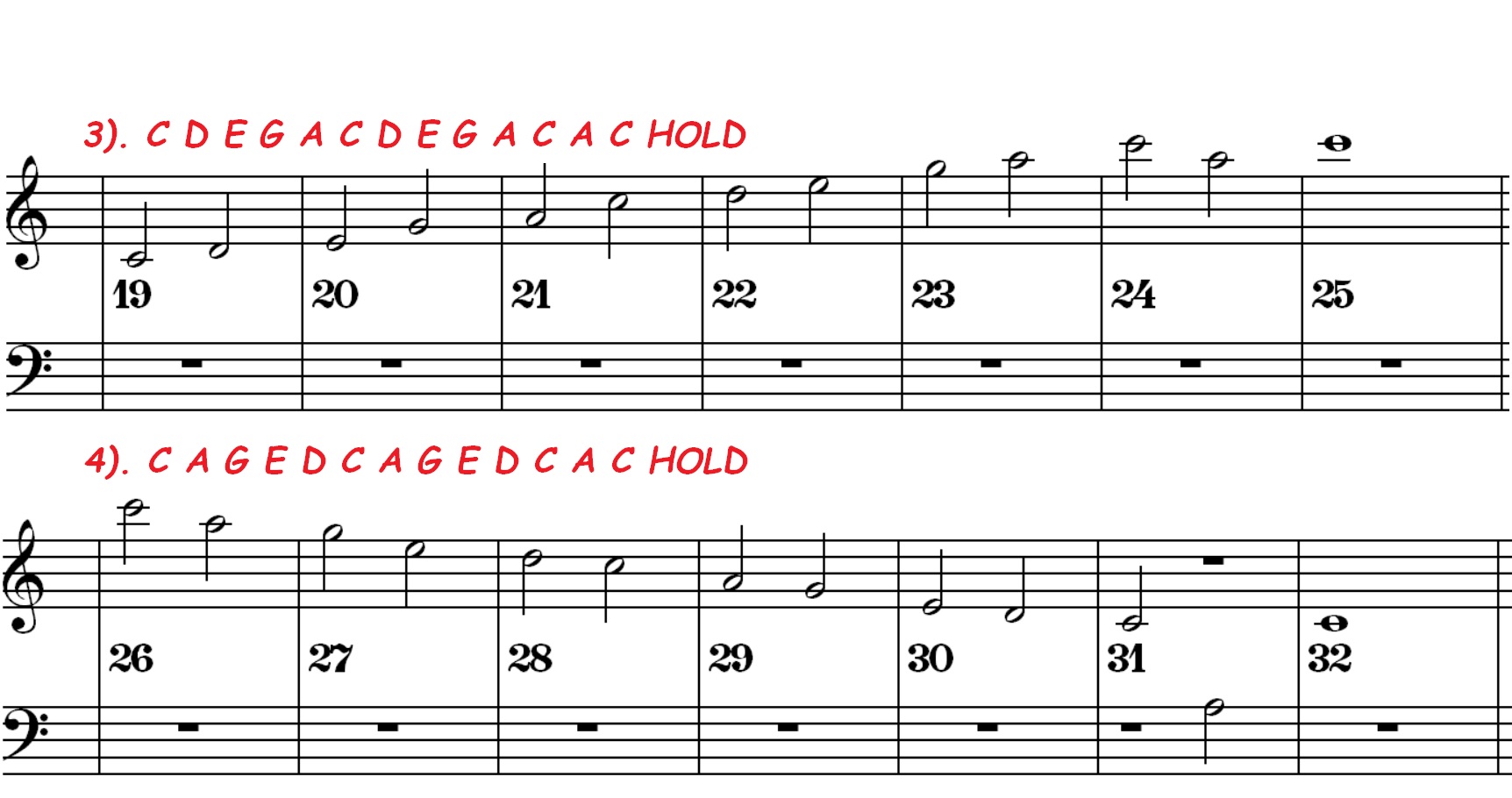
1 Up, then 2 back Down! 3 Up, 4 Down. Repeat
Drills 1-5 QUADS Q1
notes. C D E G. Then start on 3, D E G A. Then E G A C, G A C D
STOP when it gets faster than you can play correctly, start over 3X.
Up, then back down! Stop when you mess up!
~~~~~~~~~~~~~~~~~~~~~~~~~~~~~~~~~~~~~~~~~~~
There are 2 patterns in this exercise. Up/Down, and Down/Up.
Now play the Drill!
~~~~~~~~~~~~~~~~~~~~~~~~~~~~~~~~~~~~~~~~~~~
This exercise separates the men from the boys!
These are very similar to the above exercises, except you play "3-note"
THE PATTERNS! You play the 1st 3 notes 123, then note 4, then
~~~~~~~~~~~~~~~~~~~~~~~~~~~~~~~~~~~~~~~~~~~
Track T2 is identical to Track T1, except it starts at a faster tempo.
~~~~~~~~~~~~~~~~~~~~~~~~~~~~~~~~~~~~~~~~~~~
Ya know the expression "In The Box"! Well, there's a special
123234 123234 123234 5 ~ Then move up 1 note: 234345 234345 234345 6
Play them down
The BB Box!
We're really getting into SOLO Territory now! We're going to work on
The reason this whole thing works is because of repetition! You're
COUNT-IN: 123 123
DOWN: 5 4 3 2 1 2 ~ 5 4 3 2 1 2 ~ 5 4 3 2 1 2 ~ 3
If you think this one was cool, wait till we add in
The Big Box!
This one is The Money Maker!
Here's where you'll be for those killer solos you love! Yeah, we
We'll start with one idea. It has 2 parts. Up, and Down.
Because this is so important, we'll do each part a couple times
Down: DCD CAC AGA GEG EDE DEG E
Up Down:
One more cool riff to add before we tie them together!
DCAGED DCAGED DCAGED C
DEGACD DEGACD DEGACD C
~~~~~~~~~~~~~~~~~~~~~~~~~~~~~~~~~~~~~~~~~~~
Extending Scales ~ Get a bigger bang for your buck!!
As I said above a time or two, we can stretch out the scales and patterns
Here are 2 scale patterns to work on that do this! The first one simply plays
Here's another way to look at it!
1). You go DOWN 6 notes. CAGEDC
You play DOWN 3 notes, CAG. Back up 1, Play DOWN 3 notes from A. AGE.
OK, let's change it up a little! The next 2 tracks play Am and F#m
1). For this first track, play:
Notice how both scales sound uniquely different over the 2
This next section is actually a sneak peek at a new workshop that's
By using some "Swing" techniques, and using chord inversions, you can
Before we get into this, let's talk about chord inversions
Drill'M:
This track plays each phrase 2 times, each ending on
Similar to the above track, this one plays the phrase 6 times
~~~~~~~~~~~~~~~~~~~~~~~~~~~~~~~~~~~~~~~~~~~
The 1st 3 tracks are "Learn'm" tracks. You WORK these 3 track together.
You do ALL 3 of these every session!
So, the whole killer scale is just a bunch of "3-note" phrases! But you
Learn it! Do it now for the whole scale. No tempo changes. When you
You will notice a bit of redundncy in the next section. So, read THIS . . .
This track starts a bit slower and gets progressively faster.
This one gets a bit more aggressive! Stay here until you nail it!
Nail this one, and your concert tour contract is a shoe in!
~~~~~~~~~~~~~~~~~~~~~~~~~~~~~~~~~~~
JUST PLAY EVERY OTHER NOTE! Play 1, skip 2. Play 3, skip 4. Play 5!
~
You made it this far!
You've nearly made it through this entire workshop! You've
Back to PlayTheDarnThing HOME
Please consider making a small donation to help us keep Play The Darn Thing
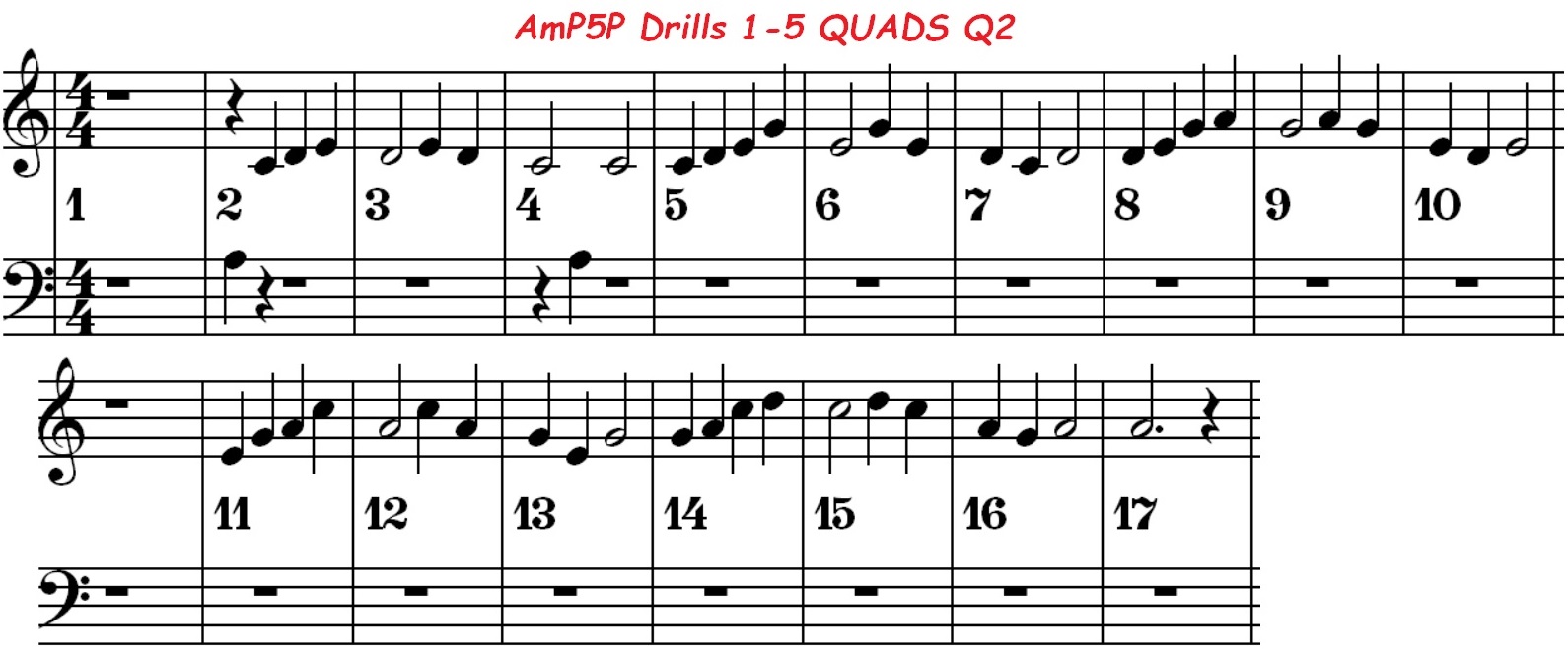
Drills 1-5 QUADS Q2
Q2 plays notes 1 2 3 4 3. A C D E D
So 1 up to 2 up to 3 up to 4 DOWN to 3
A to C to D to E down to D.
Then BACK DOWN: E D C A C.
Then start on note 2, C. C D E G E ~ G E D C Then D, Etc.
When you finish going Up/Down, come back down. Now you'll
play the DOWN patterm followed by the UP pattern. Down/Up
The score shows about half of the full pattern. Just continue
until you finish the usual 2 octaves.
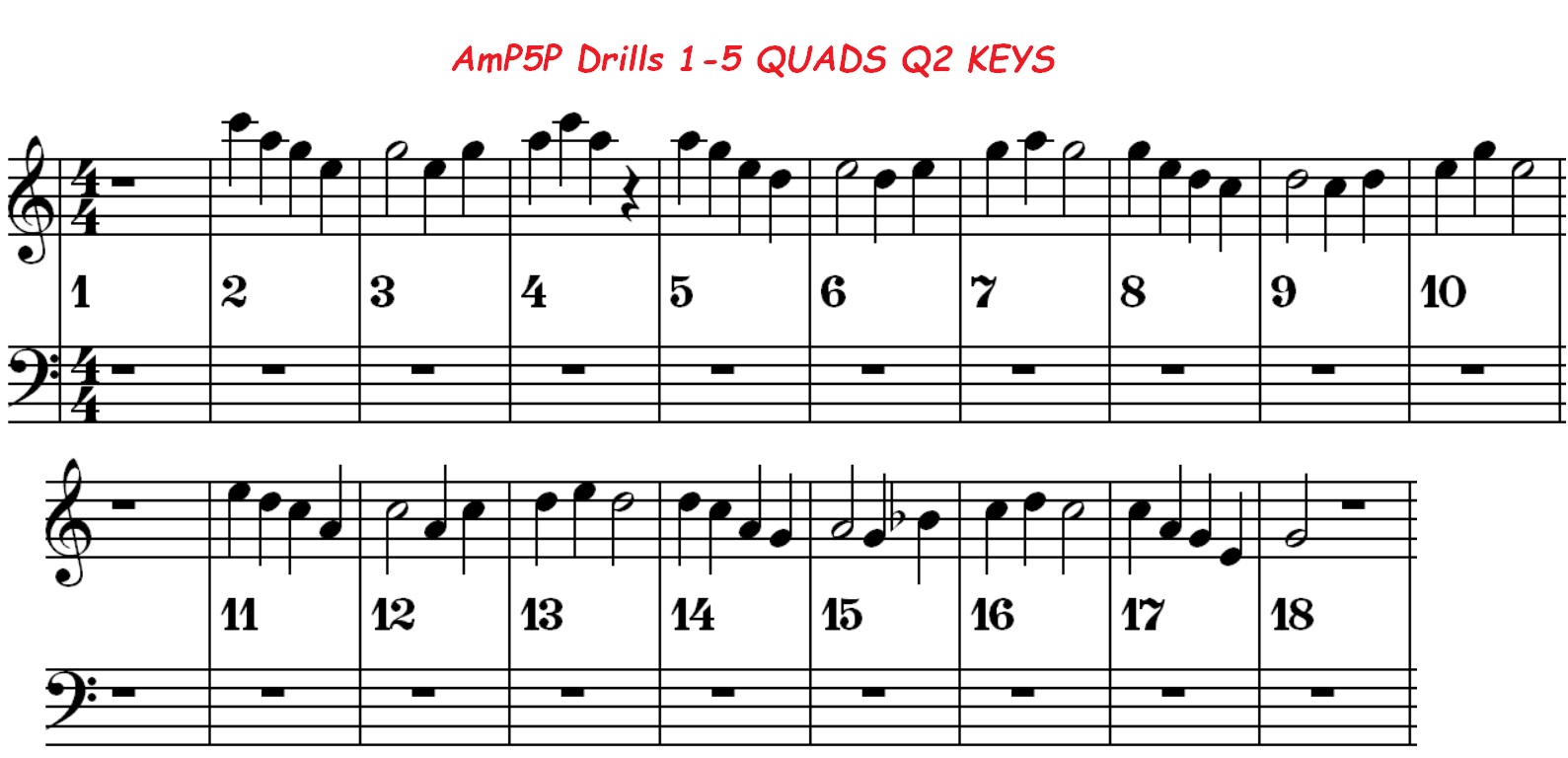
Before you do the drill, play this SLOW speed drill
until you get the pattern.
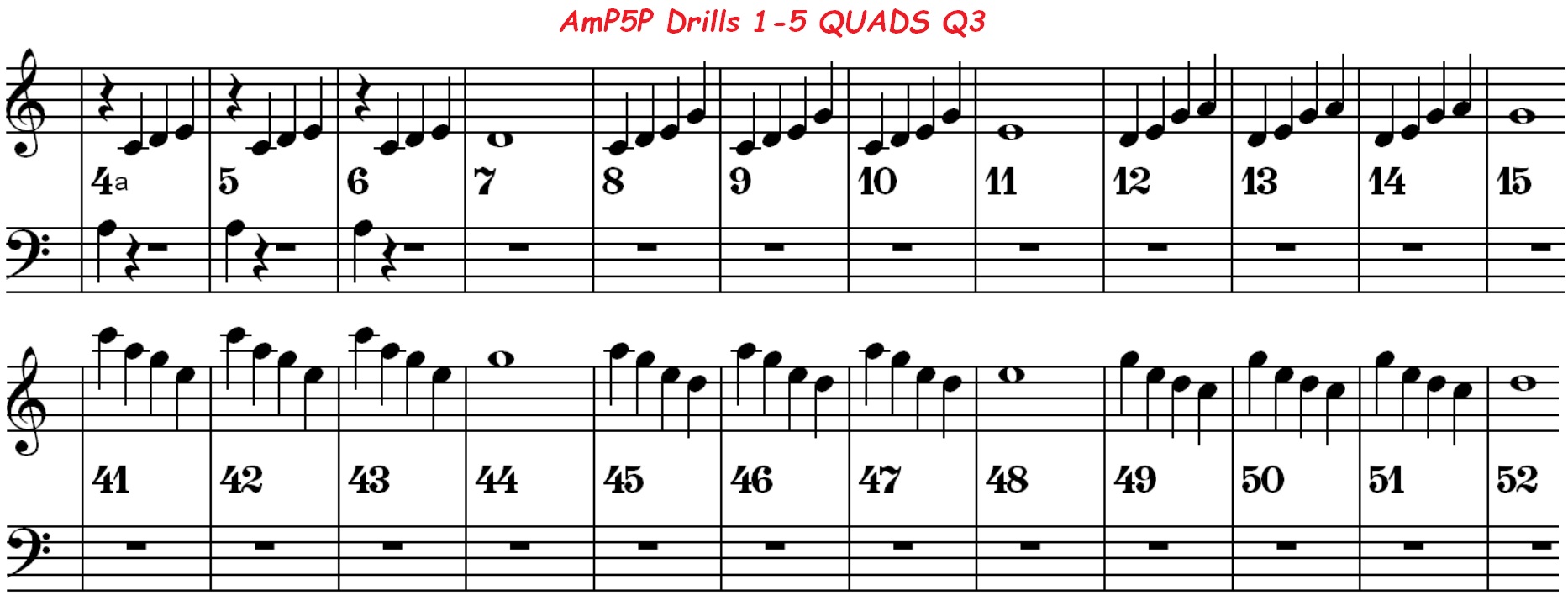
Drills 1-5 QUADS Q3
It's similar to Track Q2. You play NOTES 1234 1234 1234 3
ACDE ACDE ACDE D. Then move up to note 2 as usual and repeat.
Coming back down, you play CAGE CAGE CAGE G
Triplets!
patterns instead of 4 notes. Triplets will get a bit more aggressive.
That's why we did quads first! You count these: 123 123, etc.
trip' - a - let trip' - a - let
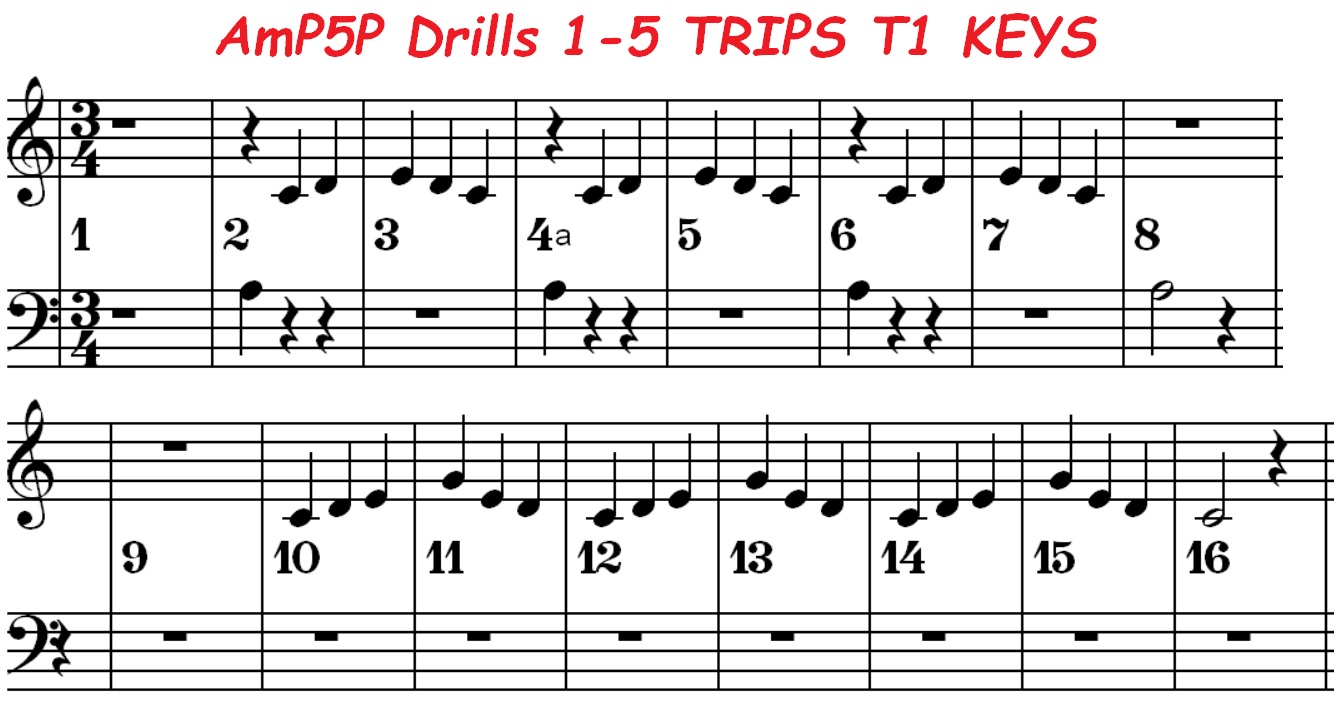
Drills 1-5 TRIPS T1
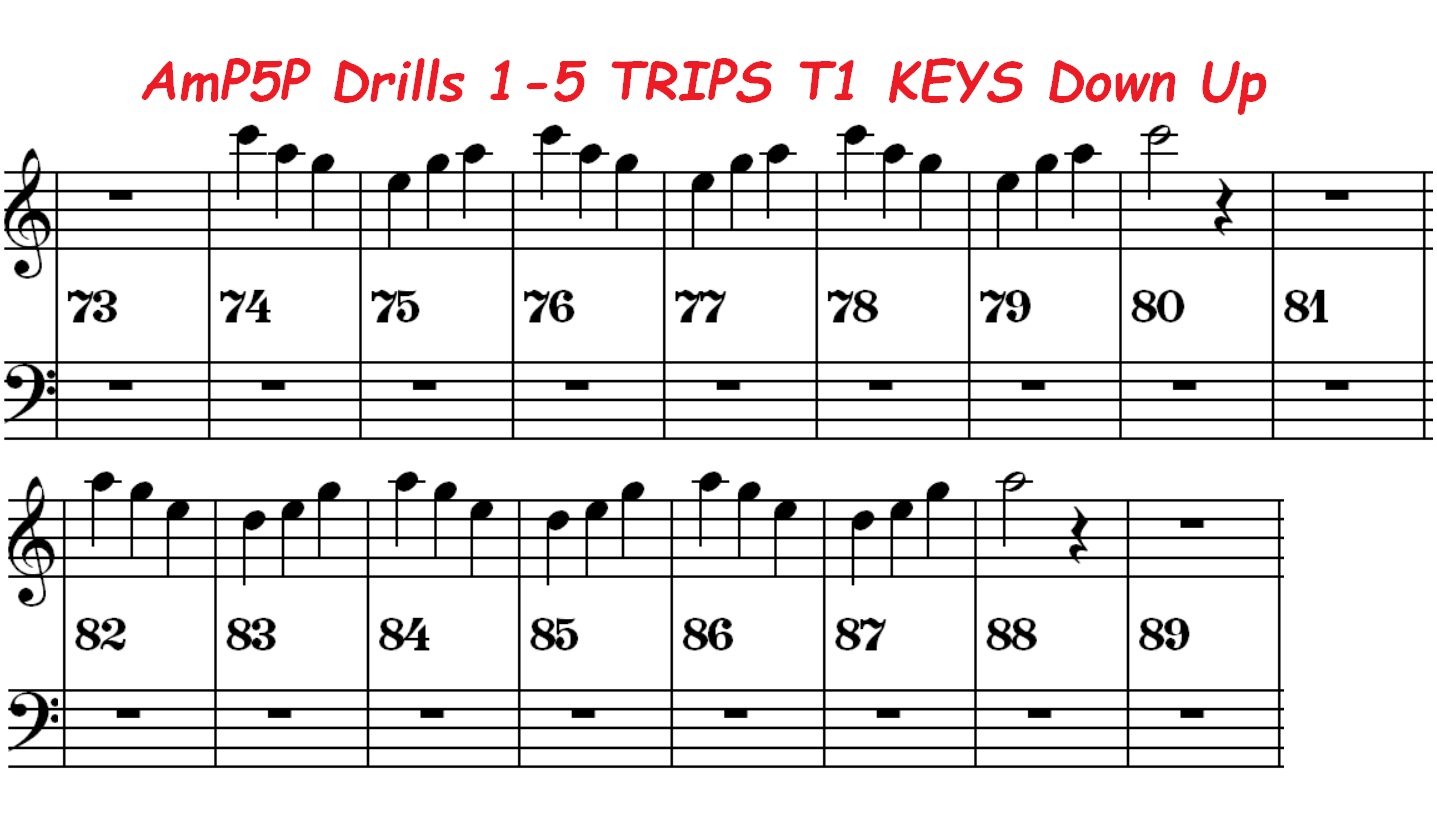
back down to 3 and 2. Play it 3 times, end on the 1st note and hold it.
123 432 123 432 123 432 1 HOLD. Then move up to note 2.
A C D E D C A C D E D C A C D E D C A HOLD 1 2 3
C D E G E D C D E G E D C D E G E D C HOLD 1 2 3
D E G A G E . . . E G A C A G . . . ETC!
Play each one UP. Then play them back DOWN.
Drills 1-5 TRIPS T2
Once you can get through Track T1, work on Track T2!
The Boxes!
BOX inside the penta scale, 1st position! Sometimes we call it
The Money Maker! Here's why . . .
Box 1 sounds cool, melodic. But it doesn't cut through the mix
very well. Box 4 is FUN! But if you stay on the high notes all
the time, it gets boring to the listener! Listen to those great
solos you love. Most of the solo will usually be right in the
middle, in the Money Maker Box!
The whole scale, when broken down, is made up of 4 small
boxes. And 2 of them can be combined into one Big Box!
The following "BOX" exercises will get you used to playing
where the MONEY is! And will set you up for playing some
GREAT SOLOS!
OK, by now, you KNOW where all of the notes are. All you're
doing now is learning "patterns"! So keep your thinking cap
on, and work through the following pattern exercises without
explicit graphics or charts! As in . . . LEARN how to play!
Drills BOX 1 UP
ACDCDE ACDCDE ACDCDE G ~ CDEDEG CDEDEG CDEDEG A . . . ETC.
Play each one UP. Next track, play them DOWN.
432321 432321 432321 4
EDCDCA EDCDCA EDCDCA E
This one is FUN! And sounds GREAT!
just 5 notes! And we'll use different fingering. Not the same as
we usually do in the "positions"! We're starting to drift away from
sounding like we're running up and down a scale!
Drills BB BOX 1 UP
building stamina! Endurance! And BUILDING MUSCLE MEMORY!
You're doing things now you never did before! And you will
progress beyond the plateau you've been stuck in!
Keep in mind, this whole thing is going to get insanely fun, and
produce some crazy results once we get through the Am stuff! The
next workshop covers ALL keys! Systematically! With very little text!
UP: 1 2 3 4 5 4 ~ 1 2 3 4 5 4 ~ 1 2 3 4 5 4 ~ 3
E G A C D C ~ E G A C D C ~ E G A C D C ~ A
D C A G E G ~ D C A G E G ~ D C A G E G ~ A
the Albert King Box in Part 3!!!
~~~~~~~~~~~~~~~~~~~~~~~~~~~~~~~~~~~~~~~~~~~
hit a lot of those high notes! And they're fun! But this is where
the money's at!
When you can nail the BB Box and the Big Box . . .
you're gonna be JAMMING!
This exercise starts a new way of playing the scales. Instead of
playing all the notes in a row, we play them "broken". Not all in
order. This opens up doors! It produces colorful sound. More inter-
esting. It allows us to use the same notes and make phrases LONGER!
In this next exercise, we play notes DEGACD. But we start on the 2nd
note, E. Play the note before it, D. Then E again. E D E. Then the
next note above E is G. Now do the same with G and E. G E G. Next
note above G is A. Play A and the note before it, G, Then A again.
It's just a staircase. Start on one step. Step down one step. And
back up. Then step up to the next higher step, down a step, back up.
Then up to the next step!
It's important you get this! It's the main building block for
the whole thing! Learn this pattern!
EVERYTHING YOU'VE DONE SO FAR WAS PREPARING YOU
FOR THE NEXT PART OF THIS WORKSHOP! Nail down
these next patterns!
Sounds like this . . .
SLOWLY to make sure you get it! Then we'll WORK on it!
So, UP first . . .
EDE GEG AGA CAC DCD CAC A
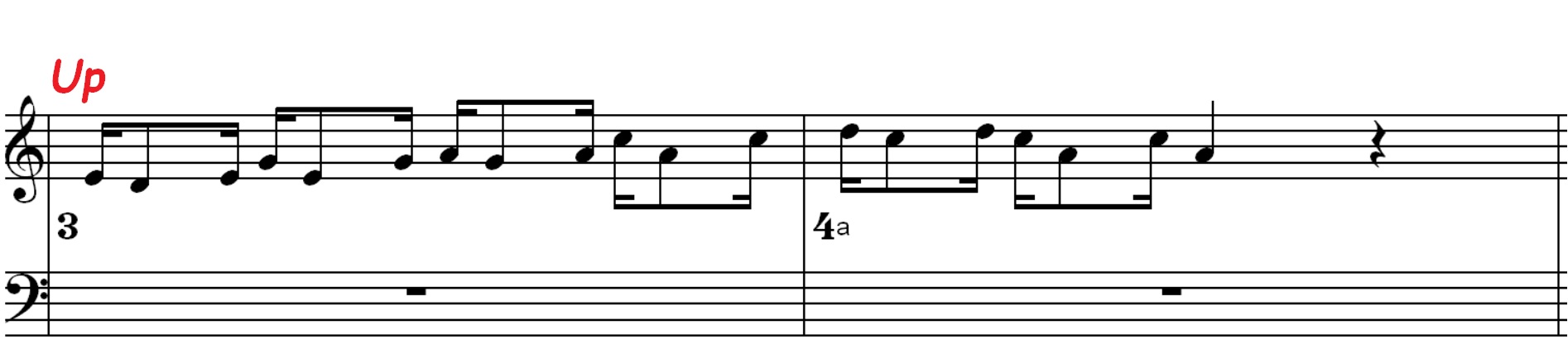

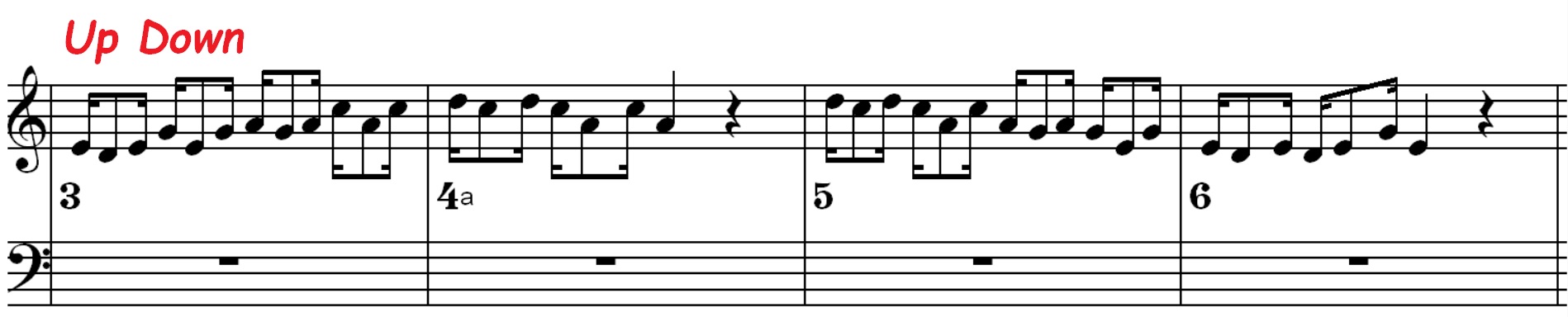
Up: EDE GEG AGA CAC DCD CAC A
EDE GEG AGA CAC DCD CAC A
DCD CAC AGA GEG EDE DEG E
Do them like the ones above.
DEGACD DEGACD DEGACD C
UP
DOWN
DCAGED DCAGED DCAGED C
UP DOWN
to cover a larger amount of territory, spread it out across the whole
fretboard, over the entire keyboard, over the entire horn. Just using the
same 5 notes! We just repeat notes in a pattern! And end up with a huge pattern!
Like taking 12345 and making it a lot longer.
123 234 345 451 512 etc.
ACD CDE DEG EGA GAC
Or really stretch it out!
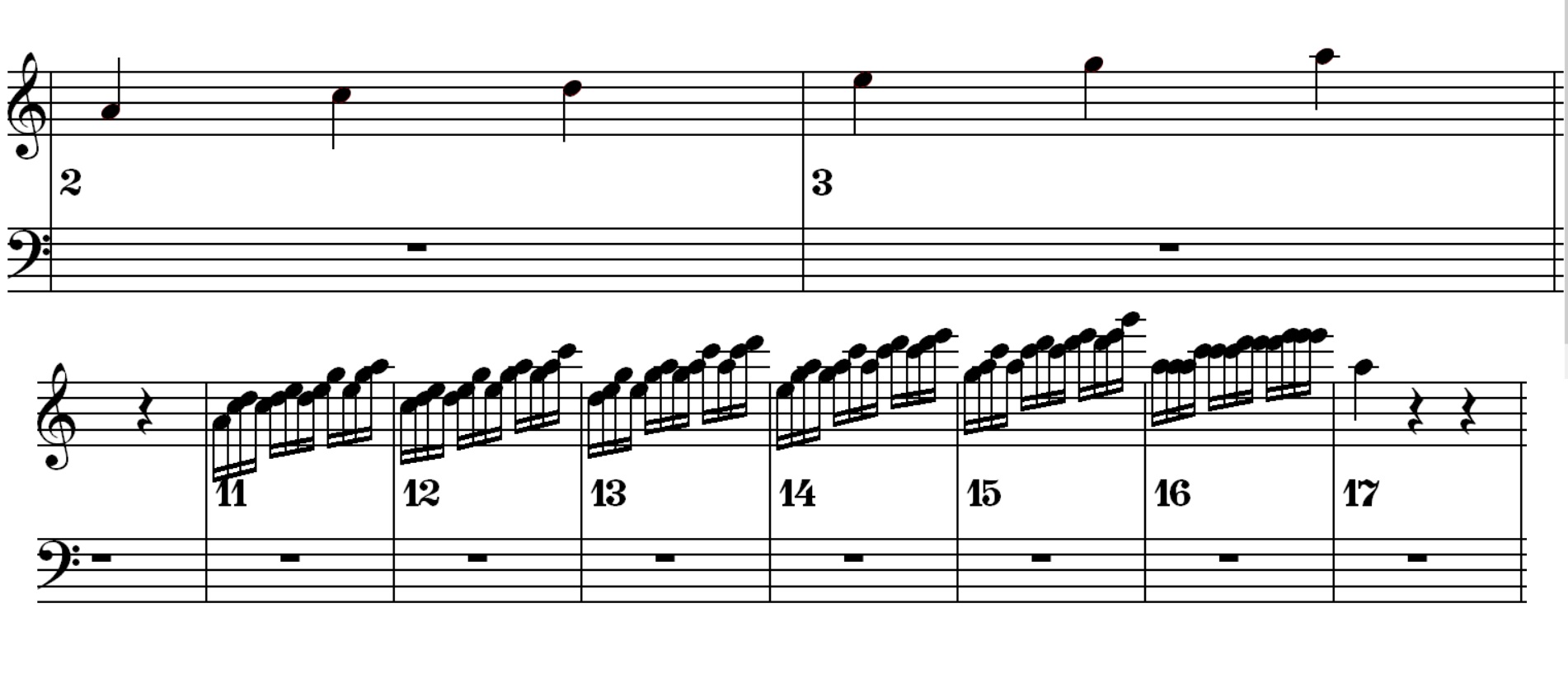
the whole scale DOWN, then UP. ALTERNATING BETWEEN THE POSITIONS.
Starting on C, play the scale down: C A G E D C Then play A, UP! A C D E G A
Then DOWN: G A C D E G, UP: E G A C D E, and DOWN: D C A G E D
It looks like this . . .
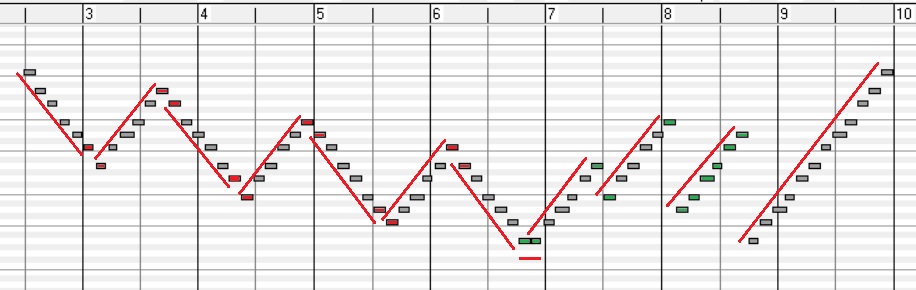
The second one takes the same scale, but breaks it up into 3-note patterns.
CAG AGE GED EDC DCA (2 OCTAVES) Then back up, starting on A:
ACD CDE DEG EGA GAC, ending on GAC. Then a long scale UP: A to C 2
octaves, and a final C.
It looks like this . . .
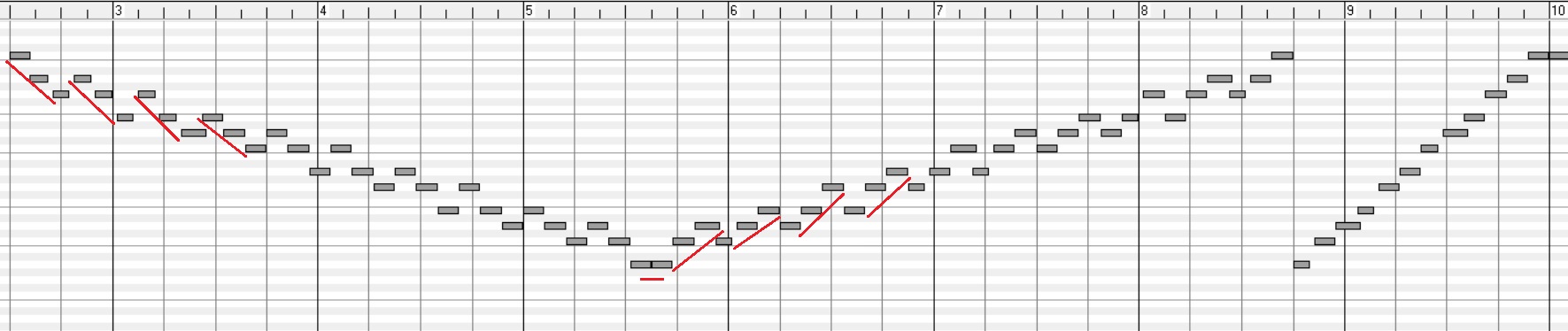
There's a bunch of logic - theory behind these 2 patterns. They both fit
perfectly over a basic 12-bar progression in C or Am! Albeit, I wrote it in
6 measures for simplicity.
They also can create some really cool solo concepts! We're going to build
on this HEAVILY!
Note the repeated "A" note in measure 5. Last then first note. In a 12-bar,
that's the measure right before the turn-around.
ALSO NOTE, measure 6 would be the turn-around! In a 12-bar, measure 6
would be measures 9 and 10.

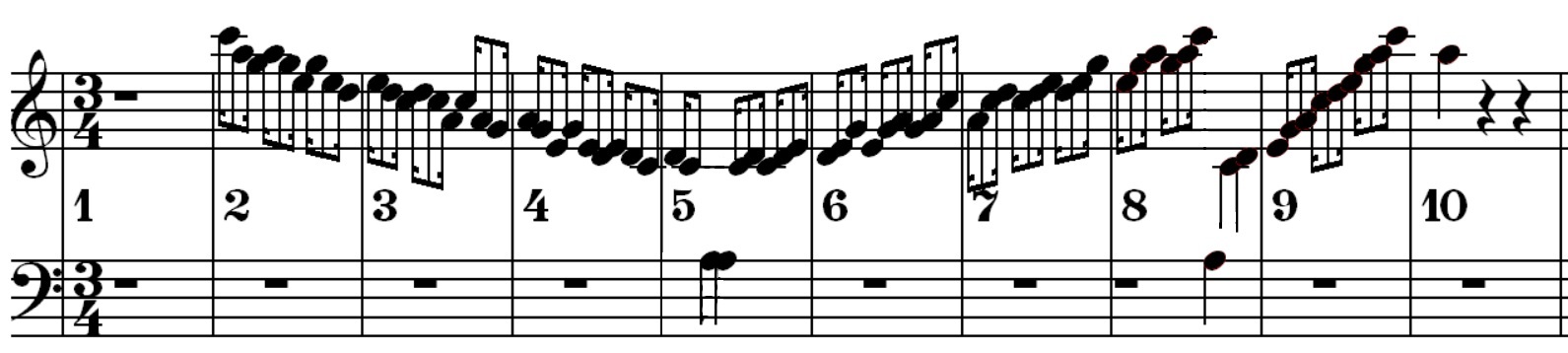
The 1st Pattern: Starting at the top of the scale,1st position, on C.
Pattern 1
2). Starting 1 note lower than you ended above (C), go from A, UP 6 notes. ACDEGA
3). Starting 1 note lower than you ended. (A) go DOWN - repeat the pattern. GEDCAG
4). Same as #2. EGACDE 5). Same as #3. DCAGED 6). Same as #2 CDEGAC
7). Same as #3. AGEDCA 8). Same as #2 EXCEPT when you play the lowest note or highest
notes, you change direction. SO, you repeat A and go UP. ACDEGA
This is played over a 12-bar Am Blues, and we need to end up at the end of measure 12. So
9). Jump DOWN to E for the turn-around and go UP. EGACDE
10). Drop down to D. DEGACD
11). Finish the turn-around by playing the whole scale, UP from A, 6th string!
So you can see the stairstep pattern here.
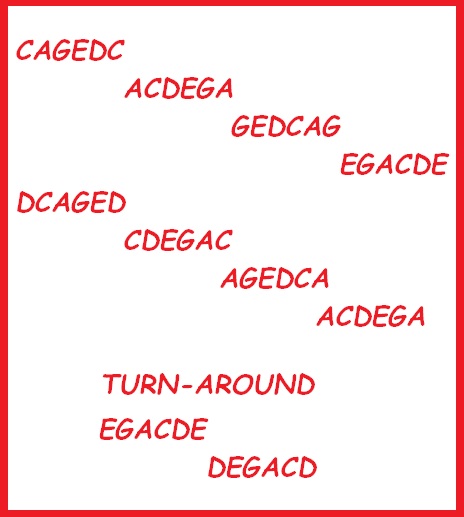
ACDEGACDEGACDEGAC
~~~~~~~~~~~~
The 2nd Pattern: Starting at the top of the scale,1st position, on C, finger 4.
Pattern 2
Repeat the pattern. Play 3, back up one, play 3, etc.
End playing the fill scale, single notes, like you did in the above exercise.
So you can see the stairstep pattern here.
CAG AGE GED, etc. Then . . .
ACDEGACDEGACDEGAC
~~~~~~~~~~~~~~~~~~~~~~~~~~~~~~~~~~~~~~~~~~~
Am F#m!
Pentatonic scales, in 2 different ways! The Am scale will be the same
as usual, in 1st position. We'll play F#m 2 ways.
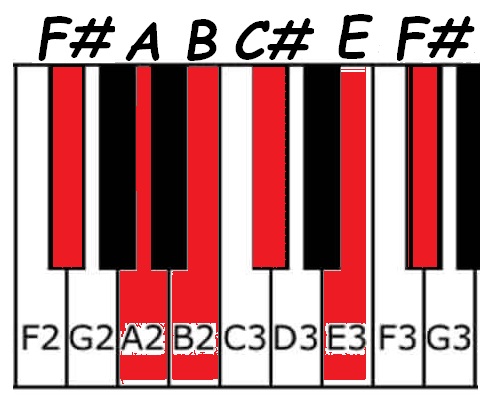
We'll alternate between playing the F#m scale with, and without the low F#!
F#ABC#EF#ABC#EF#A F# After playing 1st position Am, slide down to F#.
Let's work on the 2 scales a little bit. Just 2 minutes!
Play F#m up 1 octave, Am up 1 octave. Repeat one more octave.
Fm Am Fm Am. Reverse for coming down! Am F#m Am F#.
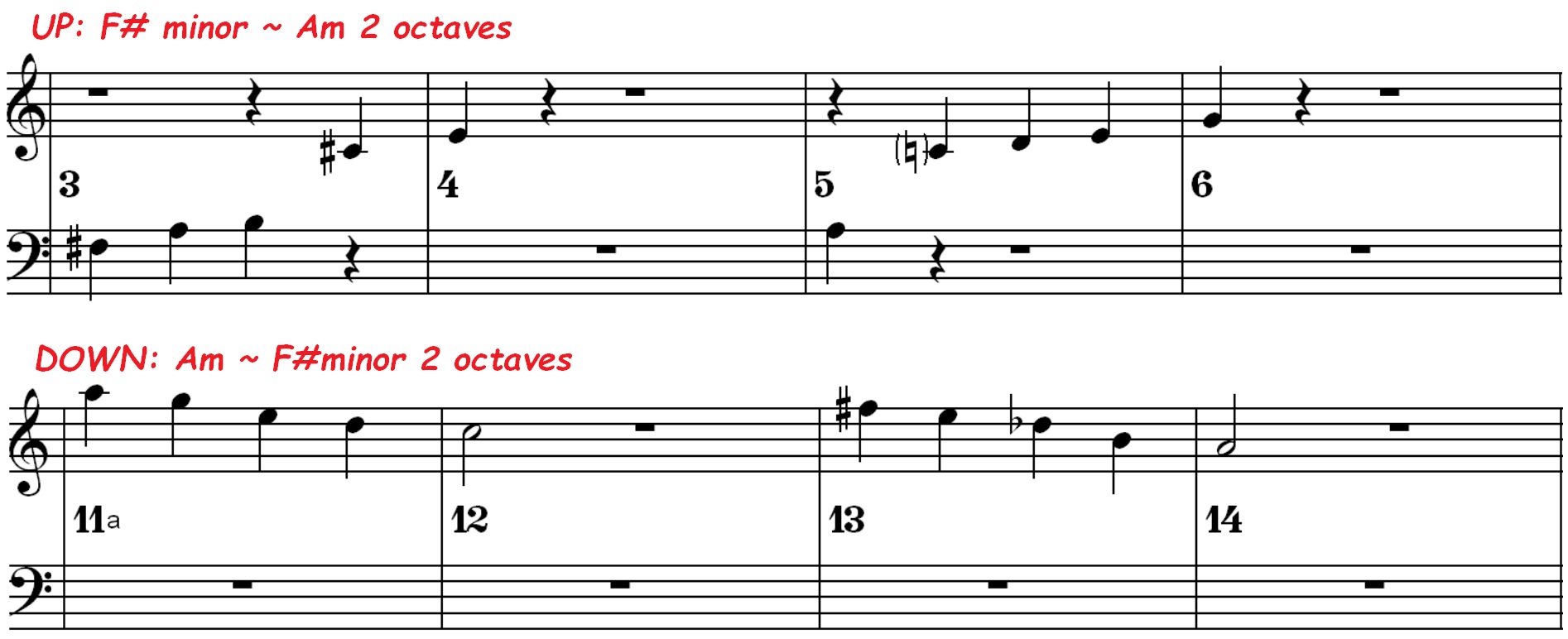
F#m Penta, then Am
1st position Am A C D E G 2 OCTAVES, UP. Then DOWN.
F# minor, starting on "A". 2 OCTAVES. DO NOT play the LOW F#!
Repeat 1st position Am A C D E G 2 OCTAVES, UP. Then DOWN.
F#m, starting on F#!
The track alternates over Am and F#m chords. So you'll have
4 distinctly different sounding modal progressions!
So you play . . .
Am penta, Up then Down:
ACDEGACDEGAC A HOLD
CAGEDCAGEDCA A HOLD
F#m penta, Up from A, then Down:
ABC#EF#ABC#EF#A F# F# HOLD
AF#EC#BAF#EC#BAF# A
Am penta, Up then Down:
ACDEGACDEGAC A HOLD
CAGEDCAGEDCA A HOLD
F#m penta, Up from F#, then Down:
F#ABC#EF#ABC#EF#A F# HOLD
AF#EC#BAF#EC#BAF# F# HOLD
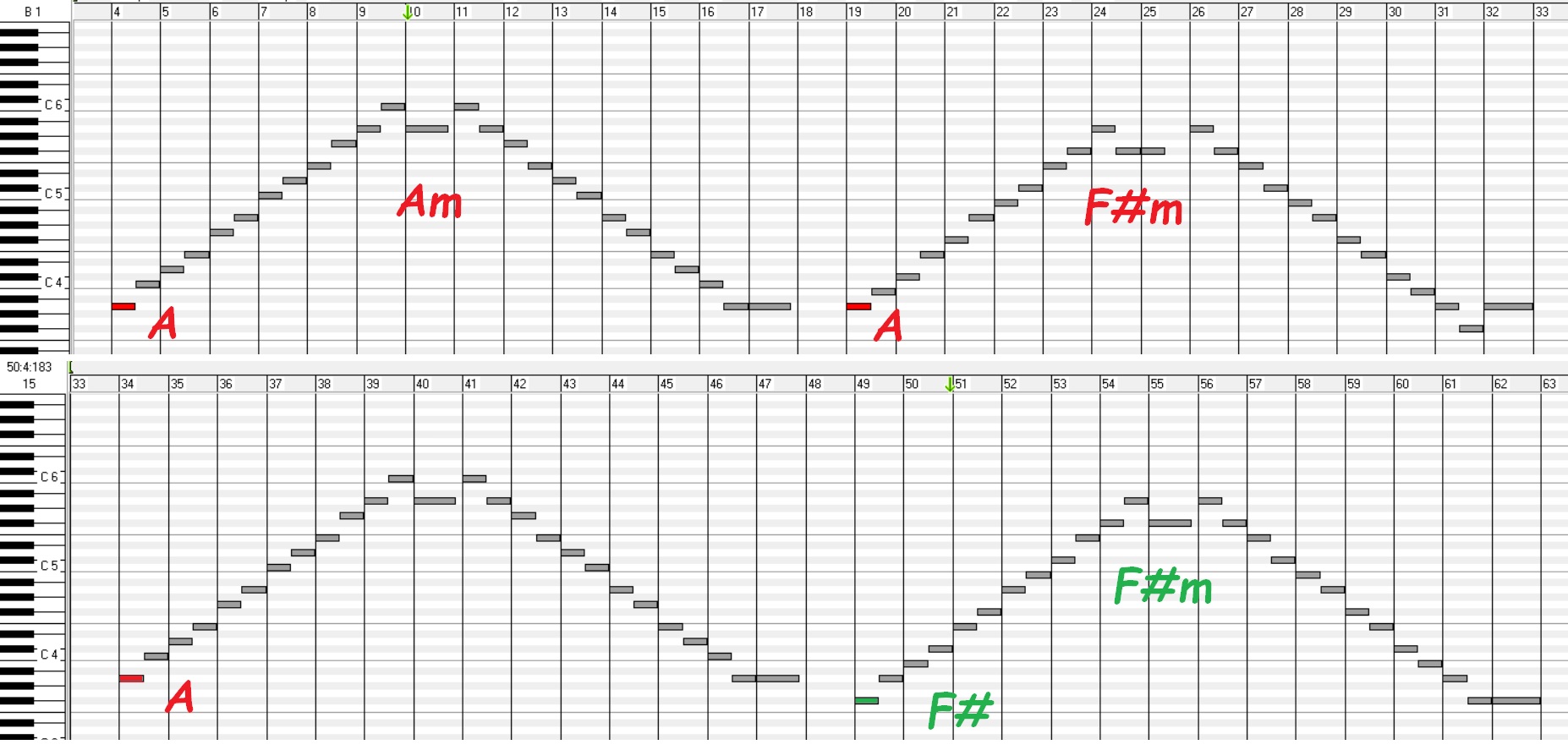
Am Penta, F#m Am F#m.
progressions! It sounds like you're playing 4 different scales!
~~~~~~~~~~~~~~~~~~~~~~~~~~~~~~~~~~~~~~~~~~~
~~~~~~~~~~~~~~~~~~~~~~~~~~~~~~~~~~~~~~~~~~~
ITM ~ Swing Feel!
in the works called "It Don't Mean A Thing!"
Remember the old Swing smash hit, "In The Mood"? It has a rhythm,
a "feel". Kinda like Triplets, yet somehow different!?!
Da dada Dadada Da dada Dadada Da dada Dadada . . . !
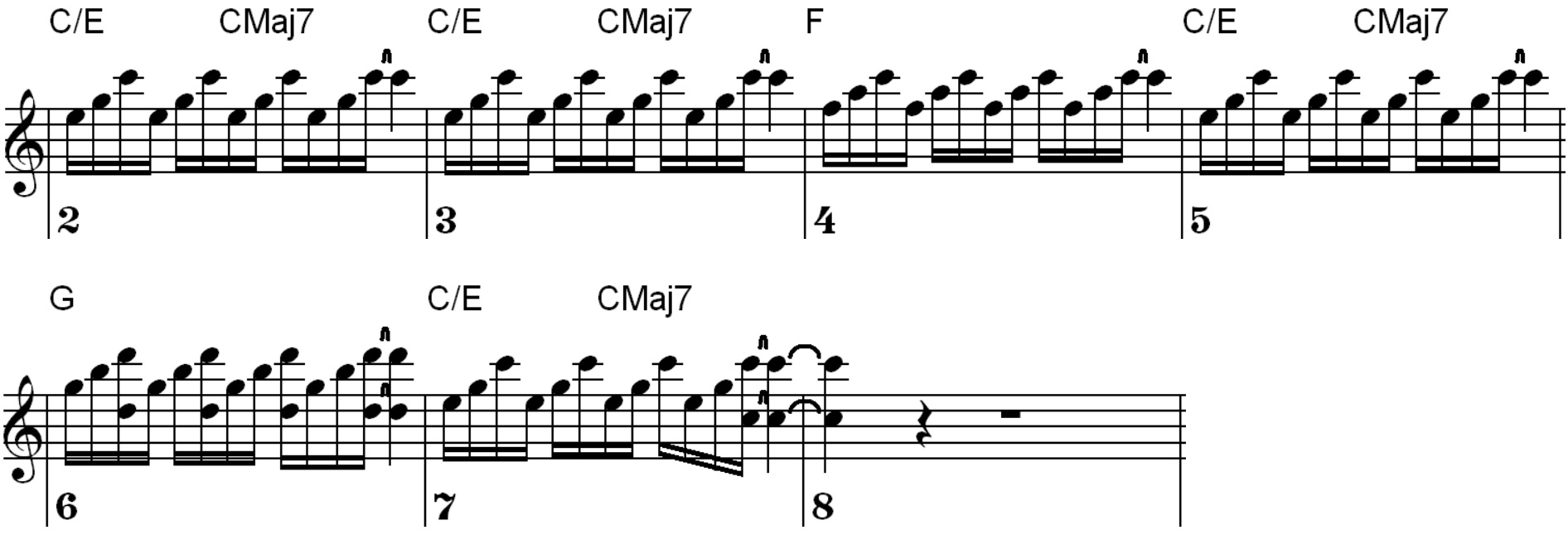
make some really cool phrases. Licks! And up your soloing game by miles!
We're going to incorporate some Swing, and some chord invesions, create
some really cool syncopations! This is gonna be . . . FUN!
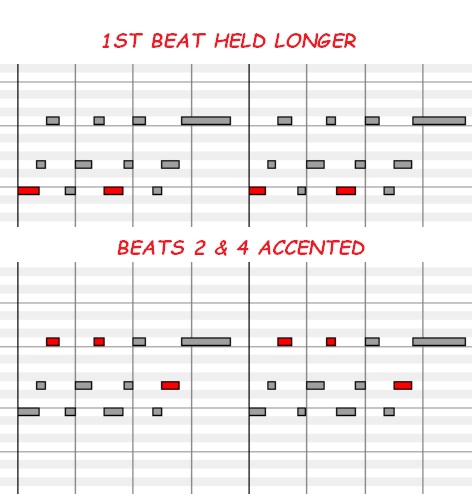
Swung Eighth Notes: In swing music, eighth notes are not played straight.
They are "swung." This means that the first note of the pair is held longer
than the second, creating a rhythmic tension, or syncopation that pushes
the music forward.
Swing feel is Syncopated. Emphasizing "off-beats", and adds to a more lively
quality of the music. This syncopation creates a sense of forward motion
and excitement.
Accentuation: In swing music, beats 2 and 4 are typically accented, which
contributes to the distinctive groove that makes people want to dance.
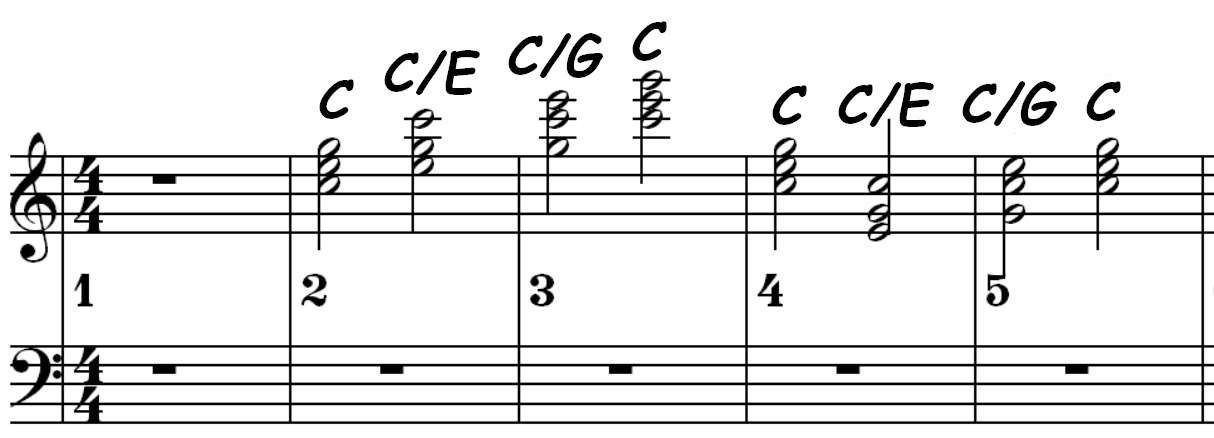
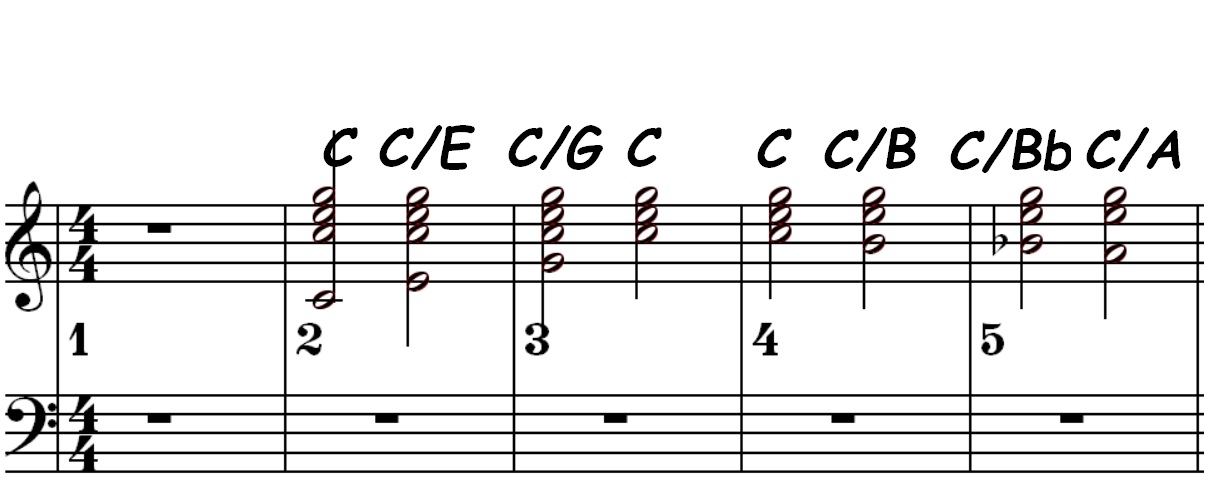
If we take a simple C major chord, we have 3 notes. C E and G. Played in
that order, we are not "inverted". This is called Root Position.
But if we play the chord E G and C, we have inverted the order of the notes.
It's still a C major. But now it's played in 1st inversion. Now let's play
G C and E. That's 2nd inversion. We invert chords for different reasons.
Each one is still a C major. But they sound different! And depending on the
melody, (or harmony) and depending on what chord we're going to, or from,
sometimes it sounds really sweet to use an inverted chord!
To show inversions, we often use what's called a "slash chord" to show the
inversion. For example, if we wanted to play a C major with the E on the
bottom, because of the chord we are going to, the chord we're coming from,
or because of the melody, we could write the chord symbol as C/E.
Stated C over E. Meaning C major with E on the bottom.
Have a listen . . .
While we're on the topic of slash chords and inversions . . . Sometimes we
add bass notes to a chord to create a walkdown, or walkup. The bass note
creates a cadence, of movement. The bass note could be a note from the chord,
or notes not in the chord. Here are 2 examples.
OK, let's get into the SWING of things!
That's the kind of feeling we're going for here. Playing these
rhythms slowly kinda loses that feel. So when you start each of
these, they might seem a bit lame. But as the tempo picks up,
you'll start to feel it!
Keep in mind, it's REPETITION and REDUNDANCY that will
turn you into a monster player!
Also, keep in mind, all of these tracks consist of the exact phrases
used in the majority of those incredible solos you want to play!
OK, so the instructions are going to diminish now. I'll just show
you the pattern. Before you start each track, go over the pattern.
Make sure it makes sense. "ETC." means do the same for each note in
the scale as usual!
PATTERN 1:
The pattern: 1st, 2nd and 3rd note of the scale played 3 times,
ending on the 1st note. This one's really slow but you need to "get"
the pattern. It's used in ALL of the tracks in this section!
Learn'M:
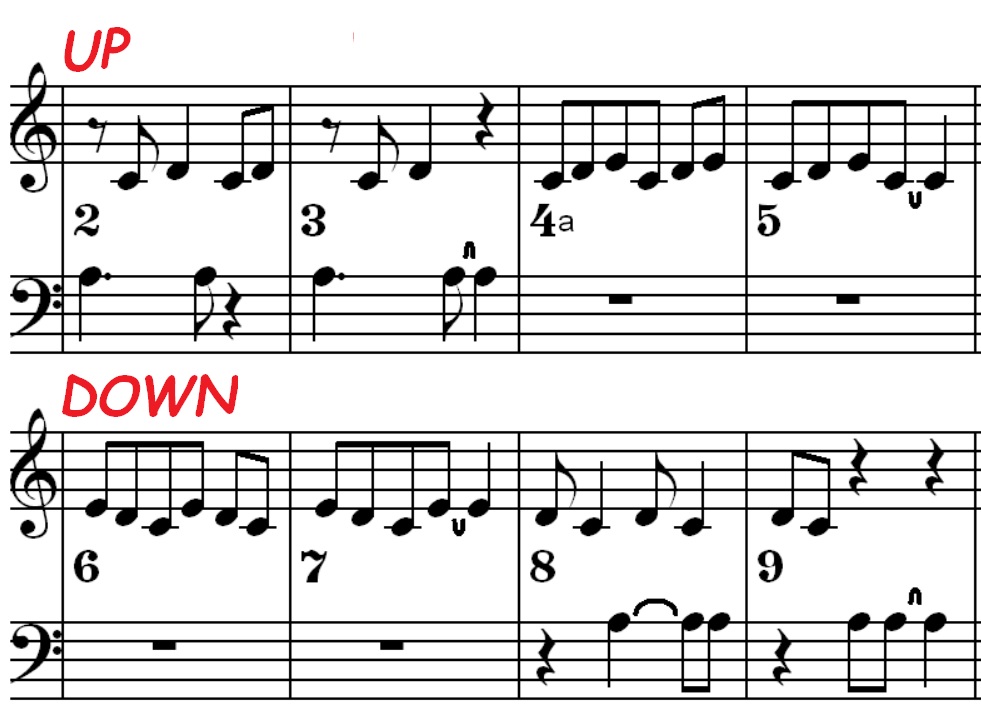
UP 1x: ACD ACD ACD A HOLD ~ CDE CDE CDE C HOLD Etc.
Down 2x: CAG CAG CAG C HOLD ~ AGE AGE AGE A HOLD
UP DOWN
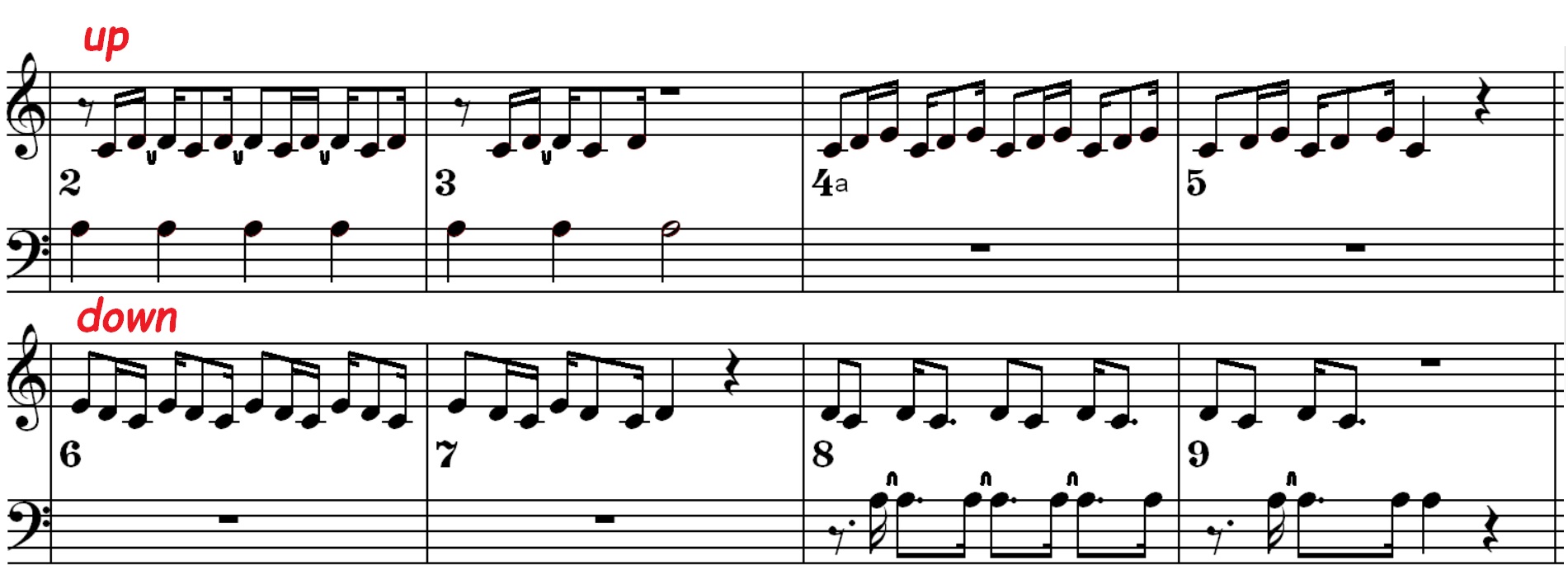
UP: ACD ACD ACD ACD ACD ACD A HOLD ETC.
DOWN: CAG CAG CAG C HOLD ~ AGE AGE AGE A HOLD
UP DOWN
a different note.
ACD ACD ACD ACD E HOLD (Ends on the next higher note)
ACD ACD ACD ACD G HOLD (ends on the note before the 1st one)
CDE CDE CDE CDE G HOLD
CDE CDE CDE CDE A HOLD ETC.
ALL UP, then DOWN
UP, then back down starting from the last note in the phrase.
UP: ACD ACD ACD ACD ACD ACD E HOLD
DOWN: EDC EDC EDC EDC EDC EDC A HOLD ETC.
UP DOWN
This one is a REAL MONEY MAKER! Nail It!
~~~~~~~~~~~~~~~~~~~~~~~~~~~~~~~~~~~~~~~~~~~
Do each one as always, until you mess up.
Everything you've done so far is preparation for this ONE group of
drills! These . . . will make you a Soloist! And, a GOOD ONE!
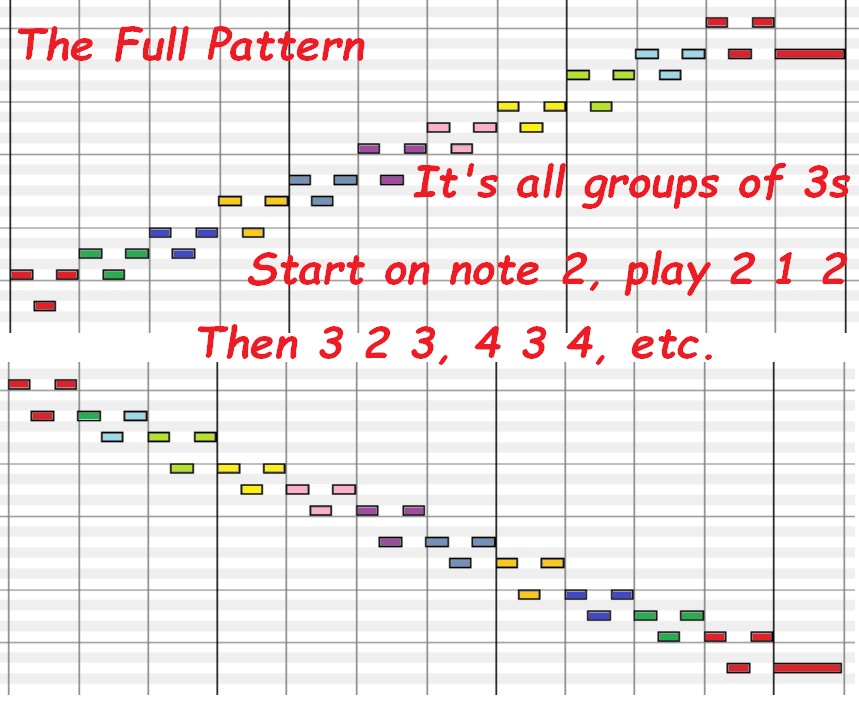
Picture going up a staircase. You step up to step 2, back down to 1,
then back up to 2. Then up to 3, down to 2, up to 3 again. Etc.
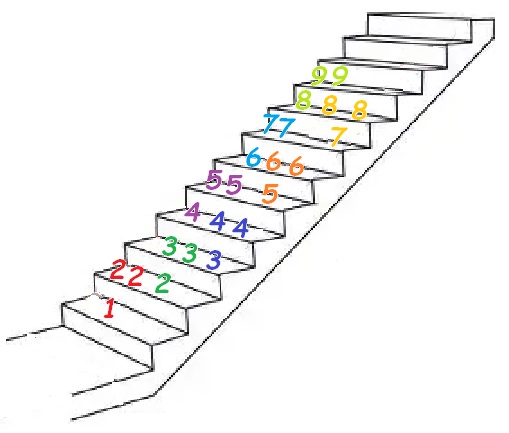
Basically, all you do is start from the 2nd note of the scale. "C"
in this case. Then play the note before it. So, C A C. And that's
the magic! You just play the scale, starting from the 2nd note.
C D E G A, etc. And afer you play each note, play the note before
it and repeat the note. So each note is played twice, with the note
before it in the middle. 212, 323, 434, 545, etc!
Drills Money Maker Pattern UP
need to be able to play each one as a separate phrase, and in groups
of phrases. The 1st track will get you there!
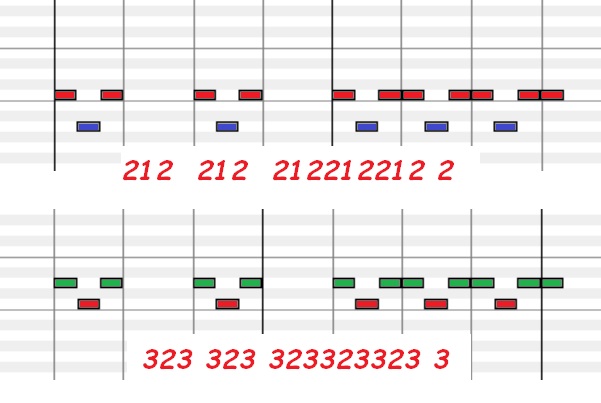
You play notes:
212 212 212212212 2. Then 323 323 323323323 3. Etc,!
UP
have the pattern down, go to the next track. It could take a few sessions.
The whole Scale
In engineering and systems theory, redundancy is the intentional
duplication of critical components or functions of a system with
the goal of increasing reliability of the system, usually in the form
of a backup or fail-safe, or to improve actual system performance.
'Nuff said!
You do the next 3 tracks in order, as you are able to complete
each one. Stay on the 1st one until you NAIL IT! Next session,
skip this one and work on the 2nd one. When you have it nailed,
do the 3rd one each session.
Don't move on to the next one until you can get through this one!
SLOW
MEDIUM
OK, one more track before we go to Part 3. (Pentatonic Positions 2 to 5,
and lots of soloing applications! Putting it all to work!)
ITM SKIPS
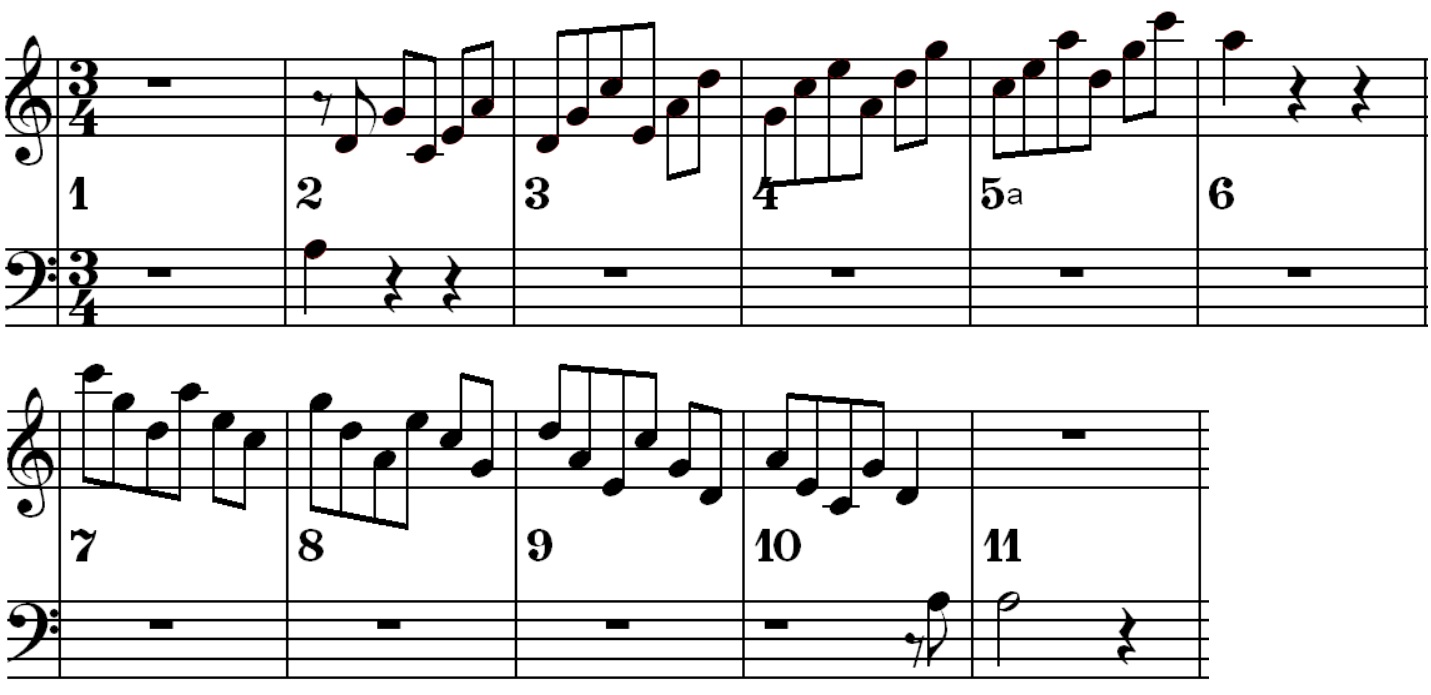
UP: ADG CEA DGC EAD GCE ADG CEA DGC A HOLD
DOWN: CGD AEC GDA ECG DAE CGD AEC GDA A HOLD
UP then DOWN
HOLY SMOKES!
Congrats!

CLICK HERE to jump back to the beginning of the workout section!
come a long way! But we still need to tie it all together! We
have 2 more things to do!
1). We need to tie this up. Get you playing some real solos! But
you need a few more phrases to do this!
2). We've focussed heavily on the 1st position. Worked a little
on the other 4 positions. We're gonna change the focus of this
workshop shortly. Up until now, my main concern was getting you
to understand the scale. AND . . . to build up your hand and
finger strength! AND . . . Muscle Memory!
If I included the other 4 position in all of these exercises
so far, it would have been really confusing! But now you have a
solid handle on Pentatonics. We'll start working with the other
positions shortly!
So, how will we put this all together? With the Jam Tracks!
You'll use what you learned so far, and what's new in Part 3
to build your solos!
Part 3 has more than just Jam Tracks!
It's all part of the learning process!
Ready to ROCK! Jump on over to Part 3: Jam Workouts!
NOTE: You WORK Part 2 every session until you get through it one time.
Then you WORK Part 3 until you get through it. Then . . .
Go back and do Part 2 again! Alternate between them.
Once you've been through Parts 2 and 3 a couple times, you can
alternate between them in part. One day work on Part 2. Another
day, Part 3. Just pick up where you leave off each time!
When you're ready, go here to JAM!
Part 3: The JAM WORKOUTS! It's time to PLAY!
Contact me any time! Got a question?
Ask me! Or request a workshop topic!
Email me any time! ~/~
Wayne on Facebook
Main Directory Page
online. PTDT & MidKar rely on your help because we are not monetized!
Membership, 43,813 MIDIs, KARs and BIAB files, and ALL of the Tutorials
and Workshops are FREE! Thank you for your support! Wayne
Click the PayPal link if you'd like to help!